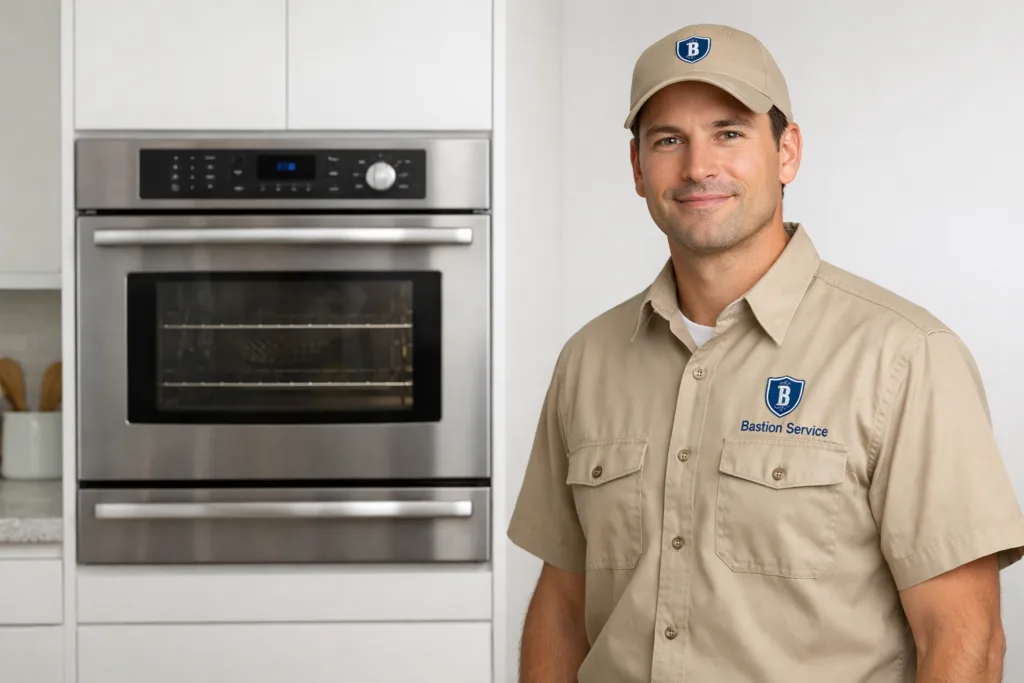
Oven problems tend to show up gradually before they become impossible to ignore. A longer preheat, cookies browning unevenly, or a temperature that seems to drift during baking can all point to specific failures in a Kenmore oven. Sorting out the symptom pattern first usually makes the repair path much more straightforward.
Related Kenmore and oven service paths in Century City include Kenmore Appliance Repair in Century City, Oven Repair in Century City, and Kenmore Refrigerator Repair in Century City.
Common Kenmore oven problems in Century City homes
Most oven issues fall into a handful of recognizable categories. While different models vary, the same basic parts are often involved: heating elements, igniters, sensors, controls, fans, door components, and wiring. The way the oven behaves helps narrow down which area needs attention.
Oven not heating at all
If the oven stays cold after starting a cycle, the cause may be different depending on whether the unit is electric or gas. On electric models, a failed bake or broil element, damaged wiring, or a control problem may stop heat production. On gas models, a weak or failed igniter is a common reason the oven will not light even when the surface burners still work normally.
Sometimes the display appears normal and the cycle starts, but no actual heat is produced. That detail matters because it often points away from a simple power issue and toward a failed heating or ignition component.
Slow preheat or weak heating
When a Kenmore oven eventually heats but takes much longer than it used to, the appliance may be operating with weak heat output rather than a total failure. A bake element can partially fail, an igniter can weaken enough to delay ignition, or a sensor can misread the cavity temperature and cause the oven to heat inefficiently.
This symptom often shows up before a complete breakdown. Homeowners may notice that dinner takes longer, frozen foods need extra time, or the oven seems to struggle to hold temperature after the door is opened.
Uneven baking and temperature swings
If one rack cooks faster than another or the back of the oven browns faster than the front, the problem may involve more than simple rack placement. Uneven baking can come from weak heating elements, sensor drift, a failing convection fan, or poor heat cycling caused by a control issue.
Temperature swings are especially frustrating because the oven still appears to work, but results become inconsistent. Bread may come out underdone in the center, casseroles may take much longer than expected, and baking times stop matching the recipe.
Oven overheating
An oven that runs hotter than the selected setting should not be brushed off as a minor calibration issue without testing. In some cases, the cause is a temperature sensor reading incorrectly. In others, a control relay may be sticking and allowing the oven to continue heating beyond the target temperature.
Overheating can ruin food, damage cookware, and create a safety concern if the oven is left operating with unstable controls.
Control panel, display, or touchpad problems
Kenmore ovens can also develop electronic control issues that have nothing to do with the heating system itself. Buttons may stop responding, the display may flicker or go blank, or the oven may beep unexpectedly and show an error code. In some cases, the oven starts only intermittently or cancels cycles on its own.
These symptoms can point to a failing interface, a damaged control board, or a wiring connection problem behind the panel.
Door and self-clean cycle issues
If the oven door will not close properly, heat can escape and affect cooking performance. A worn hinge, damaged gasket, or misaligned door can all contribute to poor temperature stability. Problems that begin after a self-clean cycle are also common, since the extreme heat of that cycle can stress sensors, lock components, thermal protection parts, and electronic controls.
What different symptoms usually suggest
Because several failures can produce similar complaints, it helps to look at the exact pattern rather than the broad symptom alone.
- Cold oven with normal display: often points to an igniter, element, relay, or internal wiring issue.
- Very long preheat: may indicate weak heat output, a failing igniter, or a sensor problem.
- Food burning on top but undercooked inside: can suggest uneven cycling between bake and broil functions.
- Oven runs too hot or too cool: may involve calibration, sensor drift, or control board faults.
- Error code after self-clean: often points to lock assembly, thermal fuse, sensor, or control trouble.
- Unit shuts off during cooking: may be related to overheating protection, failing controls, or unstable electrical connections.
These patterns do not replace testing, but they do help explain why part replacement by guesswork often leads to extra cost without solving the problem.
When the oven should not keep being used
Some oven issues are mainly about convenience, but others should be treated as a reason to stop normal use until the appliance is checked.
- If the oven overheats or burns food unexpectedly, continued use can become unsafe.
- If it trips power, shuts down mid-cycle, or shows recurring error codes, the fault should be addressed before regular cooking continues.
- If the door does not seal or latch correctly, heat loss and control problems can get worse.
- If a gas model has a strong gas smell, stop using it and address the gas concern immediately before arranging repair.
- If wiring smells hot, the control panel acts erratically, or the oven behaves unpredictably, it is best not to keep testing it through repeated use.
Repair or replace: what usually makes sense
Many Kenmore oven repairs are worthwhile when the problem is limited to one main failed part and the rest of the appliance is in good condition. A bad igniter, sensor, heating element, latch assembly, or a specific electrical component is often a reasonable repair on a unit that has otherwise been reliable.
Replacement becomes more worth considering when the oven has multiple unrelated problems, recurring electronic failures, or major control issues on an older appliance that has already become difficult to trust. The key question is not only whether the oven can be fixed, but whether the repair is likely to restore consistent day-to-day cooking without turning into a repeating problem.
Helpful details to note before service
A few observations from the homeowner can make diagnosis faster and more accurate. It helps to note:
- whether the problem affects bake, broil, or both
- whether the issue started suddenly or developed over time
- whether the oven is too hot, too cool, or simply uneven
- whether an error code appears
- whether the problem started after a power interruption or self-clean cycle
- whether the display works even when the oven does not heat
Even simple details like “preheat now takes twice as long” or “the right side cooks faster than the left” can point service in the right direction.
What homeowners in Century City can expect from a symptom-based repair approach
For households in Century City, the best repair decisions usually come from matching the repair plan to the way the oven is failing instead of replacing parts one by one. That approach helps determine whether the issue is isolated, whether the appliance is worth repairing, and whether the expected result is stable cooking performance rather than a short-term fix.
When a Kenmore oven begins showing signs like slow preheat, inconsistent temperature, failed heating, or control trouble, the most useful next step is to identify the exact fault and address the cause behind the symptom.