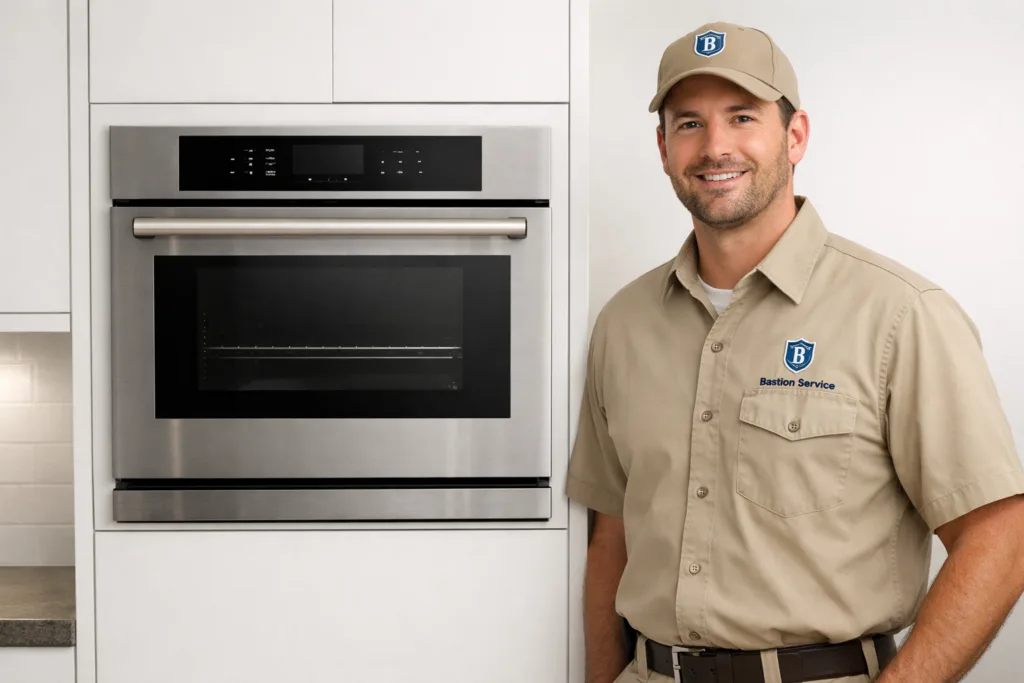
Wall ovens tend to show problems in recognizable patterns. One household may notice that preheat drags on longer than usual, while another sees uneven browning, temperature swings, or a control panel that suddenly stops responding. On JennAir models, those symptoms can come from very different causes, so the most useful first step is separating a heating problem from a sensor, door, latch, or control issue.
Related JennAir and wall oven service paths in Century City include JennAir Appliance Repair in Century City, Wall Oven Repair in Century City, and JennAir Refrigerator Repair in Century City.
Common JennAir wall oven symptoms and what they can mean
If your oven is acting differently from one cycle to the next, the symptom pattern usually tells a lot about where the fault is developing. Paying attention to when the issue starts can help narrow the repair path.
Oven not heating at all
A full no-heat condition often points to a failed bake or broil circuit, a temperature sensor issue, a safety cutoff, wiring damage, or a control failure. Some ovens appear to start normally, with lights and display working, but still never produce heat. That difference matters because a powered-on but cold oven is diagnosed differently from one that is completely unresponsive.
Slow preheat
When preheat takes much longer than it used to, one heating circuit may be weak or not engaging properly. A sensor that is reading incorrectly can also make the oven struggle to reach the set temperature. In daily use, this often shows up as longer meal prep times, inconsistent roasting results, or dishes that seem underdone even after the expected cook time.
Uneven baking
If food comes out darker on one side, bakes too fast on the edges, or stays pale in the center, the issue may involve uneven heat distribution, a failing element, a drifting sensor, or a door that is not sealing well. Homeowners sometimes first notice this with cookies, casseroles, or sheet-pan meals that used to bake evenly.
Temperature running too hot or too cool
An oven that overshoots the set temperature can scorch food and make baking unpredictable. One that runs too cool may leave food undercooked even though the display says it has preheated. In many cases, the cause is not obvious from the display alone. Sensor readings, calibration behavior, relay performance, and control response all need to be considered.
Shutting off during a cycle
If the oven starts normally and then turns off while cooking, the fault may involve controls, thermal protection components, wiring connections, or power-related issues inside the unit. Intermittent shutdowns should not be ignored, especially if they happen during longer bake cycles or repeated use.
Error codes or unresponsive controls
JennAir wall ovens that flash an error, beep unexpectedly, lock up, or stop responding often have an electronic control, keypad, communication, or latch-related problem. These are situations where guessing can get expensive, because replacing the wrong electronic part does not solve the original failure.
Why symptom timing matters
Two ovens can seem to have the same problem but need completely different repairs. An oven that heats normally at first and then falls off temperature points to a different path than one that never reaches temperature in the first place. An error that appears only during self-clean is different from one that shows up during ordinary baking.
That is why the details matter:
- Does the issue happen during preheat, baking, broiling, or self-clean?
- Is the problem constant or intermittent?
- Does the oven recover after a reset, or does the same symptom return?
- Is one mode affected while another still works?
These clues help determine whether the likely repair involves heating components, sensing, door and latch parts, or the control system.
Door and latch problems can affect performance more than expected
A wall oven door that does not close firmly can lead to heat loss, inconsistent cooking, and repeated preheat problems. Worn hinges, gasket issues, latch failures, or alignment problems may seem minor at first, but they can create bigger temperature-control complaints over time.
Problems that begin after a self-clean cycle deserve special attention. High heat can stress latches, switches, wiring, and electronic controls. If the door stays locked, will not lock, or the oven starts behaving differently after self-clean, that symptom history is important in deciding the repair approach.
Signs it is time to stop using the oven and schedule service
Some issues are more than simple inconvenience. It is smart to stop regular use and have the unit checked if you notice any of the following:
- The oven repeatedly trips the breaker
- There is a burning smell from the control area
- The same error code returns after resetting power
- The unit shuts off during cooking
- The door will not close or lock correctly
- The oven temperature becomes highly unpredictable
- The trim or surrounding surfaces become unusually hot
For homeowners in Century City, these are the kinds of symptoms that can turn a targeted repair into a broader control or wiring problem if left unchecked.
Repair or replace? What usually makes sense
Many JennAir wall oven problems are worth repairing when the fault is isolated and the appliance is otherwise in solid condition. A failed sensor, heating element, latch assembly, switch, or a clearly identified control-related issue often has a straightforward repair path.
Replacement becomes more realistic when the oven has multiple active problems, repeated electronic failures, significant wear around the door or cavity, or a repair cost that no longer makes sense for the condition of the unit. Age matters, but it is not the only factor. A well-kept oven with one specific failure may still be a good candidate for repair, while a newer one with several compounding issues may need a more cautious evaluation.
What a useful service visit should focus on
Good wall oven service is not just about making the display light up again. The goal is to identify why the symptom is happening, verify which system is actually failing, and determine whether the repair is likely to restore reliable cooking performance.
That usually means looking closely at:
- Heating behavior in bake and broil modes
- Sensor readings and temperature response
- Door seal, hinge, and latch condition
- Control operation and error history
- Whether the problem is isolated or affecting multiple systems
For households in Century City, that kind of focused evaluation helps answer the question that matters most: is this a sensible repair with a clear path forward, or is the oven showing signs of broader decline?
Getting better results from your wall oven before and after repair
While a failing part will not fix itself, a few observations can make the problem easier to identify. If possible, note whether the issue appears in all cooking modes or only one, whether preheat completes unusually fast or slow, and whether the display shows any recurring code or message. Also pay attention to whether the oven sounds normal, since clicking relays, repeated attempts to start heating, or a cooling fan that behaves differently can all be useful clues.
After repair, consistent preheat times, more predictable baking, and stable temperatures are the main signs that the oven is back to normal operation. If the appliance still behaves inconsistently after a recent repair, it may indicate that more than one component was affected or that the original symptom had more than one cause.
Household cooking problems that often point back to the oven
Sometimes the first sign of trouble is not the appliance itself but the food. If meals that used to be routine start coming out differently, the oven may be drifting out of normal performance. Watch for patterns like these:
- Roasts cooking unevenly from front to back
- Cookies browning too fast on top or bottom
- Casseroles staying cold in the center
- Frozen foods taking much longer than package directions suggest
- Recipes needing constant time or temperature adjustments
Those day-to-day cooking frustrations often line up with sensor problems, weak heating performance, or heat loss around the door. When the same issue repeats across different dishes, it is usually a strong sign that the oven needs attention rather than a change in recipe technique.