

Hoshizaki logo Independent Hoshizaki repair

Hoshizaki Ice Machine Repair in Los Angeles

On-site ice machine diagnosis and repair in Los Angeles. We find the cause first, then give you a written estimate before any work starts.

4.9 Google rating · 82 reviews
  • Same-day service available
  • 90-day repair warranty
  • Licensed & insured
Book online

Schedule a service visit

Choose the setting and equipment so the correct availability and service-call fee are shown.

Where is it used?

$85 service call · applied toward the repair if approved

  • $85 / $120 service callHome appliance / business equipment
  • Written estimateBefore any work starts
  • 90-day warrantyOn the completed repair
  • Open 7 days8 AM–6 PM

What the machine is doing

Common Hoshizaki ice machine problems

Most problems trace back to water, airflow, scale or controls. Here is what is usually behind each one, and what your staff can safely check before we arrive.

No ice at all

A water supply problem, a safety shutoff, a failed water pump or condenser fan, or a refrigeration fault.

Safe to check

Make sure the breaker has not tripped and the water valve feeding the machine is fully open. Write down any message on the display.

Bin fills too slowly

Heat, most of the time. A dirty condenser, blocked vents or a hot room stretch every freeze cycle. Scale on the evaporator slows it more.

Safe to check

Move boxes, cases and towels away from the machine’s air vents. Note how hot the room feels.

Ice won’t drop

The machine freezes a slab but does not harvest it. Common causes are scale on the evaporator, the ice thickness probe, the harvest assist air pump on models that have one, or the hot gas harvest circuit.

Safe to check

Don’t pry ice loose with a tool; it can damage the evaporator. Don’t keep resetting the machine. Note what it did and when.

Thin, cloudy or uneven cubes

Cloudy ice usually points to water quality or a spent filter. Thin or uneven cubes point to uneven water flow: scale in the water distribution tube, a weak water pump or a thickness probe out of adjustment.

Safe to check

Look at the date on your water filter cartridge. If it is overdue, mention it when you call.

Leaking water

A clogged or kinked drain, a loose water line, overflow from a water system problem, or a machine that is not level.

Safe to check

Look for a kinked or crushed drain hose and a backed-up floor drain. Put out a wet-floor sign.

Slime, odor or bad taste

Slime and scale build up in the water system between cleanings. They grow faster in warm rooms and near flour or yeast.

Safe to check

Find out when it was last cleaned. Use only cleaning and descaling products approved for your exact model.

Not sure what is wrong? Describe what the machine is doing and we will take it from there.

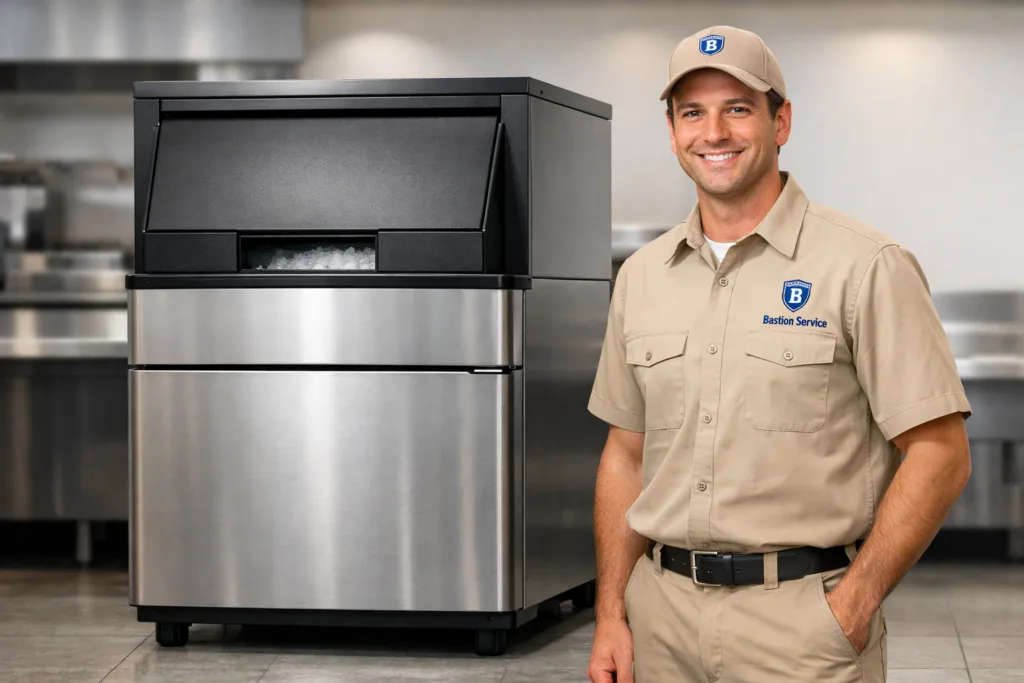
Hoshizaki repair technician in Los Angeles
On-site service across Los Angeles

Diagnosis

What the technician checks

  • Operating sequence

    The technician observes where the normal cycle stops instead of guessing from the final symptom.

  • Water and drainage

    Supply pressure, filtration, distribution, pumps, valves and the drain path are checked for restrictions or leaks.

  • Airflow and cooling

    Condenser condition, room temperature, ventilation and the cooling system are tested under operation.

  • Controls and exact model

    Error history, sensors, controls, model and serial data are matched before an estimate or parts recommendation.

$85 / $120

Diagnostic service call. $85 for home appliances and $120 for business equipment. If you approve the repair, the fee is applied toward the total cost.

Equipment

Hoshizaki equipment we repair

We repair supported Hoshizaki equipment on site. Repair only, no new equipment installation.

  • Modular and self-contained ice machines
  • Undercounter equipment for compact spaces
  • Air-cooled, water-cooled and remote-cooled systems
  • Cube, flake and nugget ice equipment
  • Ice and beverage dispensers
  • Equipment used in kitchens, hotels, cafés, offices and homes
  • Supported refrigerators and freezers listed in the model reference below
Model reference

Hoshizaki ice machine model references

12 reviewed model references
Symptoms and care

Bastion Service repairs Hoshizaki ice machines. These model and manual references help identify your equipment; symptoms alone do not confirm a diagnosis.

Manual candidates require the complete model, serial/build and installed controller to be checked. A specification sheet is not an operating manual. These references do not authorize installation or DIY repair.

Repair service only. New equipment installation is not offered.

Ice Machine repair

KM 1340 H modular crescent cubers4

KM 900 H modular crescent cubers4

KM 650 H modular crescent cubers3

KM 600MAH air cooled crescent cuber1

Symptoms and maintenance

Ice Machine symptoms and care by family

Models and manuals

Match the complete model, serial/build and installed controller before using a document.

Bastion Service repairs existing equipment. We do not install new equipment.

KM-1340 H modular crescent cubers7 topics Back to models and manuals

Official service manual; model, serial/build and installed E/G controls must match. MRH3 historical board-part assignment remains unresolved. | Document: 73196 | Issued: 2013-04-29 | Revised: 2016-09-21

No ice even though the bin is empty

An empty bin does not rule out a bin-control problem on these KM-1340 models. The manual describes thermostatic control that can stop the machine in unusually cold surroundings. Water-supply restrictions, a clogged external filter or a protection alarm can also interrupt production. Tell the technician whether the stoppage followed cold weather, a water interruption or control work. Do not bypass the bin control or open the electrical compartment; the control switch alone does not isolate every electrical load.

A single sound or a repeating alarm?

Record the number of beeps in each repeating group and when they occur. In this manual, the G board makes a single sound when switched to ICE, while the E-board description notes a sound at power-off. Those events differ from repeating protection alarms. Repeating one-beep groups point to high evaporator temperature, which can have several causes. Give the technician the full model number and any prior board-repair record; do not identify the installed board from sound alone or repeatedly reset an alarm.

Two beeps and ice that is slow to release

A repeating two-beep group means harvest ran beyond the manual's limit on two consecutive cycles. Ice that is slow to release can involve scale, restricted water delivery, temperature sensing, valve operation or refrigeration performance. On the water-cooled MWH variant, the technician also has a different condenser-water system to consider. Describe whether ice releases late or remains attached. The sound alone does not identify a replacement part; leave internal testing and ice removal to qualified service.

Three beeps or increasingly slow ice production

Repeating three-beep groups indicate that two freeze cycles reached the configured time limit. This edition lists different default limits for KM-1340MWH and the other KM-1340 H variants, so another model's timing is not a reliable comparison. Scale, water-level sensing, leaking valves, weak circulation or refrigeration trouble may extend the cycle. Report changes in output and recent cleaning or filter work. Do not lengthen a timer to mask the problem; the technician must match the installed controls to the exact model.

Six or seven beeps need electrical diagnosis

In the reviewed E and G control descriptions, repeating six- or seven-beep groups indicate low or high control voltage. They do not prove that the control board itself has failed. Tell the technician whether the problem began after a power interruption or electrical work. Leave voltage checks, panel access and corrective work to qualified personnel. Do not repeatedly cycle power or replace protective devices to force the machine to run.

Ice buildup that returns after cleaning

Persistent ice buildup can involve scale, uneven water distribution, restricted flow, sensing trouble or a refrigeration fault. Cleaning history helps narrow the investigation, but a clean-looking surface does not rule out an internal problem. The reviewed KM-1340 H rows also use a different harvest-pump arrangement from some other KM machines. Describe where the ice remains and when production changed. Leave thawing, internal inspection and control adjustments to qualified service; do not copy another model's switch settings.

Keep routine care separate from internal service

The reviewed schedule calls for daily scoop cleaning with a neutral cleaner and a thorough rinse, plus monthly exterior care. Include any external water filters in monthly maintenance checks. Arrange the specified yearly cleaning and sanitation of the machine and bin liner using the exact instruction manual or maintenance label; water quality and operating conditions may require more frequent attention. Have condenser care matched to the model and its location. Do not assume every variant has the same air filters or approach a remote condenser that is not safely accessible.

Early KM-1340 H: after cleaning1 topic Back to models and manuals

KM-1340MAH/MWH/MRH early E-control edition; excludes MRH3 and unverified replacement controls. | Document: 73135 | Issued: 2006-10-16 | Revised: 2006-11-30

Ice making did not resume after cleaning

If production stopped immediately after cleaning, tell the technician before assuming the compressor has failed. This early design prevents compressor operation when the cleaning valve is not fully closed. Have the cleaning setup checked by qualified service; do not open panels or bypass the interlock.

Early KM-1340MAH: air-filter care1 topic Back to models and manuals

KM-1340MAH air-cooled filter guidance, early E-control edition. | Document: 73135 | Issued: 2006-10-16 | Revised: 2006-11-30

Include the air filter in early KM-1340MAH maintenance

A loaded mesh filter can reduce output on this air-cooled model. Its early maintenance guidance calls for checking the filters at least twice a month. Include filter condition in scheduled care, and have persistent low production investigated. This filter guidance does not apply to the water-cooled MWH system.

Early KM-1340 H: operating conditions and downtime2 topics Back to models and manuals

KM-1340MAH/MWH/MRH instruction edition; excludes MRH3. Match the unit documentation; no inferred serial or controller boundary. | Issued: 2005-08-11

Lower output when the kitchen or incoming water gets hotter

Lower output during hotter conditions is useful diagnostic information, not proof of a failed component. This edition specifies air at 45-100 F and incoming water at 45-90 F. Report persistent changes to your technician; do not adjust controls to compensate.

Plan for extended downtime and freezing conditions

Before extended downtime or freezing exposure, ask qualified service to prepare the machine. Switching it off alone does not remove trapped water. The MWH also needs attention to its separate condenser-water circuit. Leave internal draining and restart preparation to the technician.

KM-900 H modular crescent cubers5 topics Back to models and manuals

KM-900MAH/MWH/MRH/MRH3, reviewed E-control edition. Match the installed bin control and full serial. MWH specification ranges are L00001D-M20500D and M30501D onward. Timer statements differ within this edition; no universal limit is assumed. | Document: 73105 | Issued: 2003-01-28 | Revised: 2007-04-12

Record the repeating beep pattern

Record the beep count and pauses for your technician. One brief startup sound differs from a recurring alarm. The reviewed E controller distinguishes temperature, cycle-time and voltage protection. Avoid repeated resets or opening electrical panels.

A full bin and delayed stopping

Stopping behavior depends on the installed bin control and cycle stage. Four- or five-beep alarms belong to the mechanical-bin circuit in this edition. Report persistent overfilling; do not bypass the control or copy another model's settings.

Slow output or ice that will not release

Scale, restricted water flow, sensing faults or refrigeration trouble can slow production. Note whether ice stays attached or cycles take longer. A three-beep alarm needs model-specific timer review, not an automatic diagnosis or a universal minute limit.

Small cubes or water collecting in the bin

Small cubes can involve water delivery or drainage; unusual melting can involve a blocked bin drain. Tell the technician which changed first. Leave internal valve, pump and drain inspection to qualified service.

Routine care matched to your machine

Keep the scoop and bin clean, rinse thoroughly, and reserve the bin for ice. Follow the machine's own labels. Arrange condenser care for the actual cooling type; the air-condenser schedule does not apply to MWH.

KM-650 H modular crescent cubers6 topics Back to models and manuals

KM-650MAH/MWH/MRH, manual 73196 revised 2016-09-21. Match installed E/G controls, bin type and auxiliary code. Diagrams: MAH/MWH V-1 and earlier (p86), V-2 to C-2 (p95), D-1 and later (p96); MRH V-1 and earlier (p87), V-2 to C-1 (p97), C-2 and later (p98). Pages 86-87 omit harvest pump timer relays; pages 95-98 include them. These are literal document boundaries, not production dates or permission to change settings. | Document: 73196 | Issued: 2013-04-29 | Revised: 2016-09-21

Repeated beeps and controller indicators

Count the beeps in each repeating group before calling for service. In this manual's E/G alarm tables, one beep points to excessive evaporator temperature, two to repeated harvest timeouts, and three to repeated freeze timeouts. Six and seven identify low- and high-voltage protection. These signals narrow the technician's checks; they do not identify a failed part by themselves. E boards also use H TIMER and F TIMER lights for the corresponding timeouts. Those are internal board indicators, not a front-panel error display. A single G-board startup beep is different from a repeating shutdown alarm. Report the pattern and whether ice production stopped; leave panel removal, electrical checks and alarm resets to a qualified technician.

An empty bin but no restart, or ice piling too high

KM-650 specifications allow thermostatic or mechanical bin control, so a full-bin shutdown does not have one universal restart test. A thermostatic control can stop production in unusually cold surroundings even when the bin is empty. With a mechanical control, mineral buildup can restrict the sensing paddle, and shutdown timing depends on the operating cycle. On a G board, BC OPEN and BC CLOSED describe the bin-control input, not a diagnosis of the refrigeration system. Tell the technician whether the machine stopped with a full bin, stayed off after ice was removed, or kept making ice above its normal level. Do not reposition the sensor, defeat the bin control or adjust it to force production.

Longer cycles and less ice between busy periods

When a KM-650 still makes ice but cannot keep up, note whether the delay occurs while ice forms or while it releases. Restricted water flow, mineral deposits and uneven water distribution can prolong production. A dirty condenser, a water valve that leaks during freezing, poor pump circulation or a refrigeration fault are other possibilities in the service chart. Remote KM-650MRH equipment also has condenser-pressure controls that need the correct remote-system checks. Record recent filter service, cleaning and changes in output for the visit. Extending a freeze timer or changing harvest pump timing can conceal a problem or damage the machine; the technician should match the installed controller and factory configuration first.

Ice remains on the evaporator or builds into a thick layer

Repeated ice buildup after harvest needs more than a longer cleaning cycle. The KM-650 troubleshooting context includes scale on the evaporator, blocked or misaligned water distribution parts, insufficient incoming water, a sticking float and faults in the harvest or refrigeration circuit. On configurations using a G-board harvest pump timer, incorrect settings are another service consideration; earlier configurations do not share that same timer arrangement. Tell the technician whether buildup started after cleaning or control work and whether a repeating alarm followed. Leave internal ice removal, water-system disassembly and controller adjustments to service personnel so the underlying release or water-flow problem can be found.

Scoop hygiene, filter records and scheduled cleaning

Wash the ice scoop daily with a neutral cleaner and rinse it thoroughly. Keep the exterior clean with a soft cloth, and include the bin door in routine care. The maintenance table calls for monthly attention to external water filters and annual cleaning and sanitizing of the machine and bin, with more frequent work when water quality or the operating environment requires it. Inspect air filters where fitted; do not assume a water-cooled KM-650MWH has the same air-filter arrangement as a KM-650MAH. Keep a record of filter changes and sanitation visits. Internal cleaning, inlet-screen work, hose checks and condenser service belong with a qualified technician following the matching instructions or maintenance label, not an improvised chemical recipe.

Planning a long shutdown or exposure to freezing conditions

An extended closure or a location that may freeze calls for proper water-system preparation, not just leaving the ice machine idle. Tell the service technician how long the KM-650 will be out of use and whether freezing temperatures are possible. The manual's KM-650 tank-draining arrangement differs from the overflow-pipe method shown for larger KM-1340 units, so those instructions should not be interchanged. Have the matching shutdown procedure completed for the machine's water and condenser configuration. Do not run WASH with an empty tank; the manual warns that this can damage the water pump.

KM-600MAH air-cooled crescent cuber6 topics Back to models and manuals

KM-600MAH only; p66 allows thermostat or mechanical bin control. Shared E/G diagram p85 is without harvest pump timer relays. No KM-650 auxiliary boundary or installed-controller assignment is inferred. | Document: 73196 | Issued: 2013-04-29 | Revised: 2016-09-21

KM-600MAH early E-control edition; thermostat on p19. Not a mechanical-bin or replacement-controller routing rule. | Document: 73167 | Issued: 2008-08-12 | Revised: 2008-08-25

KM-600MAH instruction edition; p13 uses an actuator paddle. No serial transition is supplied by the reviewed pages. | Issued: 2008-06-24 | Revised: 2010-03-31

Early E-control unit: repeating beeps

On the early E-control edition, repeating groups of one, two, or three beeps indicate high evaporator temperature, a harvest timeout, or a freeze timeout. Six and seven indicate low and high supply voltage. H TIMER and F TIMER are internal board indicators, not front-panel display messages. Record the pattern for service; do not open the control box or repeatedly reset a shutdown.

Small or irregular cubes

Small cubes can accompany restricted water flow or water loss through the pump-out check valve. Scale and dirty water-distribution parts can also distort the ice. Tell the technician whether cube size changed gradually or suddenly, and provide the water-filter service history. Appearance alone does not identify a failed component.

Bin full, bin empty, or unexpected stopping

KM-600MAH documentation covers both thermostatic and mechanical bin controls. They do not use the same sensing method or stopping sequence. A thermostatic unit can stop with an empty bin when ambient temperature falls below 45 F; a mechanical unit may need its paddle and shutdown sequence checked. Report the ice level and room conditions when stopping occurs. Have a technician identify the fitted control before testing it; never bypass the bin shutoff.

Brief drain flow between ice-making cycles

A short pump-out is part of normal operation, so drain flow at a cycle transition is not automatically a leak. The combined manual lists a ten-cycle factory pump-out interval for KM-600MAH, but the first pump-out differs between E and G controls. This is not a setting to copy onto an unidentified board. Report continuous water loss, unusually small cubes, or a new change in drain behavior; leave timer and switch adjustments to service.

No ice after cleaning

If ice production stops immediately after cleaning, tell the service technician what work was performed. In this instruction edition, an incompletely closed cleaning valve prevents compressor operation. The technician should verify the valve and operating configuration before diagnosing refrigeration failure. Do not run WASH with an empty tank or attempt an internal adjustment yourself.

Airflow, sanitation, and planned downtime

Arrange qualified maintenance with air-filter checks at least twice monthly, a yearly condenser inspection, and cleaning and sanitizing at least annually; site conditions can require more frequent attention. Keep the bin reserved for ice and use the scoop with clean hands. For extended closure or freezing conditions, arrange proper draining: switching the machine off alone does not remove trapped water.

Preventive care

Keep your Hoshizaki ice machine running well

Scale, slime, dust and heat build up long before a machine stops. These habits protect output and food safety.

01

Clean and sanitize on schedule

Follow the cleaning and sanitizing schedule in the instructions for your exact model. Hard water, warm rooms, and flour or yeast in the air may require more frequent care.

02

Keep the condenser clean

Air-cooled machines pull kitchen air through the condenser. Grease and dust clog it, the machine runs hot, and output drops. On remote systems, keep debris away from the outdoor unit.

03

Change water filters on time

Replace cartridges on the filter maker’s schedule. A clogged filter starves the machine of water; a spent one lets scale through.

04

Act on early signs

Smaller cubes, a slower bin or a new noise usually show up before a shutdown. That is the time to call.

Repair or replace?

Repair usually makes sense when

  • The problem is in one part: a pump, probe, fan motor, valve or control board.
  • The machine keeps up with your busiest shift when it runs right.
  • It has not needed major repairs again and again.

Replacement is worth a look when

  • The compressor or evaporator failed on an older machine, and the estimate gets close to the price of a new one.
  • Several major systems need work at the same time.
  • Your volume has outgrown the machine.

We only do repairs, so we have no reason to push a new machine. We will tell you plainly if a repair is not worth it.

Customer reviews

What customers say

Wow! Andrew hit all of the “check the boxes” for his workmanship: He showed up on time as discussed. He is courteous and polite! He diagnosed and explained the issue with our LG refrigerator. He Quoted us a price (very reasonable). Repaired the problem within an hour! He even cleaned up the dusty back of the refrigerator ( which hadn’t seen daylight forever!) Above and beyond customer service! I highly recommend this guy to anyone who asks me if, “I know anyone who repairs appliances?” Give Fix Tech Appliance Repair a call !!👍🏼

jeffrey cloutier · Google review

Andre is the best tech we have ever worked with. After Samsung sent 3 techs out and couldn’t fix our bespoke fridge -Andre came to our house and diagnosed and fixed it in 2 hours with a warranty and no additional parts. Truly a wizard.

jake cruzen · Google review

Fast and efficient, affordable prices, does not have hidden agenda, and are honest. Thank you

Maria Rodriguez · Google review

Read more customer reviews

FAQ

Questions about Hoshizaki repair

Still not sure? Call (323) 433-6360 and describe what the machine is doing.

How much does the visit cost?

The diagnostic service call is $85 for home appliances and $120 for business equipment. If you approve the repair, this fee is applied toward the total cost. You get a written estimate before any work begins.

Can you come today?

Same-day service available. Call (323) 433-6360 to schedule. We are open 7 days, 8 AM–6 PM.

Do you need my model number?

It is helpful but not required. A phone photo of the label with the model and serial number is plenty. If you cannot find it, the technician will read it on site.

How long does a repair take?

It depends on what failed. Some repairs are finished during the visit; others need a part ordered. After the diagnosis you will know the plan before work starts. Once the machine is running again, the bin still needs time to refill, so plan backup ice for your next shift.

What if a part has to be ordered?

We will tell you after the diagnosis and schedule the return visit.

Is Bastion Service affiliated with Hoshizaki?

No. Bastion Service is an independent repair company. We repair Hoshizaki ice machines but are not affiliated with Hoshizaki.

What areas do you serve?

Businesses across Los Angeles, including the Westside, South Bay, Beverly Hills, West Hollywood, Santa Monica, Culver City, Torrance and Mid-Wilshire. Not sure you are in range? Call and ask.

Ice machine down? Let’s get it making ice again.

Open 7 days, 8 AM–6 PM, with same-day service available. Service across Los Angeles: Westside, South Bay, Beverly Hills, West Hollywood, Mid‑Wilshire and nearby.

Call Now Book Service