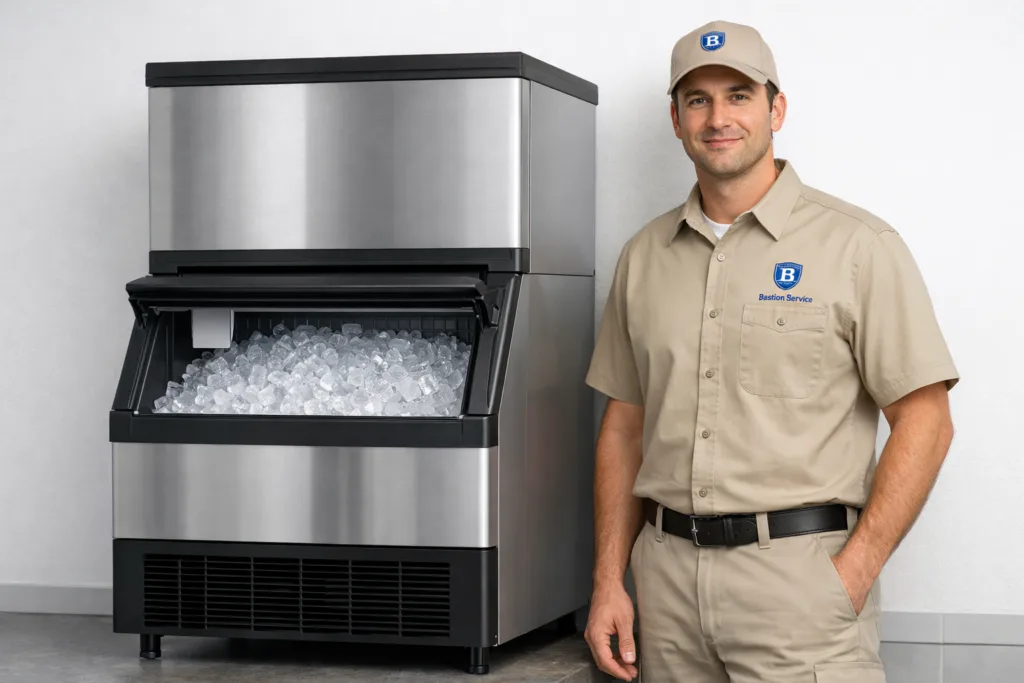




Ice problems rarely stay isolated for long in a busy operation. When a Hoshizaki unit starts producing less ice, leaking, shutting down, or struggling to complete a cycle, the effect is felt in drink service, food handling, staff workflow, and sanitation. Bastion Service provides repair support for businesses in Redondo Beach that need the problem identified quickly, the equipment condition explained clearly, and service scheduled based on how much downtime the operation can tolerate.
For specific equipment paths in Redondo Beach, review Hoshizaki Refrigerator Repair in Redondo Beach, Hoshizaki Freezer Repair in Redondo Beach, and Hoshizaki Ice Machine Repair in Redondo Beach.
Many ice machine symptoms look similar at first, but they do not point to the same repair. Low output may come from restricted water supply, scale on internal components, a weak pump, a faulty inlet valve, sensor errors, airflow problems, or refrigeration performance loss. A machine that seems to have one simple problem can actually be reacting to a different underlying fault, which is why repair decisions are more effective when they are based on the full symptom pattern instead of the visible complaint alone.
Common Hoshizaki Ice Machine Symptoms That Point to Repair
Low ice production
If the bin is not filling as expected, the issue may be developing long before the machine stops completely. Slower production often shows up as longer freeze cycles, inconsistent cube formation, or a unit that runs but never seems to catch up with demand. For businesses in Redondo Beach, this is usually the point where scheduling service is easier and less disruptive than waiting for a full shutdown during a peak period.
- Restricted water flow into the machine
- Scale buildup affecting distribution or sensing
- Condenser blockage or heat rejection problems
- Refrigeration system performance issues
- Control or sensor faults that interfere with normal cycling
Harvest problems
When a Hoshizaki machine freezes ice but does not release it correctly, the unit may stall in harvest, run too long, or stop with ice still attached to the evaporator area. Harvest issues can be tied to scale, water distribution irregularities, sensor problems, valve behavior, or refrigeration-related conditions. These problems often worsen with continued operation because the machine keeps attempting cycles that it cannot complete correctly.
Leaks and overflow
Water around the base of the machine should not be treated as a minor nuisance. Leaks can come from drain restrictions, cracked tubing, loose fittings, overflow conditions, damaged internal components, or ice formation in places where it should not occur. In a business setting, leaking equipment can affect flooring, nearby storage, safety, and cleanup time, so it is usually worth addressing before the source expands into a larger interruption.
Unexpected shutdowns
A machine that stops mid-cycle, powers off unexpectedly, or repeatedly goes into protective shutdown is usually responding to a fault condition. These shutdowns may be related to temperature conditions, electrical issues, sensors, control board behavior, motor load, or water system problems. Restarting the unit without understanding why it stopped can lead to repeated failures and more difficult troubleshooting later.
Ice Quality Problems Usually Signal More Than Appearance Issues
Poor ice quality is not just a presentation issue. Soft cubes, incomplete cubes, cloudy ice, odd taste, unusual odor, or irregular shapes can all indicate conditions that affect machine performance as well as usability. In many cases, the same factors that change ice quality also reduce output and put extra stress on internal components.
Common causes include:
- Mineral accumulation inside water-contact components
- Water flow imbalance during fill or freeze cycles
- Drainage issues that interfere with normal operation
- Temperature or refrigeration problems
- Components that are no longer responding accurately during production or harvest
When ice quality changes at the same time as low production or harvest trouble, that combination usually points to a repair issue rather than a simple one-time inconsistency.
Water Flow and Scale Buildup Often Drive Repeating Failures
Hoshizaki ice machines depend on stable water movement and clean internal surfaces to cycle normally. When scale buildup develops, it can affect sensors, pumps, water paths, and release behavior during harvest. A machine may still run for a while under these conditions, but performance often becomes inconsistent before the unit starts showing more obvious failure symptoms.
Water flow problems can show up as:
- Longer fill times
- Partial or thin ice formation
- Erratic cycling
- Freeze-ups in the wrong areas
- Reduced daily output without an obvious external leak
If the same issue seems to return after cleaning or reset attempts, there may be a repair need involving valves, pumps, sensors, controls, or other parts affected by ongoing scale and water condition stress.
When Continued Use Can Make the Problem Worse
Some machines can limp along with reduced output for a short time, but others should not stay in normal use once symptoms are obvious. Continued operation is more risky when the unit is leaking, stopping in harvest, making unusual noise, tripping protections, producing very little ice, or creating visibly poor ice. In these cases, the short-term goal is not just to restore production but to avoid adding damage to components that are already under strain.
Delaying repair can increase wear on pumps, valves, motors, sensors, and refrigeration components. It can also turn a manageable service call into a longer outage if the machine finally fails during a high-demand period. For businesses that rely on steady ice availability, timing matters almost as much as the repair itself.
What a Service Visit Helps Clarify
A repair appointment should do more than confirm that the machine has a problem. It should help decision-makers understand what is failing, how severe the issue is, whether the equipment can remain in limited use, and what repair path makes the most sense for the machine’s age and condition.
- Whether the symptom is caused by water, scale, electrical, control, or refrigeration issues
- Whether the machine should stay online or be taken out of service
- How the fault is affecting output, cycle completion, and ice quality
- Whether the issue appears isolated or part of broader wear
- What next steps are reasonable for scheduling and operations planning
That information is especially important for businesses in Redondo Beach trying to balance immediate ice needs with the risk of a larger equipment failure.
Repair Decisions for Older or Repeatedly Failing Units
Not every problem points to replacement, and not every older machine is a poor repair candidate. The better question is whether the current issue is isolated and repairable, or whether it is one more sign of broader decline in reliability. If the unit has had recurring shutdowns, ongoing harvest issues, frequent scale-related performance loss, or repeated water system faults, a service evaluation can help put the latest symptom in context.
Useful factors include the machine’s condition, maintenance history, production performance, frequency of previous problems, and the operational cost of another unexpected outage. Without that context, repair decisions tend to be based on frustration rather than equipment condition.
Related Cold-Side Equipment Considerations
Some businesses using Hoshizaki ice machines also operate Hoshizaki refrigerators and freezers in the same workspace. When multiple cold-side units are in use, it can help to determine whether the ice machine problem is truly isolated or whether surrounding conditions such as airflow, utility issues, drainage conditions, or maintenance gaps may be contributing to broader equipment stress. That kind of comparison can be useful when prioritizing service and preventing repeat disruptions across essential food-storage and ice-production equipment.
If your machine is producing less ice, leaking, failing during harvest, shutting down, or making ice that no longer looks or performs the way it should, the next step is to schedule repair before the problem affects more of the workday. For businesses in Redondo Beach, timely service helps protect uptime, reduce avoidable damage, and restore predictable ice production with a repair plan that fits the actual fault.