
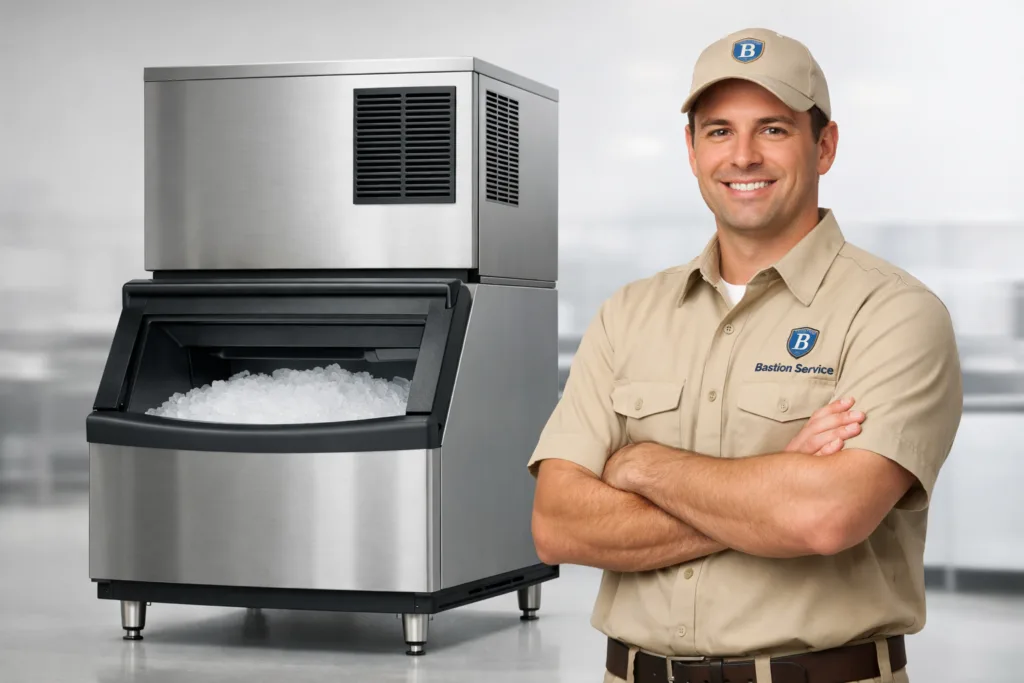




When a Hoshizaki ice machine starts missing cycles, leaking, or falling behind on production, the priority is keeping operations moving while the actual fault is identified. Similar symptoms can come from very different causes, including water supply restrictions, scale buildup, drain blockages, control failures, sensor issues, or refrigeration-related problems. Bastion Service provides repair support in Inglewood with an emphasis on diagnosing the symptom pattern, confirming what is failing, and helping businesses schedule the next step before downtime grows.
For specific equipment paths in Inglewood, review Hoshizaki Refrigerator Repair in Inglewood, Hoshizaki Freezer Repair in Inglewood, and Hoshizaki Ice Machine Repair in Inglewood.
For businesses in Inglewood, that matters because an ice machine problem rarely stays isolated for long. Low output can turn into a shutdown, a minor leak can become a floor hazard, and recurring harvest trouble can strain other components. A service visit helps determine whether the machine should remain in use, what repair path makes sense, and how urgent the situation is based on production needs.
Common Hoshizaki ice machine symptoms that usually need repair
Most service calls begin with a simple complaint: not enough ice, no ice, water where it should not be, or ice that no longer looks right. The machine may still run, but that does not mean it is running correctly. Symptom-based testing is important because continued operation under the wrong conditions can lead to longer outages and more involved repairs.
Low ice production or no ice at all
If the bin is not filling as expected, the issue may involve restricted inlet water flow, a fill problem, scaling on internal surfaces, a failed valve, sensor trouble, or weak cooling performance. In some cases the machine is still cycling, just too slowly to support daily demand. In others, it may start a cycle and stop before completing it.
This type of problem often becomes urgent when the machine can no longer keep up during normal business hours. Repair service helps confirm whether the loss of output is tied to maintenance-related buildup, a failing component, or a larger system issue that needs prompt attention.
Harvest problems and incomplete release
A machine that freezes water but does not release ice properly may be dealing with scale, water distribution issues, hot gas or valve problems, sensor errors, or timing faults in the control sequence. Common signs include ice that sticks, partial sheets, uneven release, or repeated stalling between freeze and harvest.
Harvest issues are important to address early because they can reduce production even when the machine appears to be working. Repeated failed releases also increase wear on parts that are trying to complete a cycle under the wrong conditions.
Leaks, overflow, and drain issues
Water on the floor, water inside the cabinet where it should not be, or repeated overflow often points to a blocked drain path, cracked tubing, fill irregularities, or backup related to ice formation and water movement. Even a small leak can create sanitation concerns and affect nearby equipment.
If the source is not obvious, repair is usually the safer choice than continued use. What looks like a minor overflow can actually signal a drain restriction or flow problem that will continue to worsen.
Scale buildup and poor ice quality
Cloudy ice, misshapen cubes, white residue, or inconsistent batch quality often indicate mineral buildup or water-related restrictions. Scale affects more than appearance. It can interfere with normal freeze and harvest performance, restrict circulation, and contribute to recurring shutdowns or low production.
When ice quality problems appear together with performance issues, service can help determine whether the machine needs cleaning, part replacement, or both. That distinction matters because some machines have a maintenance problem while others have a maintenance problem plus a failing component.
Unexpected shutdowns and intermittent operation
If the unit stops during the day, restarts on its own, or runs inconsistently, the cause may involve a sensor, control board, bin control, electrical interruption, or temperature-related safety response. Intermittent faults are often the hardest for staff to judge because the machine may appear normal during one cycle and fail during the next.
Documenting when the shutdown happens, what the machine was doing at the time, and whether production had already dropped can make diagnosis faster. In many cases, early service prevents a full outage at a worse time.
What a symptom-based diagnosis helps uncover
Businesses usually need more than a general explanation of the symptom. They need to know what has failed, whether the machine can continue operating, and what kind of repair planning is realistic. A proper diagnosis separates water flow problems from control issues, maintenance buildup from refrigeration faults, and isolated part failures from broader wear.
That information helps with scheduling and decision-making. Some repairs are limited to a valve, sensor, pump, drain component, or control issue. Others point to repeated scale exposure, declining system performance, or multiple related failures that affect reliability. The value of diagnosis is not just finding the immediate fault. It is understanding the likely downtime and the best path back to stable ice production.
Signs the machine should not be left running
Some machines can remain in limited operation while service is being scheduled, but others should be taken offline to avoid added damage. Warning signs include active leaking, repeated failed harvests, frequent automatic shutdowns, unusual noises, inconsistent fill behavior, or rapidly worsening output.
- Water is pooling around the unit or overflowing repeatedly
- The machine is freezing but not releasing ice correctly
- Ice production has dropped sharply in a short period
- The unit stops and restarts unpredictably
- Ice quality has changed along with cycle performance
- Staff notice abnormal sounds during freeze or harvest
Running the machine under these conditions can turn a manageable repair into a larger interruption. If production is already slipping, scheduling service before a complete stop is often the better operational decision.
Repair planning for businesses in Inglewood
Repair decisions are usually based on more than one symptom. A business may be dealing with low output, occasional leaks, and visible scale at the same time. In that situation, the question is not only what part has failed, but whether the machine is likely to return to dependable operation after the repair is completed.
For businesses in Inglewood, useful repair planning includes the age and condition of the machine, the number of active faults, the effect on daily demand, and whether the current issue appears isolated or part of repeated performance decline. A newer unit with a defined failure may be a straightforward repair. An older machine with recurring production issues and heavy buildup may call for a wider cost-and-downtime discussion.
When to schedule service instead of waiting
Waiting can be tempting when the machine still makes some ice, but partial function often hides a bigger problem. If output no longer matches demand, if the machine requires frequent staff attention, or if cycle behavior has become inconsistent, repair scheduling should move up in priority.
The most useful next step is to have the unit evaluated while the symptom pattern is still clear. That gives the technician a better chance to identify the source of the problem, recommend the right repair, and help reduce the risk of a complete shutdown during a busy period. If your Hoshizaki ice machine is leaking, shutting down, producing weak output, or showing harvest and ice-quality problems in Inglewood, service should be scheduled before the disruption spreads further.


