




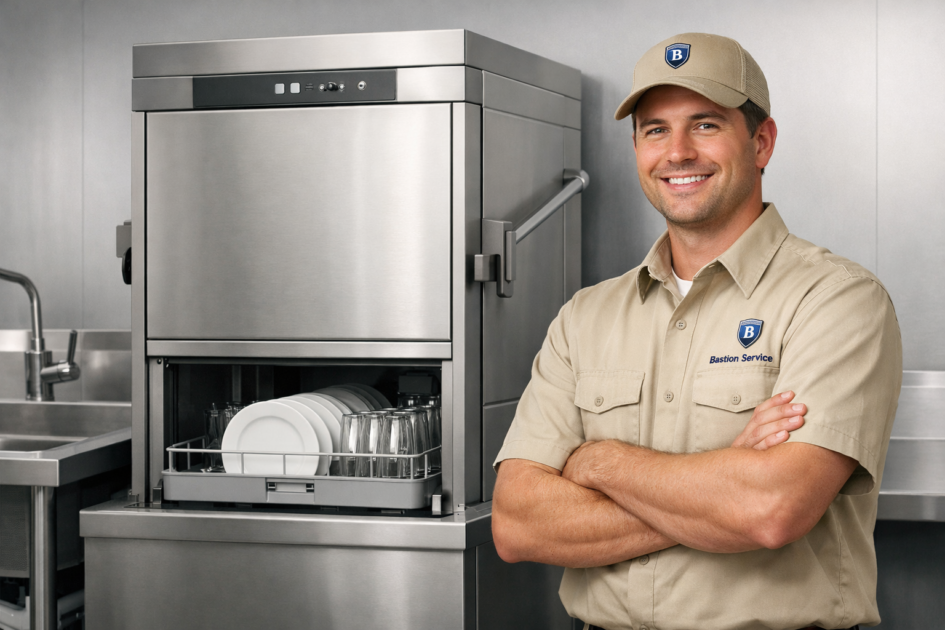
When a Hobart dishwasher begins leaving racks unclean, holding water, leaking, or stopping before a cycle finishes, the priority is getting the machine evaluated in a way that matches the actual symptom pattern. For businesses in Fairfax, dishwasher downtime can slow service, create rewash volume, and put pressure on staff who depend on steady rack turnover. Bastion Service provides Hobart dishwasher repair with attention to what the unit is doing, when the problem started, and whether continued use could lead to a longer outage.
Related commercial service paths in Fairfax include Hobart Commercial Repair in Fairfax and Commercial Dishwasher Repair in Fairfax.
Why symptom-based service matters
Dishwasher problems rarely look the same from one site to another. One machine may fill normally but fail to circulate wash water. Another may seem to run but leave poor results because rinse temperature is too low or drain performance is restricted. A leak at the floor may come from a door seal, a hose connection, or an internal component that only fails during part of the cycle. That is why repair planning works best when the symptom is tied to cycle behavior rather than guesswork.
For Fairfax businesses, that approach helps answer the questions that matter most: whether the machine can be used safely until service, whether a single failed part is likely, and whether the problem is already affecting pumps, heating components, controls, or drainage. It also reduces the chance of replacing parts that are not causing the interruption.
Common Hobart dishwasher problems that call for repair
Poor wash results, residue, or repeat cleaning
If dishes, trays, or utensils come out with food soil, film, or inconsistent results, the issue may involve weak wash pressure, blocked spray components, pump problems, low rinse performance, detergent delivery issues, or scale and debris inside the machine. On Hobart units, wash quality complaints often need more than a quick visual check because the source can be mechanical, temperature-related, or tied to how the unit is moving water during the cycle.
When poor results show up mostly during busy periods, that can point to a performance issue that becomes more obvious under heavier use. In a high-output kitchen or food-service setting, that pattern often matters because the machine may appear usable while still falling behind in actual cleaning performance.
Drain problems and standing water
A Hobart dishwasher that drains slowly or leaves water behind after a cycle may have a blocked drain path, drain pump trouble, sensor issues, valve problems, or a control fault that is interrupting the drain sequence. Standing water should not be treated as a minor inconvenience. It can lead to residue buildup, odors, reduced wash quality, and more difficult cleanup for staff.
If water remains in the machine regularly, service should be scheduled before the condition leads to overflow risk or a broader system issue. A recurring drain complaint is often easier to resolve early than after it has affected multiple cycles.
Low rinse temperature or weak sanitizing performance
If the dishwasher is not reaching expected temperature, takes longer to recover, or appears to be washing without proper final rinse heat, the problem may involve heating elements, controls, relays, thermostats, wiring, sensors, or scale restricting normal operation. Temperature-related faults are important because the machine can still appear to run while underperforming where it matters most.
In many Fairfax operations, low rinse temperature causes more than a single bad load. It can slow throughput, create uncertainty about results, and force staff to spend time checking workarounds instead of moving service forward.
Leaks, drips, and water on the floor
Leaks can come from gaskets, fittings, hoses, pumps, valves, seals, or drain-related failures. The location of the water on the floor does not always show the true source. Some leaks happen only during fill, others during wash circulation, and others when the machine drains or sits idle.
Because leak sources can shift with each part of the cycle, it helps to note when staff first see water and whether the amount changes from one run to the next. Continued use can increase the risk of cabinet damage, surrounding surface damage, and a repair that becomes larger than it first appeared.
Cycle interruption, no-start, or intermittent shutdown
If the dishwasher will not start, stops mid-cycle, loses power intermittently, or shows irregular control behavior, the issue may involve a safety switch, control board, wiring fault, sensor problem, or another electrical interruption. Intermittent faults are especially important to document because a machine may seem normal during a short test and fail later under regular use.
Staff notes can make a big difference here. If the machine stops at the same point each cycle, flashes a code, trips protection, or restarts only after cooling down, that pattern helps narrow the repair path more quickly.
What usually points to service now instead of later
Some symptoms should be treated as immediate repair issues rather than something to monitor. These include:
- Water leaking onto the floor
- Failure to drain after each cycle
- Low or inconsistent rinse temperature
- Repeated cycle interruption or shutdown
- Noticeably poor wash results after normal cleaning checks
- Unusual pump noise, humming, or strain during operation
- Burning odor, repeated breaker trips, or unstable power behavior
Even if the machine still runs, unstable operation often means the unit is no longer performing reliably enough for daily business use. Waiting can turn a manageable service visit into a full stoppage during a busy shift.
How diagnosis helps avoid unnecessary downtime
Many dishwasher complaints overlap. A unit that leaves wares dirty may have a wash pump issue, but it might also be struggling with heat, water flow, clogged components, or a control problem. A machine that does not finish its cycle may have an electrical fault, but it could also be reacting to a sensor reading that is outside normal range. Looking only at the visible symptom can send the repair in the wrong direction.
For Hobart dishwasher repair in Fairfax, the most efficient path is usually to identify what the machine is doing at fill, wash, rinse, drain, and shutdown. That allows the service call to focus on the failed system rather than treating the machine as if every symptom means the same repair.
Repair or replacement: how businesses usually decide
Not every dishwasher problem points to replacement. If the unit is in otherwise solid condition and the problem is limited to a pump, valve, heating component, sensor, control part, hose, or seal, repair is often the more practical choice. If the machine has repeated failures across multiple systems, significant wear, or downtime that keeps disrupting operations, replacement may deserve a closer look.
The better question is whether the repair is likely to return the machine to stable service for the site. That depends on equipment condition, failure history, the role of the dishwasher in daily workflow, and how much interruption the business can tolerate.
What to note before scheduling Hobart dishwasher service
Before the service visit, it helps to gather a few details from staff who have been using the machine. Useful notes include:
- Whether the issue happens every cycle or only sometimes
- When the problem first appeared
- Whether the machine fills, washes, rinses, and drains normally
- Any visible leaks, standing water, or unusual sounds
- Whether temperature seems low or recovery is slow
- Any error display, shutdown point, or restart behavior
- Whether the problem gets worse during peak volume
These observations often shorten the path from arrival to diagnosis because they show whether the fault is constant, load-related, or tied to a specific stage of operation.
Service support for Hobart dishwasher issues in Fairfax
When a Hobart dishwasher starts affecting wash quality, drainage, temperature, or cycle completion, the next step is to schedule repair before the problem leads to a larger interruption. For businesses in Fairfax, early service can protect workflow, reduce rewash burden, and help prevent a small fault from spreading into pump, control, or heating damage. A focused visit based on the machine’s actual symptoms is usually the fastest way to decide whether the unit needs a targeted repair, parts replacement, or a broader plan for reliable operation.