
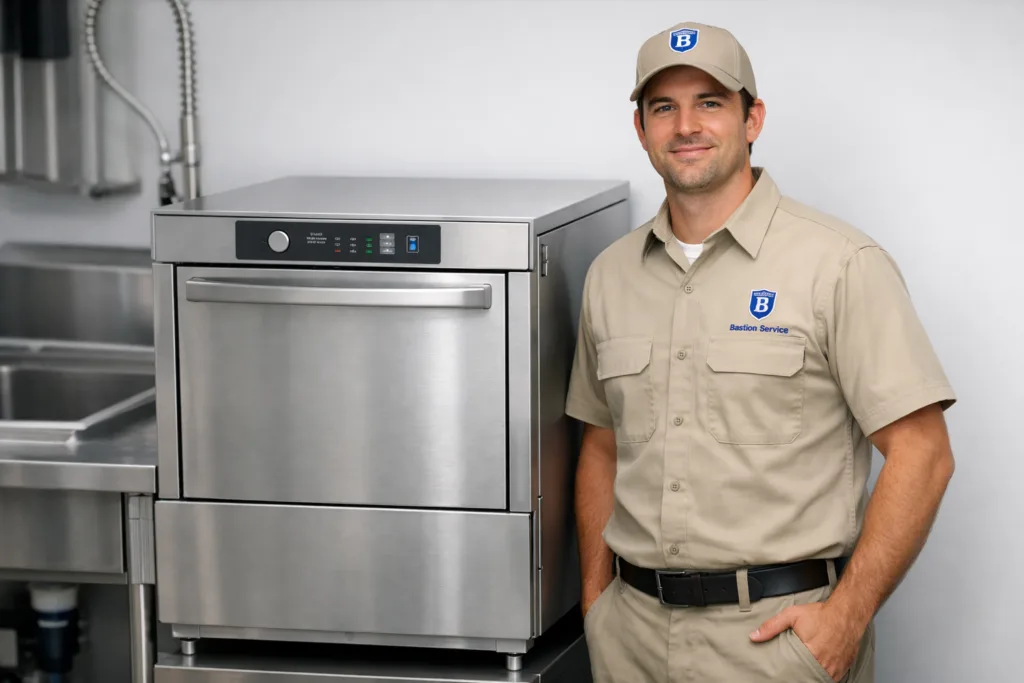






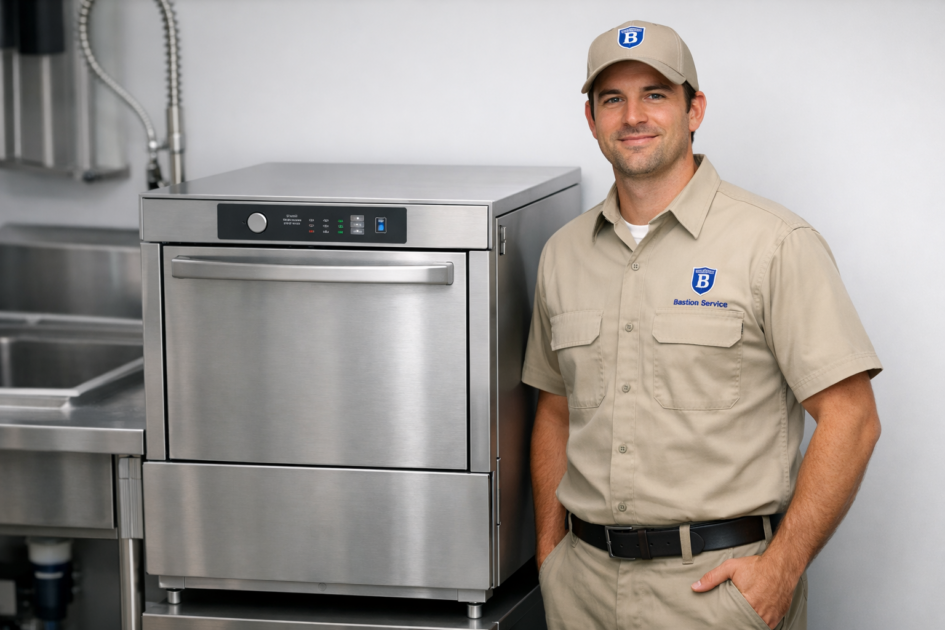
When a Hobart dishwasher starts leaving racks dirty, stops draining, or interrupts a wash cycle, repair decisions in West Los Angeles usually need to happen fast. The same visible symptom can come from very different causes, including wash pump trouble, fill problems, heating faults, sensor issues, scale buildup, or control failure. For businesses that rely on warewashing equipment during daily service, the priority is to identify the actual fault, understand how it affects safe operation, and schedule repair before downtime spreads into the rest of the kitchen workflow.
For specific equipment paths in West Los Angeles, review Hobart Dishwasher Repair in West Los Angeles and Commercial Appliance Repair in West Los Angeles.
Bastion Service works with businesses in West Los Angeles to troubleshoot Hobart warewashing equipment problems, confirm the likely source of the failure, and help operators decide whether the machine can stay in limited use or should be taken offline until repairs are completed. That service-focused approach matters when dish volume, sanitation standards, and labor flow all depend on reliable machine performance.
Common Hobart warewashing equipment symptoms that need repair
Warewashing equipment often shows warning signs before a full shutdown. A unit may still power on while producing inconsistent results, longer cycle times, poor final rinse performance, or repeated interruptions. Those symptoms should not be treated as minor if they are affecting output or forcing staff to compensate manually.
Poor wash performance and dishes not coming out clean
If glasses, plates, utensils, or pans come out with residue, grease, film, or food particles still present, the issue may involve wash pressure, blocked spray components, detergent or rinse aid delivery, temperature problems, or scaling inside the wash system. In a business setting, poor wash results do more than create rewash time. They slow rack turnover, increase labor, and can disrupt service timing during busy periods.
In some cases, the machine is technically running but not producing usable results. That is a strong sign that service is needed, especially when normal cleaning procedures and operator checks are no longer restoring wash quality.
Fill problems, low water levels, or cycles that start incorrectly
A dishwasher that fails to fill properly, fills too slowly, or starts a cycle with the wrong water level may have trouble with inlet components, float systems, sensing circuits, valves, or controls. Low fill conditions can reduce wash effectiveness and may also place unnecessary strain on pumps or heating components. Overfill conditions can create a separate risk of leaking, unstable operation, and shutdowns.
If staff notice inconsistent startup behavior from one cycle to the next, it is worth addressing before the problem becomes a complete no-start or repeated service interruption.
Drain issues and standing water in the machine
Standing water, slow draining, or a cycle that ends with water left behind can point to a blocked drain path, drain pump trouble, a failed drain component, or a control issue that prevents the cycle from finishing correctly. This kind of problem often gets worse with continued use because debris, scale, or pump strain can affect additional parts of the system.
Drain problems also create practical sanitation and workflow concerns. If racks cannot move through reliably, staff may start building workarounds that cost time and increase the chance of a full stoppage during service hours.
Leaks around the unit or water where it should not be
Leaks can come from door gaskets, hoses, pump seals, fittings, drain components, or internal water movement that is no longer being controlled correctly. A small leak may look manageable at first, but water around warewashing equipment can lead to bigger concerns, including electrical exposure, floor hazards, cabinet damage, and corrosion around nearby components.
Any active leak should be taken seriously. Even when the machine still runs, the repair decision should account for both equipment protection and workplace safety.
Rinse temperature concerns and sanitation complaints
If the machine is not reaching proper rinse conditions, final results can become inconsistent even when dishes appear mostly clean. Heating components, thermostats, boosters, sensors, controls, and related electrical parts can all contribute to temperature-related faults. Operators may first notice this as poor drying, spotting, sanitation complaints, or a machine that seems to take longer than normal to complete a cycle.
Temperature problems are important because they affect more than convenience. They directly affect whether warewashing equipment is supporting the standards your operation depends on.
Control faults, shutdowns, and interrupted cycles
When a Hobart unit freezes during operation, shows repeated error conditions, will not advance through the cycle, or needs repeated resets to keep working, the problem may be tied to controls, relays, sensors, switches, wiring, or a failed component causing the system to lock out. A machine that only runs after operator intervention is already showing reduced reliability.
These faults often create uncertainty for staff because the equipment may appear to recover temporarily. In practice, repeated interruptions usually mean the machine needs a proper repair plan rather than continued resets and guesswork.
What symptom patterns often mean for repair urgency
Not every problem carries the same level of urgency, but some symptoms should move to the top of the service schedule because continued use can create bigger failures.
- Urgent: active leaking, burning smells, electrical irregularities, no heat, repeated shutdowns, failure to drain, or visible water escaping during operation
- High priority: poor wash pressure, inconsistent fill, cycle interruptions, rinse temperature concerns, or fault codes that keep returning
- Still worth scheduling soon: unusual noise, longer cycle times, inconsistent cleaning results, or a machine that only works reliably under limited conditions
For many businesses in West Los Angeles, the real issue is not whether the dishwasher still turns on. It is whether the unit can keep supporting service volume without creating sanitation risks, staffing slowdowns, or an unplanned outage.
Signs continued operation may worsen the problem
Some warewashing issues allow a short window for limited use, while others should not be pushed. If staff are regularly restarting the machine, adjusting loads to compensate for poor cleaning, clearing standing water by hand, or watching for leaks between cycles, the unit is already affecting operations in a way that points toward repair.
Continued use may worsen the problem when:
- the machine is leaking during or after cycles
- water is not draining fully
- heating performance is inconsistent
- the dishwasher stops mid-cycle without explanation
- unusual grinding, buzzing, or vibration has started
- staff must reset controls repeatedly to finish a shift
Waiting too long can turn an isolated component failure into a wider repair involving additional parts, longer downtime, and more disruption to normal kitchen flow.
Repair decisions for Hobart warewashing equipment
A useful service visit should do more than confirm that the dishwasher has a problem. It should help the operator understand what failed, whether the fault has affected related components, how repair timing should be prioritized, and whether the machine can continue in service safely until work is completed.
That is especially important when the symptom could point to several different causes. A no-heat complaint, for example, may come from a heating element issue, a control problem, a sensor fault, or another related failure. A drain complaint may be a simple blockage in one case and a more involved pump or control issue in another. Good diagnosis prevents unnecessary part replacement and helps the business plan around actual repair needs.
When repair makes sense and when replacement may come up
Many Hobart warewashing equipment problems are repairable, especially when the issue is isolated and the rest of the machine remains in stable condition. Repair is often the sensible option when the unit has been operating well overall and the current fault can be corrected without chasing multiple unrelated failures.
Replacement may become part of the discussion when the machine has recurring breakdowns, multiple failing systems, rising repair frequency, or performance issues that continue even after recent service. For a business in West Los Angeles, that decision usually comes down to expected uptime, repair cost, operational disruption, and whether the unit can realistically return to reliable day-to-day use.
What to have ready before scheduling service
To speed up troubleshooting, it helps to note what the machine is doing and when the problem occurs. Useful details often include:
- whether the unit powers on normally
- if the problem happens every cycle or intermittently
- whether the issue involves washing, filling, draining, heating, or controls
- any leaking, unusual noise, or visible warning indicators
- whether staff have had to reset the unit or stop using it
Even a short symptom history can help narrow the likely cause and make the repair visit more efficient.
Service planning for businesses in West Los Angeles
When Hobart warewashing equipment starts affecting rack turnover, sanitation confidence, or kitchen timing, the next step is to schedule diagnosis and move toward repair based on the actual symptom pattern. For West Los Angeles businesses, acting early can reduce avoidable downtime, limit secondary damage, and make it easier to restore steady operation without a longer interruption than necessary.


