
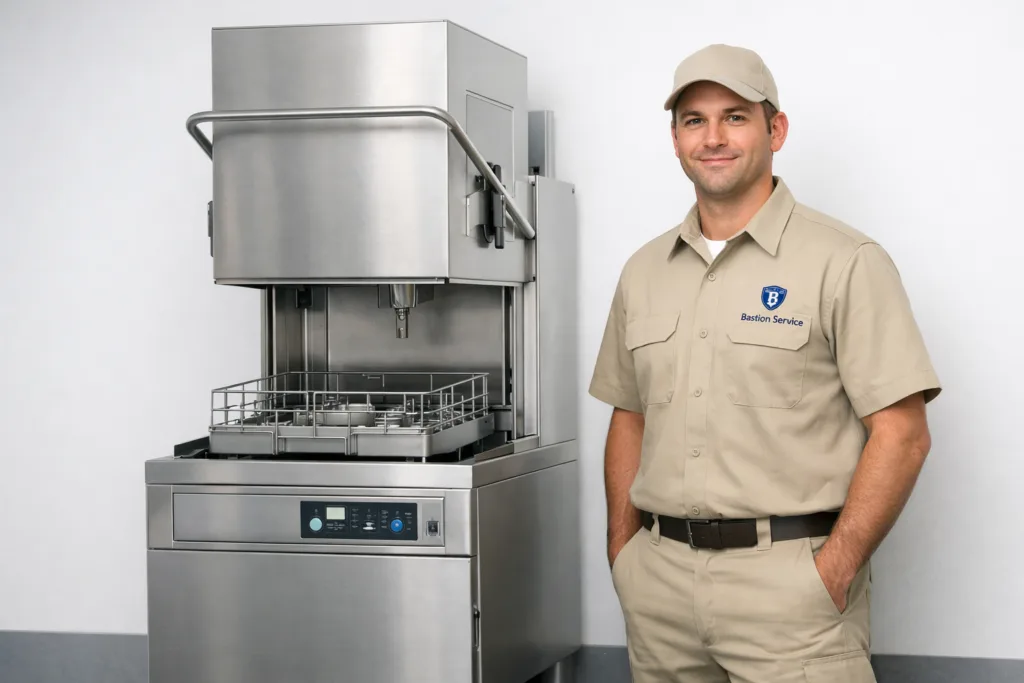




When Hobart warewashing equipment starts delaying dish flow, failing sanitation checks, or creating repeated rewash loads, the next step should be service based on the actual symptom pattern. For businesses in West Hollywood, repair decisions often need to happen quickly because wash performance problems can affect staffing, table turns, prep flow, and overall kitchen pace. Bastion Service provides Hobart warewashing equipment repair for businesses that need troubleshooting, repair scheduling, and a realistic assessment of whether the machine can keep operating until service is completed.
For specific equipment paths in West Hollywood, review Hobart Dishwasher Repair in West Hollywood and Commercial Appliance Repair in West Hollywood.
Not every problem points to a major failure, but recurring symptoms usually mean the unit needs more than basic operator adjustments. A machine that fills slowly, drains inconsistently, leaks during cycles, fails to maintain rinse temperature, or shuts down with control errors can move from nuisance to outage without much warning. The value of a service visit is identifying whether the issue is isolated to one component or tied to a broader problem affecting pumps, heating, valves, sensors, or controls.
What Hobart warewashing equipment problems do you troubleshoot?
Service typically focuses on the issues that disrupt daily operation first: poor cleaning results, fill and drain faults, leaks, rinse temperature concerns, sanitation complaints, and control-related failures. While staff may notice only one visible symptom, the source can involve several connected systems inside the machine.
- Dishware coming out dirty, streaked, cloudy, or greasy
- Slow fill, no fill, overfilling, or inconsistent water levels
- Standing water, slow drain, or failure to complete drain cycles
- Rinse temperature not reaching expected levels
- Leaks at the door, underneath the machine, or around fittings
- Cycle interruption, startup failure, or erratic keypad and control behavior
- Unusual noise during wash, drain, or fill phases
- Sanitation concerns tied to temperature, timing, or wash performance
Wash performance problems that lead to rewash and slowdowns
If a Hobart dishwasher is no longer delivering clean results, the problem may not be as simple as dirty ware entering the machine. Wash performance issues often involve circulation problems, blocked wash arms, reduced pump output, filter restrictions, temperature inconsistency, or chemical delivery faults. In a busy kitchen, teams usually notice this first as repeated loads, dishes that need manual touch-up, or visible residue after cycles that previously worked well.
When results decline gradually, staff sometimes compensate by running longer cycles or sending items through twice. That may keep operations moving for a short time, but it also adds wear, increases water and energy use, and can hide a repair need that is already developing. If cleaning quality is inconsistent from load to load, diagnosis helps determine whether the problem is hydraulic, thermal, mechanical, or control-related.
Signs the problem is more than normal buildup
Repeated spotting, grease left behind, utensils not clearing properly, or racks that come out with mixed results can point to reduced wash action rather than a one-time loading issue. If the unit used to clean effectively under the same workflow and now does not, service is usually warranted.
Fill and drain issues that interrupt cycle completion
Fill and drain faults are among the most disruptive warewashing problems because they can stop a cycle before it starts properly or leave the machine unusable between loads. Slow fill may involve inlet valve trouble, restrictions in the water path, sensing issues, or control problems. No-drain or partial-drain conditions may be tied to blockages, drain pump failure, hose restrictions, or faults in the sequence that tells the machine when to evacuate water.
Standing water in the tank after a cycle should not be treated as a minor inconvenience. It can lead to odor complaints, cleanup delays, and uncertainty about whether the next load will run correctly. If the machine occasionally drains and occasionally does not, intermittent failure is still a repair issue. In many cases, inconsistent behavior is a warning sign that the underlying part is weakening or the control sequence is no longer dependable.
When fill or drain problems need fast attention
- The unit times out before washing starts
- Water remains in the machine after multiple reset attempts
- Overflow or unexpected water level changes appear during operation
- Staff must manually intervene between loads to keep the machine working
Leaks, overflow, and water around the machine
Water on the floor around warewashing equipment should be taken seriously because it can signal anything from a worn seal to a failing internal connection or overfill condition. Some leaks show up only during specific parts of the cycle, while others continue even after the machine stops. That distinction matters because it helps narrow the likely failure area, but either way, visible leaking should be evaluated before it causes additional equipment damage or safety problems for staff.
Door gaskets, hoses, fittings, pumps, valves, and level-related faults can all contribute to leakage. Overflow conditions may also indicate a fill control issue rather than a simple seal problem. If employees are mopping around the machine daily or noticing water trails during busy shifts, the problem is already affecting normal operations and should be scheduled for repair promptly.
Rinse temperature and sanitation concerns
Warewashing equipment that does not maintain proper wash or rinse temperature can create one of the most frustrating symptom patterns: the machine appears to run, but the results are unreliable. Temperature-related complaints may involve heating elements, boosters, sensors, relays, contactors, thermostatic controls, or board-level faults. In some cases, the machine heats inconsistently, causing one load to perform acceptably and the next to fall short.
Businesses in West Hollywood often notice this as longer wait times between loads, sanitation concerns, or staff uncertainty about whether dishes are ready to return to service. If the machine is struggling to recover heat, failing to hold temperature, or generating alerts tied to rinse performance, it is important to diagnose the cause rather than assume the issue is only operational. Continued use under low-temperature conditions can turn a manageable repair into a service disruption that affects the entire dish area.
Common signs of a temperature-related fault
- Cycles complete but results do not look fully cleaned
- The machine takes longer than normal to be ready
- Rinse performance is inconsistent across similar loads
- Operators report sanitation concerns or repeated temperature alarms
Control faults, shutdowns, and cycle interruptions
Some Hobart warewashing equipment problems are obvious mechanical failures, while others show up as inconsistent behavior from the controls. The machine may stop mid-cycle, fail to respond to inputs, restart unexpectedly, display error conditions, or refuse to begin a wash sequence even though power is present. These issues can involve switches, door interlocks, wiring, boards, relays, sensors, or motor-related load problems that affect the control system.
Intermittent shutdowns are especially disruptive because they create uncertainty during busy hours. A unit that works for several loads and then stops can be harder on workflow than a machine that fails completely, since staff may keep trying to recover it instead of switching immediately to a backup plan. If controls are behaving unpredictably, diagnosis should happen before the problem becomes a full no-start condition.
Why symptom-based diagnosis matters before parts are replaced
The visible complaint is not always the actual failed component. Poor cleaning may begin with low circulation but trace back to a pump problem, a restriction, or a control issue affecting timing. A leak may appear near the door while the root cause is improper fill behavior. Temperature complaints can stem from heating hardware, sensor error, or sequence faults. Replacing parts based only on the symptom that is easiest to see can lead to extra expense and more downtime.
A symptom-based service approach helps answer the questions businesses actually need answered: what is failing, how urgent the repair is, whether the unit should stay in operation, and whether the repair path makes sense for the condition of the equipment. That is especially important when the machine is still partially operational but clearly not dependable.
When to stop using the machine until repair is completed
Some problems allow short-term operation while service is being arranged, but others should be treated as stop-use conditions. Active leaking, repeated overflow, strong burning odors, complete drain failure, serious temperature loss, and frequent shutdowns all increase the risk of larger damage or unsafe operation. If staff members are watching the machine constantly, resetting it repeatedly, or adjusting workflow around recurring faults, the equipment is no longer operating normally enough to ignore.
In those situations, the best next move is usually to schedule repair quickly and determine whether continued use would create a bigger interruption later. Short-term workarounds may seem helpful during a busy shift, but they often lead to a harder shutdown at the worst possible time.
Repair planning for kitchens that cannot afford extended downtime
Repair planning for warewashing equipment is not only about identifying the failed part. It also includes timing, severity, parts access, and the real impact on dish flow if service is delayed. A machine with one isolated issue may be a straightforward repair. A unit with multiple recurring symptoms, visible wear, and declining performance may need a broader evaluation of reliability before more failures stack up.
For West Hollywood businesses, that planning matters because warewashing problems rarely stay isolated to one corner of the operation. Delays in the dish area can affect prep availability, service speed, sanitation confidence, and labor efficiency. A focused diagnosis helps turn a vague complaint into a specific repair path with practical next steps.
If your Hobart warewashing equipment is showing wash performance problems, fill and drain issues, leaks, rinse temperature concerns, sanitation complaints, or control faults, scheduling service early is the best way to limit downtime and avoid unnecessary disruption. A repair visit can confirm the cause, determine urgency, and help you decide whether the machine should remain in use while the repair is scheduled.


