
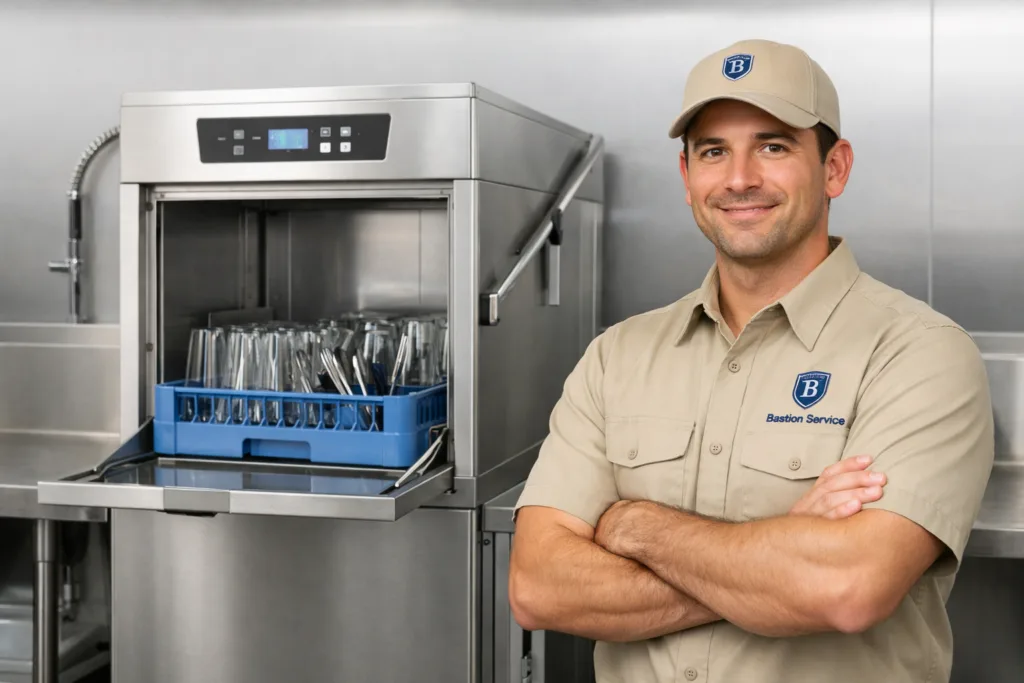




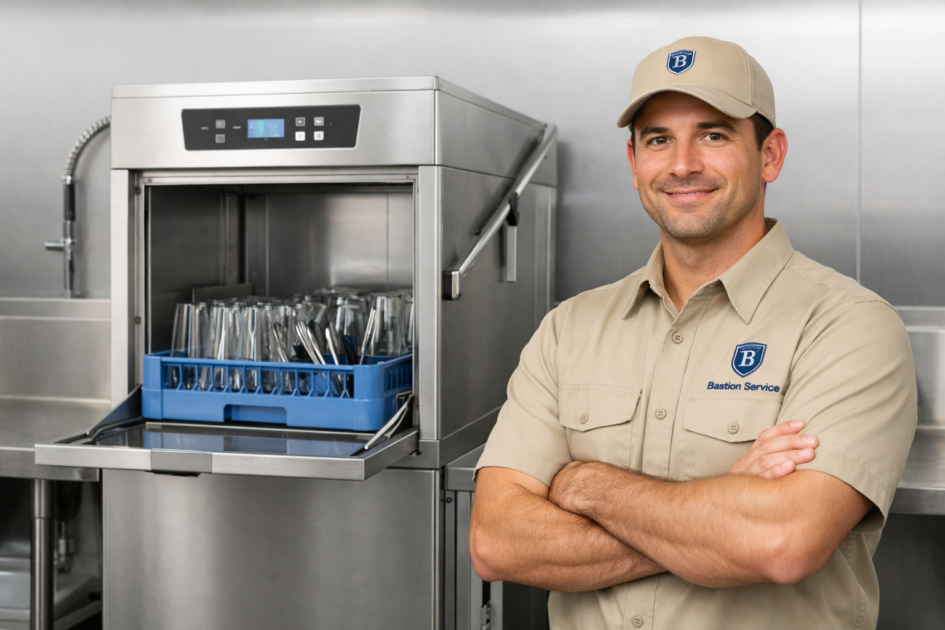
When Hobart warewashing equipment begins leaving dishes unclean, stopping mid-cycle, leaking onto the floor, or struggling to maintain rinse temperature, the effect is immediate: slower kitchen flow, sanitation concerns, and pressure on staff to work around unreliable equipment. For businesses in Hawthorne, repair service is most useful when it identifies the actual failure, explains the operating risk, and helps schedule the next step before a smaller issue turns into a full shutdown.
For specific equipment paths in Hawthorne, review Hobart Dishwasher Repair in Hawthorne and Commercial Appliance Repair in Hawthorne.
Bastion Service provides repair support for Hobart warewashing equipment used in daily business operations, with attention to the symptoms that matter most in food-service environments: wash quality, fill and drain function, leaks, heating performance, and control reliability. Instead of treating every symptom as the same kind of failure, the goal is to narrow down what system is causing the interruption so managers can make an informed repair decision.
What Hobart warewashing equipment problems do you troubleshoot?
Most service calls start with one of a few patterns: dishes are not coming out clean, the unit will not fill or drain correctly, water is leaking during operation, rinse temperature is inconsistent, or the machine is showing fault behavior through alarms, error codes, or sudden shutdowns. These symptoms can appear on undercounter units, door-type machines, conveyor-style warewashing equipment, and other dishwasher configurations used in busy kitchens.
Because one visible issue can have more than one root cause, testing matters. A fill problem can be tied to a valve, sensor, control issue, or supply-related restriction. Poor wash performance can point to spray-arm blockage, pump weakness, scale buildup, chemical feed issues, or a cycle-control problem. That is why symptom-based repair is more useful than guessing from the outside.
Dishwasher symptoms that deserve prompt repair
Poor wash results and repeat rewash loads
If racks are coming out with food debris, film, grease, or cloudy residue, the machine may be running without proper wash pressure, water distribution, temperature support, or cycle timing. In a business setting, this does more than affect appearance. It slows throughput, increases labor, and creates uncertainty about whether dishware can be turned around fast enough for service periods.
When poor results start showing up repeatedly, it is usually a sign that the issue is no longer isolated. Even if the machine still runs, performance loss should be checked before staff begin compensating with repeat cycles or manual rewashing.
Fill problems, low water level, or no fill
A Hobart dishwasher that does not fill properly may start a cycle with too little water, fail to start as expected, or stop before the wash sequence can continue. Operators may notice inconsistent tank levels, delayed cycle starts, or a machine that appears powered on but never reaches full operating condition.
These symptoms can be tied to inlet valves, float systems, sensors, switches, supply restrictions, or electronic controls. If the equipment is not filling correctly, continued use can cause poor cleaning performance and create stress on other components that rely on normal water volume.
Drain issues and standing water
When water remains in the machine after a cycle, drains slowly, or backs up during operation, the problem may involve drain obstructions, pump trouble, valve faults, or control failures that interrupt normal drain commands. Staff often first notice this as standing water in the chamber, repeated failed cycles, or unusual delays between wash stages.
Drain problems should not be treated as minor if they continue beyond a one-time obstruction. Ongoing drainage issues can lead to overflow risk, interrupted sanitation routines, and machine downtime at the worst possible time during service.
Leaks around the machine
Water leaking from the door, underneath the cabinet, or around connected components can come from worn seals, hose deterioration, pump-area leaks, loose fittings, or internal parts that only leak while the unit is operating under pressure. Some leaks appear small at first, but they often signal wear that gets worse under repeated daily use.
In a kitchen environment, leaks also affect safety and cleanup time. If the floor around the machine needs constant attention or the source is unclear, a repair visit helps determine whether the issue is a straightforward seal or connection repair or a sign of broader component wear.
Rinse temperature and sanitation concerns
If the machine runs but final rinse performance seems inconsistent, the issue may involve heating components, thermostats, sensors, relays, limit devices, or control-board faults. Operators may notice that cycles complete without expected heat, sanitation confidence drops, or the dishwasher takes longer to recover between loads.
Temperature-related problems matter because the equipment may look operational while still failing to perform to expected standards. In a high-volume setting, that uncertainty is enough reason to schedule service rather than rely on guesswork or repeated restarts.
Control faults, error codes, and shutdowns
When a Hobart dishwasher displays faults, stops mid-cycle, fails to start, or only works after repeated resets, the underlying cause may be electrical, sensor-related, or connected to a part operating outside normal range. These problems are often intermittent at first, which can make them easy to postpone until the machine stops altogether.
Repeated error conditions usually mean the equipment needs hands-on diagnosis. A temporary reset may restore operation for the moment, but it does not resolve the fault that caused the interruption.
How symptom patterns help guide repair decisions
One of the most important parts of scheduling warewashing equipment service is understanding whether the machine is safe to keep using until repairs are completed. If the unit is leaking, failing to drain, missing temperature targets, shutting down unpredictably, or producing consistently poor wash results, the risk of continued operation usually increases with each shift.
On the other hand, some issues begin as limited performance complaints rather than total failures. In those cases, diagnosis helps separate a manageable repair from a problem that is likely to spread. That distinction helps owners and managers decide whether to adjust workflow temporarily, pull the unit from use, or move ahead with repair immediately.
What a service visit should clarify
A useful repair appointment does more than identify a bad part. It should clarify what system is failing, what operational effect that failure is causing, whether related components need inspection, and whether the machine is a strong repair candidate based on condition and symptom history.
- Why the equipment is not washing, filling, draining, or heating properly
- Whether the current symptom is isolated or part of a larger wear pattern
- How the issue affects daily use, sanitation, and staff workflow
- Whether continued operation is reasonable or likely to increase downtime
- What repair path makes the most sense for the machine’s condition
When repair makes more sense than waiting
Businesses often delay service when the machine still runs part of the time, but partial operation can be misleading. A dishwasher that occasionally completes cycles while leaving dishes dirty, draining poorly, or dropping out on controls is already affecting consistency. Waiting usually means more disrupted shifts, more manual workarounds, and a greater chance of a complete outage during busy hours.
Scheduling repair sooner is typically the better choice when the same symptom appears more than once, when staff have to reset the machine to finish loads, or when the unit can no longer be trusted to deliver repeatable results. For Hawthorne businesses that depend on steady warewashing output, early intervention is often the fastest route back to normal operation.
Repair planning for older or heavily used equipment
Not every problem points to replacement. Many Hobart warewashing issues can be resolved with targeted repairs once the failed system is identified. That said, age, operating hours, prior breakdowns, and overall condition all matter when deciding how far to go with a repair.
If the unit has a long history of repeated shutdowns, visible wear across multiple systems, or repair costs that no longer align with expected remaining service life, a technician’s findings can help clarify whether additional repairs are worthwhile. In many cases, though, restoring one failed component is enough to recover stable performance and avoid unnecessary disruption.
If your Hobart warewashing equipment in Hawthorne is showing wash performance problems, fill or drain issues, leaks, temperature concerns, sanitation complaints, or control faults, repair service is the practical next step. Prompt diagnosis helps reduce avoidable downtime, supports better scheduling decisions, and gives your team a clearer path to restoring reliable dishwasher operation.


