
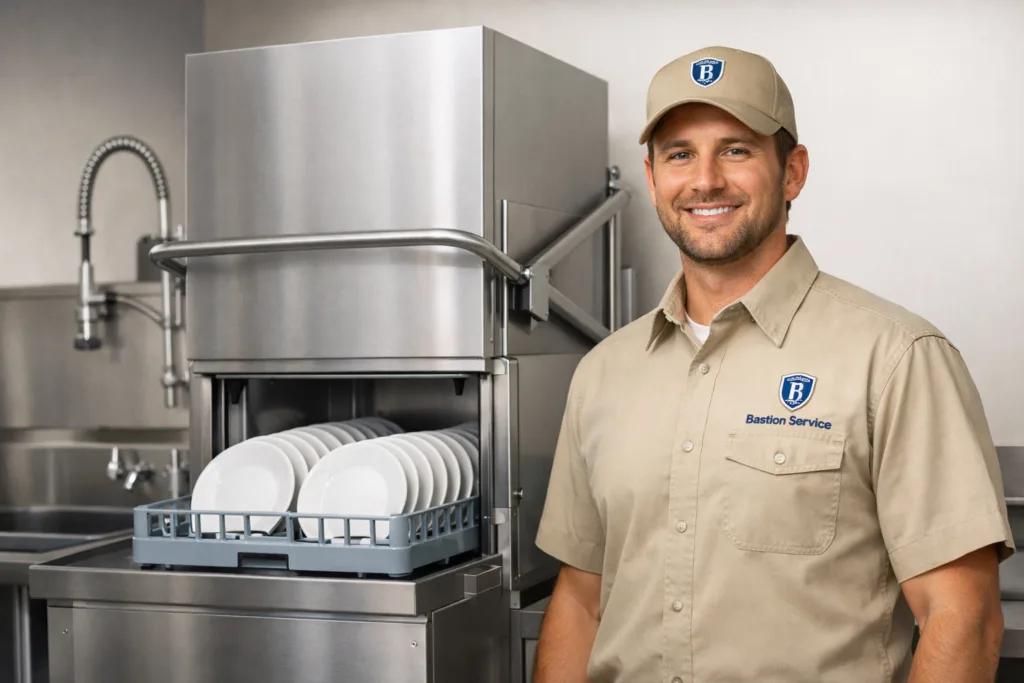




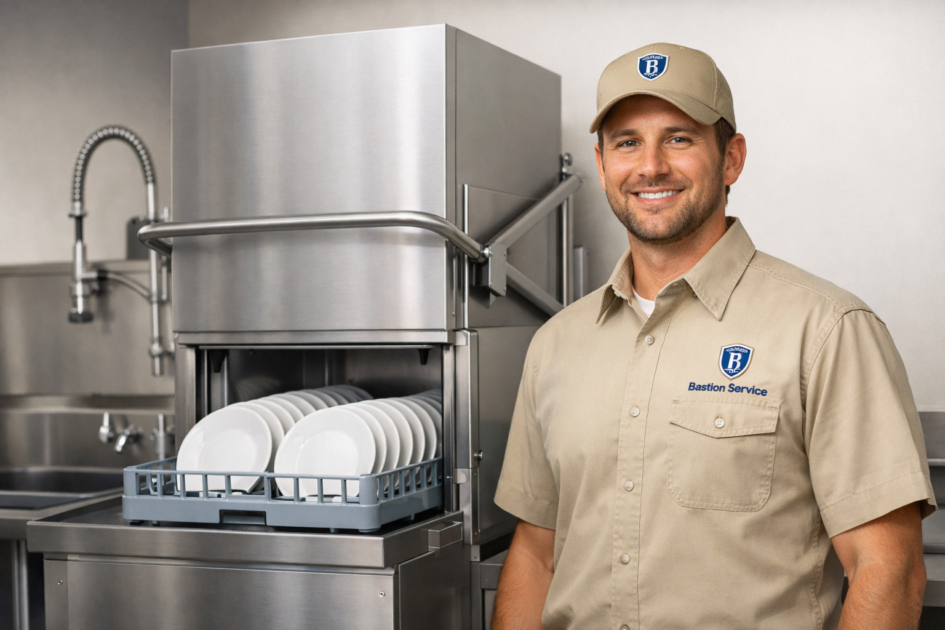
When Hobart warewashing equipment starts interrupting dish flow, slowing turnover, or producing inconsistent results, the priority is to identify the fault quickly and decide how to keep operations moving. For Del Rey businesses, repair service is most useful when it focuses on the symptom pattern, likely failure points, repair urgency, and whether the machine should remain in use, be limited to lighter loads, or be taken offline until service is completed.
For specific equipment paths in Del Rey, review Hobart Dishwasher Repair in Del Rey and Commercial Appliance Repair in Del Rey.
Bastion Service works with local operators who rely on Hobart dishwashing equipment during daily kitchen activity. The goal is not just to get a machine running again, but to address the underlying issue affecting wash performance, fill and drain function, rinse temperature, sanitation confidence, and control reliability so staff can return to a more predictable workflow.
What Hobart warewashing equipment problems usually need repair attention
Warewashing problems often show up as operating issues before they become total shutdowns. A machine may still power on and run a cycle, but if racks come out dirty, water is not draining correctly, temperatures are inconsistent, or cycles stop unexpectedly, the equipment is already affecting labor, timing, and output quality.
Common repair concerns include:
- Dirty dishes, residue, film, or poor rinse results
- Slow filling, overfilling, or no-fill conditions
- Standing water, slow draining, or repeated drain errors
- Leaks around the door, base, hoses, or internal components
- Low rinse temperature or inconsistent heating
- Sanitation complaints tied to incomplete or unreliable cycles
- Machines that stop mid-cycle, lock out, or show control faults
- Unusual noise, vibration, or pump-related performance changes
In many cases, what staff notices first is only the visible part of the problem. A wash complaint may trace back to circulation issues, a fill fault may involve valves or controls, and a temperature issue may point to heaters, sensors, or rinse system problems.
Wash performance problems and why they matter
If a Hobart dishwasher is leaving behind food soil, streaking, cloudiness, or inconsistent cleaning across a rack, the machine may not be delivering proper spray action, water volume, temperature, or cycle performance. That affects more than appearance. It increases rewash volume, ties up staff, slows dish return to the line, and can create uncertainty around usable inventory during busy service periods.
Signs of a wash performance issue
- Items come out visibly dirty after a normal cycle
- Results vary from one rack to the next
- Spray action seems weak or uneven
- Cycle completion does not match actual cleaning outcome
- Staff are compensating with prewashing or repeat runs
These symptoms can be related to wash arms, pump performance, obstructions, water delivery, heating concerns, or control-related timing problems. When poor results continue across multiple loads, repair scheduling usually makes more sense than trying to work around the issue during service.
Fill and drain issues that interrupt kitchen flow
Fill and drain faults are among the most disruptive warewashing problems because they affect cycle completion and can force staff to stop using the machine with little warning. A unit that fills too slowly, fails to fill, drains poorly, or leaves water standing in the tank can quickly create a bottleneck in Del Rey kitchens that depend on steady dish turnover.
Symptoms linked to fill problems
- The machine does not begin a cycle normally
- Water enters too slowly or not at all
- The unit overfills or behaves unpredictably during startup
- Cycle timing seems off because proper water level is not reached
Symptoms linked to drain problems
- Water remains in the machine after the cycle ends
- Drain-down is slow or incomplete
- Water backs up or recirculates when it should be emptying
- The dishwasher stops with a fault before finishing the cycle
These conditions can point to restrictions, pump trouble, valve issues, float or level sensing faults, or control problems. Because standing water and incomplete draining can also affect sanitation and restart reliability, it is best not to let this type of problem linger.
Leaks, moisture, and visible water around the machine
Leaks should be treated as more than a housekeeping issue. Water around warewashing equipment can create slip hazards, affect surrounding surfaces, and increase the chance of damage to nearby components if the source is internal. Even a small leak can worsen quickly once seals, connections, or internal parts continue operating under stress.
Operators often notice:
- Water at the base of the machine after a cycle
- Drips near the door or lower panels
- Moisture that appears only during rinse or drain portions of the cycle
- Recurring puddles that staff have to clean up between loads
Leak diagnosis matters because the source is not always obvious from where the water appears. A door issue, hose problem, pump seal concern, internal fitting fault, or drain-related problem can all present as a floor leak.
Rinse temperature and sanitation concerns
When rinse temperature is not reaching expected levels or heat recovery seems slower than normal, the result is often a mix of performance and compliance concerns. Staff may notice dishes not drying as expected, repeated temperature alerts, interrupted cycles, or general inconsistency in final results. In a busy kitchen, that can undermine confidence in the machine even before it fails completely.
Temperature-related issues may involve:
- Slow heat-up times
- Low final rinse temperature
- Booster or heating component problems
- Sensor or thermostat-related inaccuracies
- Control faults affecting heating sequence or cycle completion
If the equipment is showing sanitation-related symptoms, repair should be prioritized rather than deferred. A machine that cannot maintain proper rinse conditions can affect both output quality and daily operating procedures.
Control faults and cycle interruptions
Not every warewashing issue is mechanical. Some of the most frustrating service calls involve machines that start inconsistently, pause unexpectedly, shut down mid-cycle, or display behavior that does not match normal operating sequence. These problems often create the most uncertainty for staff because the dishwasher may appear to work intermittently while still causing repeated disruption.
Common signs of a control-related problem
- The machine powers on but does not advance correctly
- Cycles stop before completion
- Buttons, indicators, or selections do not respond normally
- The unit resets, locks out, or behaves differently from load to load
- Multiple symptoms appear at once, such as heat, fill, and drain irregularities
When several operating complaints show up together, a broader electrical or control issue may be involved rather than isolated part failure. That is one reason symptom-based service matters: repeated guessing can waste time while the root cause remains unresolved.
When a repair visit is the right next step
Service should be scheduled when the machine is still running but no longer performing reliably, not only after a full shutdown. Early repair attention can help reduce unplanned downtime, protect parts that are being stressed by continued operation, and limit the extra labor that comes from rewashing, manual dish handling, or switching to backup procedures.
It makes sense to book service when:
- Cleaning results have become inconsistent
- Water fill or drain behavior has changed
- Leaks are visible during or after operation
- Rinse temperature or sanitizing performance is in question
- The dishwasher is stopping, faulting, or acting unpredictably
- Staff are changing routines just to keep dish flow moving
For many Los Angeles area business operators working in Del Rey, the practical decision is based on operational impact. If the machine is costing time, creating uncertainty, or forcing workarounds, waiting rarely improves the situation.
Repair decisions versus replacement planning
Not every breakdown points toward replacement, and not every older machine should be repaired without review. The better choice depends on the severity of the current issue, overall equipment condition, history of repeat failures, parts considerations, and how important that unit is to daily throughput.
A service assessment can help clarify:
- Whether the failure appears isolated or part of a larger pattern
- Whether restoring reliable operation is realistic with targeted repair
- Whether multiple symptoms are connected to one underlying fault
- How continued operation may affect future repair cost
For many businesses, the real question is not only today’s repair price. It is whether the machine can return to stable performance that supports kitchen operations without ongoing interruption.
Support for Del Rey businesses using Hobart warewashing equipment
Restaurants and other food-service operations need more than general troubleshooting advice when a dishwasher is slowing production or raising sanitation concerns. The most useful next step is to have the equipment evaluated based on the actual symptoms showing up in service, then schedule the repair path that best protects uptime. If your Hobart warewashing equipment is dealing with wash performance problems, fill and drain issues, leaks, temperature concerns, or control faults, arranging service in Del Rey is the most direct way to limit disruption and restore normal dish flow.


