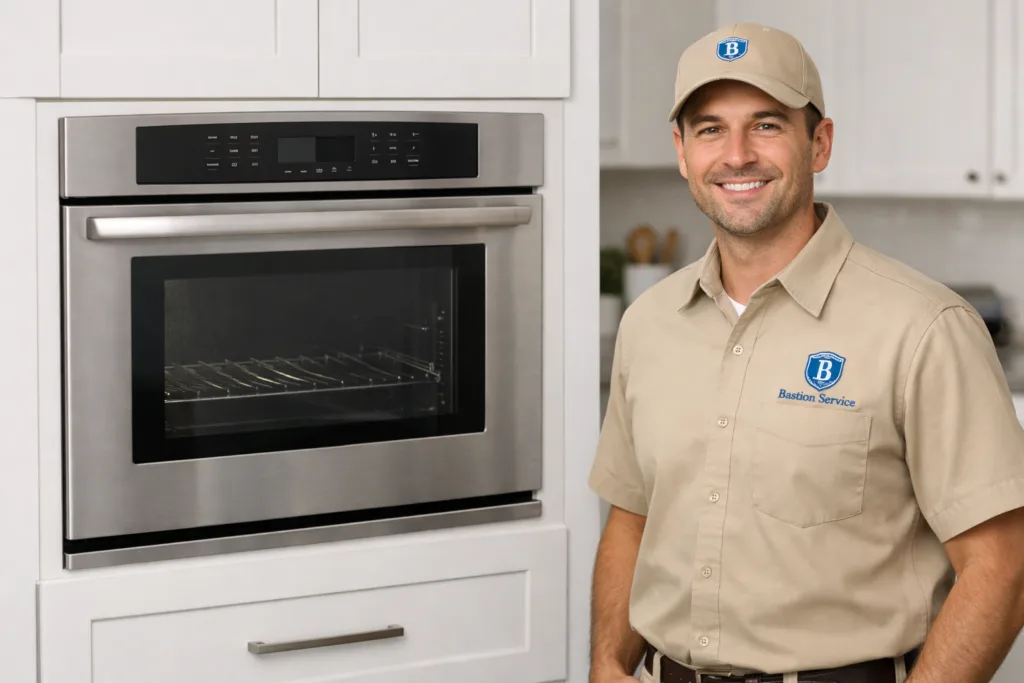
Cooking problems tend to show up in the same few ways: food comes out underdone, one rack bakes faster than another, preheat drags on, or the oven stops behaving normally in the middle of a cycle. With GE models, those symptoms can come from different parts of the heating, sensing, or control system, so the most useful way to approach the problem is by matching the repair to the exact behavior of the oven.
Related GE and oven service paths in Century City include GE Appliance Repair in Century City, Oven Repair in Century City, and GE Refrigerator Repair in Century City.
Start with what the oven is actually doing
A temperature complaint is not always a failed element, and an error code is not always a bad control board. In many Century City homes, the fastest path to the right repair is to narrow the issue down by pattern: whether the oven never heats, heats unevenly, overshoots the set temperature, or works intermittently. That distinction matters because several GE oven faults can look similar from the outside.
Not heating at all
If the oven stays cold, the likely causes depend on whether it is electric or gas. Electric models may have a failed bake element, broil element, wiring issue, thermal protection problem, or control fault. Gas models often point to an igniter problem, though sensor and control issues can also be involved. If the display appears normal but the cavity does not heat, the failure may be deeper in the heating circuit than the panel suggests.
Heating, but not enough
When the oven warms up but never reaches the selected temperature, the issue may involve a weak igniter, an element that is failing under load, a temperature sensor that is reading incorrectly, or calibration drift. Homeowners often notice this first as longer cook times, pale baked goods, or dishes that need repeated extra minutes to finish.
Uneven baking and hot spots
If one side browns faster, cookies burn on the bottom, or the top cooks long before the center is done, the problem may be related to heat distribution. Depending on the GE oven design, that can involve the convection fan, sensor accuracy, door seal condition, rack placement sensitivity, or heating performance that is no longer consistent through the full cycle. Persistent uneven baking is often a sign that the oven is cycling incorrectly rather than simply running a little hot or cold.
Slow preheat
Slow preheat is one of the most common complaints because the oven may still seem usable for a while. A GE oven that takes too long to get ready can have a weak bake element, broil assist issue, declining gas igniter, inaccurate sensor, or a control problem that prevents normal heat-up. If preheat times have changed noticeably from the way the oven used to perform, that change is worth checking rather than working around.
Temperature swings during cooking
Some cycling is normal, but wide swings are not. If meals come out overdone one day and undercooked the next, or if the oven seems hotter than the setting during one part of the cycle and cooler during another, the sensor, control board, relay activity, or heating component may not be responding correctly. This is especially frustrating for baking, where consistency matters more than peak heat.
Common GE oven problems by symptom
Food burns on top but stays raw inside
This often suggests poor overall temperature regulation, not just user error. The broil function may be overactive, the bake circuit may be weak, or the oven may be misreading cavity temperature. On some models, airflow issues can also create this pattern.
Preheat completes, but the oven does not maintain temperature
If the alert tone sounds as if the oven is ready but the cavity never holds steady heat, the sensor or control may be misreporting the actual temperature. A heating element or igniter may also be failing once it has to cycle repeatedly rather than only start from cold.
Error codes, beeping, or random shutdowns
Intermittent shutdowns usually point toward electronic or wiring issues rather than a simple calibration problem. GE ovens that flash codes, freeze at the panel, or turn off mid-cycle may have a control board issue, sensor communication problem, keypad fault, or overheating response. Intermittent faults should not be ignored just because the oven starts working again later.
Door will not close, unlock, or seal properly
A door problem affects more than convenience. Heat escapes, preheat slows down, and temperature stability suffers when the seal is worn or the door is out of alignment. If the latch does not release after self-clean, the issue may involve the latch assembly, switch, fuse, or control system that manages the lock sequence.
After self-clean, new problems can appear
Self-clean cycles expose the oven to extreme heat, and that can reveal weak components. A GE oven that stops heating, shows control problems, or stays locked after self-clean may have a failed thermal fuse, latch issue, sensor problem, or electronic damage that only became obvious under high-temperature stress. If the oven changed behavior immediately after a self-clean cycle, that timing is useful diagnostic information.
Signs it is best to stop using the oven
Some symptoms mean it is safer to pause use until the appliance is checked. That includes:
- Breaker trips when the oven heats
- Visible sparking or a blistered heating element
- Burning smells from the control area
- Major overheating or temperatures far above the setting
- Door that will not close well enough to contain heat
- Repeated shutdowns during normal cooking
For gas models, delayed ignition, repeated clicking without normal heating, or any persistent gas smell should be treated more seriously. If there is a strong gas odor, stop using the appliance and address that safety concern before arranging repair.
Repair or replace?
In many cases, repair is the reasonable choice when the problem is limited to one identifiable failure and the rest of the oven is in good shape. Elements, igniters, sensors, door parts, and many control-related faults can often be repaired without replacing the appliance. Replacement becomes a more realistic option when the oven has several major issues at once, recurring electronic failures, structural damage, or repair costs that no longer make sense for the condition of the unit.
For Century City homeowners, the decision usually comes down to four things: the age of the oven, overall condition, whether parts are still available, and whether the current problem appears isolated or part of a longer pattern. A proper diagnosis helps separate a one-part repair from a larger reliability problem.
What a service visit should help clarify
A worthwhile visit should narrow the fault to the component or system causing the symptom, verify whether the oven is operating safely, and determine whether the issue is likely to stay isolated after repair. That may include checking actual temperature behavior, confirming element or igniter performance, testing sensors, reviewing error history, and inspecting door and control operation.
When the source of the problem is identified early, it becomes much easier to decide whether to move ahead with repair, monitor the appliance for a developing issue, or start planning for replacement. That keeps the process grounded in how the GE oven is really performing in the home, not guesswork.