
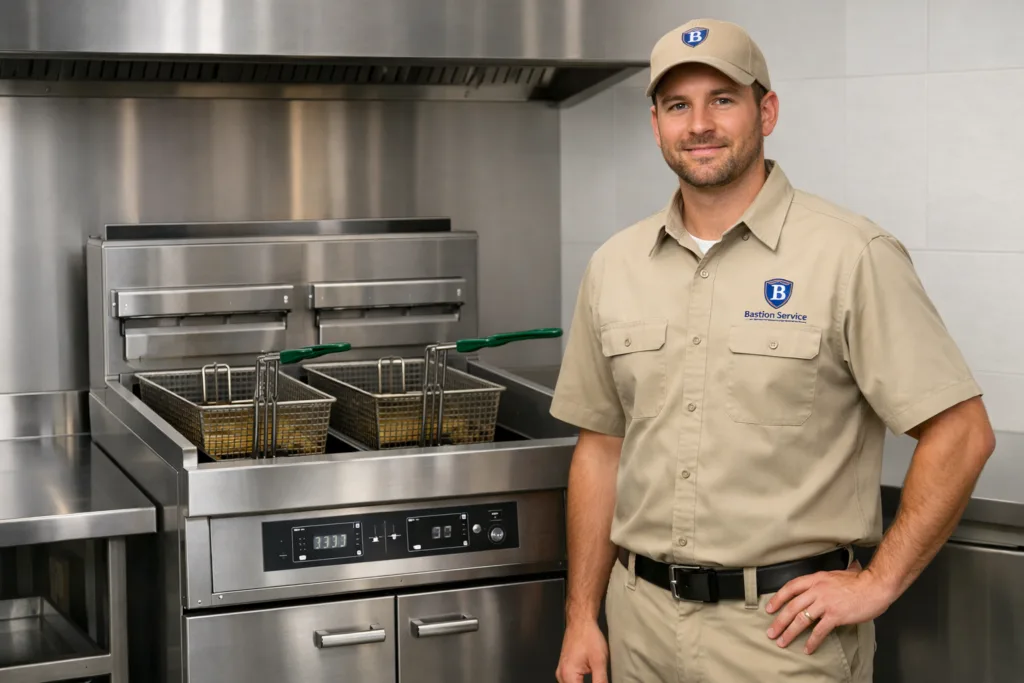






Equipment trouble in a busy kitchen usually shows up first as slower tickets, inconsistent product, or a unit that no longer behaves the same way from one shift to the next. For businesses in Sawtelle using Frymaster cooking equipment, the right response is to schedule service based on the actual symptom pattern, not just the most visible failure. Bastion Service helps operators determine whether a unit can stay in limited use, needs to be taken out of service, or requires immediate repair planning to protect uptime.
For specific equipment paths in Sawtelle, review Frymaster Fryer Repair in Sawtelle and Commercial Appliance Repair in Sawtelle.
What Frymaster cooking equipment problems usually lead to a service call?
Most issues begin with one of a few operational warning signs: heating loss, unreliable ignition, poor temperature control, repeated shutdowns, oil or fluid concerns, or recovery times that no longer support normal production. Even when the equipment still runs, these symptoms can affect food quality, output, labor flow, and safety decisions in the kitchen.
Service is typically warranted when the equipment shows patterns such as:
- Not heating at all or taking too long to reach operating temperature
- Temperature overshooting, drifting, or failing to hold steady
- Ignition clicking without lighting, delayed lighting, or intermittent startup
- Burners that appear weak, uneven, or unstable during operation
- Unexpected shutdowns during production
- Error conditions, control panel irregularities, or unresponsive settings
- Slow recovery between batches that causes output delays
- Leaks, unusual odors, or changes in normal operating sound
These symptoms do not all point to the same failed part. Similar complaints can come from controls, sensors, safety devices, burners, ignition components, gas-related performance issues, electrical faults, or wear that has built up over time. That is why repair planning should begin with fault isolation rather than assumptions.
Heating and temperature problems that affect food quality
Temperature accuracy is one of the first things operators notice when Frymaster equipment starts slipping out of normal performance. Product may come out too dark, too light, undercooked, or inconsistent from batch to batch. In other cases, the unit may appear to heat normally at startup but struggle to hold temperature once production increases.
Common temperature-related symptoms include:
- Oil or cooking zones heating unevenly
- Frequent cycling that disrupts stable cooking
- Overheating that trips protection limits
- Low-temperature operation that slows cook times
- Displayed temperature not matching real cooking results
When these issues are present, the concern is not just convenience. Poor temperature control can shorten oil life, increase waste, create inconsistent results, and reduce confidence during busy service periods. A repair visit helps determine whether the problem is related to sensing, control response, heating performance, or another fault inside the system.
Ignition, burner, and startup faults
Startup failures are especially disruptive because they often stop production before a shift can settle into rhythm. A unit that will not ignite, lights inconsistently, or shuts down shortly after startup may have problems involving ignition sequence, flame sensing, burner performance, safety interruption, or control communication.
Operators often describe these calls with symptoms such as:
- The unit tries to start but never fully lights
- Ignition works some days and fails on others
- The flame appears weak or unstable
- The equipment starts, then drops out during use
- Restarting temporarily helps, but the issue returns
These are not symptoms to ignore. Repeated restart attempts can waste time, interrupt prep and service flow, and make the failure pattern harder to identify later. Scheduling repair once ignition becomes unreliable is usually the better choice for businesses in Sawtelle trying to avoid a larger shutdown during peak demand.
Slow recovery and production bottlenecks
Some equipment problems are easy to spot because the unit stops working entirely. Others are more subtle and show up as slower output. A fryer may still heat, but if recovery between batches becomes sluggish, the kitchen feels the impact quickly. Ticket times increase, staff start compensating around the equipment, and quality can become inconsistent under load.
Slow recovery may be connected to:
- Reduced burner performance
- Temperature sensing problems
- Control issues affecting heat response
- Restriction, buildup, or wear interfering with operation
- Underlying faults that are becoming more pronounced during heavy use
When output loss is the main complaint, repair decisions should focus on actual production impact, not just whether the equipment technically still turns on. If a unit can no longer support normal volume, it is already affecting revenue and service standards.
Control faults, shutdowns, and inconsistent operation
Modern cooking equipment depends on controls to coordinate safe startup, temperature management, and normal cycling. When control-related problems begin, the symptoms can look random at first. A unit may shut down without warning, ignore settings, display erratic behavior, or perform differently from one shift to another.
These complaints often lead to service because they create uncertainty. Staff cannot reliably plan around a unit that might fail mid-use, especially in kitchens where timing and consistency matter. Shutdowns, intermittent operation, and unexplained resets are all reasons to stop treating the problem as minor and move toward diagnosis.
During service, the goal is to identify whether the issue is isolated to the user interface, control logic, sensing, safety response, power delivery, or another connected system. That distinction matters because “it keeps shutting off” can describe several very different repair paths.
Leaks, odors, and signs the unit should be taken out of service
Not every problem starts with heat loss. Sometimes the strongest warning sign is a leak, an unusual smell, visible residue, or a change in how the equipment sounds while running. These symptoms deserve prompt attention because they can indicate a condition that should not be ignored during normal kitchen use.
Service should be prioritized when operators notice:
- Fluid or oil where it should not be collecting
- Burning smells or unusual operating odors
- Popping, surging, or abnormal burner noise
- Frequent safety-limit trips
- Repeated shutdowns after the unit has been running for a period
In these situations, the key question is not just how to restore operation, but whether the equipment should remain in service at all before repair. That is a practical decision that affects staff safety, product quality, and the risk of turning one fault into several.
How symptom details help speed up repair planning
When scheduling service, the most helpful information is usually not the model-specific terminology but the operating pattern. Managers and kitchen teams can help move the visit forward by noting:
- Whether the problem happens at startup or after the unit heats up
- Whether it appears only during busy production periods
- If the issue is constant or intermittent
- Whether the temperature display matches actual cooking results
- If shutdowns happen at a certain stage of use
- Whether the equipment recently became slower, louder, or less stable
These observations help narrow likely causes and make scheduling more efficient. They also help determine urgency, especially when a Sawtelle kitchen is trying to decide whether to continue limited operation or stop using the equipment until service arrives.
Repair versus replacement considerations
Not every malfunction means replacement is the right answer. In many cases, repair makes sense when the issue is confined to a specific control, ignition, heating, or safety-related fault. The better question is whether the current problem appears isolated or whether it is part of a broader pattern of recurring downtime, declining performance, and stacked repair needs.
Replacement planning may become part of the conversation when:
- The same failure category keeps returning
- Multiple operating systems are showing wear at once
- Downtime has become frequent enough to disrupt normal kitchen planning
- Performance no longer supports production even between repairs
That said, the decision should follow diagnosis. Once the condition of the equipment is understood, it becomes much easier to compare immediate repair value against the operational cost of continued interruptions.
Scheduling Frymaster equipment service in Sawtelle
If Frymaster cooking equipment is causing delays, inconsistent results, startup trouble, or repeated shutdowns, the next step is to arrange service before the disruption spreads to the rest of the kitchen. For businesses in Sawtelle, timely repair scheduling helps clarify whether the issue is safe to manage temporarily, what the likely repair path involves, and how to get the equipment back into dependable operation with as little downtime as possible.


