
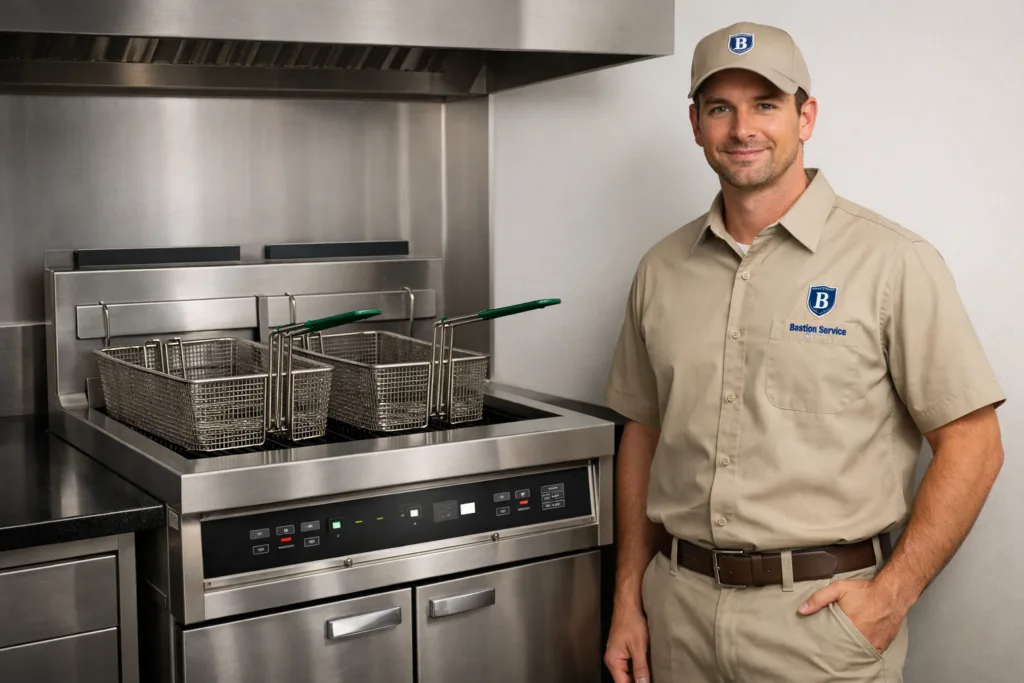




Downtime from Frymaster cooking equipment usually starts as a performance issue before it becomes a full outage. A fryer may still run, but if heat recovery is slowing, ignition is inconsistent, temperatures are drifting, or the control is dropping into faults during a busy shift, the repair decision should be based on what the equipment is actually doing in the field. For businesses in Playa Vista, service is most useful when it identifies the cause of the symptom, helps managers decide whether the unit can stay in operation, and sets realistic expectations for repair timing.
For specific equipment paths in Playa Vista, review Frymaster Fryer Repair in Playa Vista and Commercial Appliance Repair in Playa Vista.
Bastion Service provides Frymaster cooking equipment repair for Playa Vista businesses that need a practical path from symptom to scheduled repair. That includes evaluating heating performance, burner operation, controls, sensors, shutdown behavior, and repeat faults that affect kitchen output. The goal is not just to restart the unit, but to restore stable operation without extending downtime through trial-and-error parts replacement.
Common Frymaster cooking equipment problems that lead to repair
Most service calls begin with one of a few recurring patterns. Even when a unit has not completely failed, these signs usually mean repair should be scheduled before production is affected more severely:
- Equipment not heating or taking too long to reach operating temperature
- Slow recovery between batches
- Ignition failures, delayed startup, or repeated restart attempts
- Burners not staying lit or operating unevenly
- Temperature swings that affect food quality and consistency
- Error codes, control faults, or intermittent lockouts
- Unexpected shutdowns during active use
- Units that work briefly after a reset, then fail again
These symptoms can point to different causes depending on the model and the way the equipment is failing. That is why symptom-based troubleshooting matters before approving a repair or continuing to rely on the unit during service periods.
Heating and temperature issues that affect output
Not heating, underheating, or overshooting temperature
When Frymaster cooking equipment is not reaching set temperature, running too cool, or cycling above target, the effect shows up quickly in kitchen performance. Product times become harder to predict, quality becomes inconsistent, and staff may try to compensate in ways that slow down the line even more. In many cases, the fault may involve temperature sensing, control logic, safety limits, ignition-related heat delivery, or burner performance.
Units with unstable temperatures should not be judged only by whether they eventually heat up. Equipment that reaches temperature slowly or drifts throughout the shift can still create major production problems. Repair service helps determine whether the issue is isolated to a single failed component or part of a broader operating condition that will continue causing disruption.
Slow recovery during peak demand
Slow recovery is one of the most costly symptoms for food-service businesses because it reduces capacity even when the equipment appears to be functioning. A fryer that falls behind during repeated batches can create longer ticket times, uneven product results, and pressure on the rest of the kitchen. Recovery problems may be tied to burner efficiency, heat transfer problems, controls, sensing faults, or wear that has gradually reduced performance.
If recovery has become noticeably worse in Playa Vista kitchens, it is usually time to schedule repair before the issue turns into a no-heat or shutdown call.
Ignition and burner problems
Startup and burner faults are common reasons Frymaster equipment becomes unreliable during service hours. Some units fail to ignite at all. Others may ignite inconsistently, lose flame after startup, or require repeated reset attempts before they will run. These symptoms often interrupt workflow because the equipment can seem normal for part of a shift and then stop without warning.
Burner and ignition issues may involve flame sensing, ignition components, safety circuits, gas-related controls, contamination, or wear that interferes with normal operation. Because these faults can be intermittent, they are often misread as one-time problems when they are actually early signs of a larger failure pattern.
Service is especially important when staff report any of the following:
- The unit starts only after multiple attempts
- The burner cuts out during cooking
- Heat output seems weak even though the unit is on
- The equipment needs frequent resetting to stay operational
Control faults, error codes, and intermittent shutdowns
Modern Frymaster cooking equipment depends on controls, sensors, and protective shutdown logic to regulate heat and operation. When those systems begin failing, the symptoms are often confusing: the unit may display an error, lock out, restart after power cycling, or work normally for a short period before the same problem returns.
Intermittent shutdowns are particularly disruptive because they create false confidence. Staff may assume the issue has passed once the equipment comes back on, only to lose the unit again during a rush. In business kitchens, this leads to product delays, line disruption, and avoidable stress on other stations.
A repair visit for recurring control-related problems typically focuses on confirming whether the issue is tied to the interface, board, sensor feedback, wiring, safety components, or another condition that is causing the control to shut the equipment down. That distinction matters when deciding whether a repair is likely to stabilize the unit or whether the pattern points to a more serious reliability problem.
When to stop using the equipment until service is completed
Not every symptom requires immediate shutdown, but some do. Continued operation can worsen damage or increase operating risk when the equipment is overheating, dropping out unpredictably, failing to maintain dependable cooking temperatures, or showing repeated burner and ignition faults.
It is usually best to limit or stop use when:
- Temperature control is no longer dependable
- The unit shuts down in the middle of production
- Repeated resets are needed just to keep it running
- Ignition behavior is inconsistent from cycle to cycle
- Recovery has declined enough to slow service flow
- The same error returns soon after clearing it
For managers, this is where repair scheduling becomes an operations decision as much as a technical one. The right next step depends on whether the equipment can be used in a limited way, whether it should be taken offline entirely, and how urgently the fault is affecting service capacity.
Repair decisions for older Frymaster units
Older Frymaster cooking equipment is not automatically a replacement case, but repeated heating, control, and burner problems should be evaluated in terms of uptime, not just the immediate repair cost. A single failed part on an otherwise stable unit may be worth fixing. A pattern of recurring shutdowns, unstable temperatures, and repeat service history may point to a unit that is becoming harder to rely on during daily operations.
For businesses in Playa Vista, the best decision usually comes down to a few practical questions:
- Is the current fault isolated or part of a repeat pattern?
- Will the repair restore dependable performance or only short-term operation?
- How much disruption is the equipment causing during peak periods?
- Is the unit still supporting production at the level the kitchen needs?
Answering those questions after diagnosis helps owners and managers make a repair decision based on actual operating value instead of guesswork.
Scheduling Frymaster repair in Playa Vista
When Frymaster cooking equipment starts missing temperature targets, struggling with recovery, failing to ignite, or shutting down during use, the most effective next step is to schedule service around the symptoms that are affecting production now. For Playa Vista businesses, repair should lead to a usable plan: identify the fault, determine whether the equipment can stay in service, outline the repair scope, and move toward restoring stable kitchen performance with as little disruption as possible.


