




EdgeStar refrigerators, freezers, ice makers, and wine coolers often fail in ways that look simple at first but are not. A warmer cabinet, a puddle on the floor, or a unit that runs all day may point to airflow trouble, a control issue, a bad seal, a fan problem, or a deeper cooling-system fault. Sorting out which system is actually failing is what keeps a repair decision grounded in the real condition of the appliance.
For specific EdgeStar appliance paths in Mar Vista, review EdgeStar Refrigerator Repair in Mar Vista, EdgeStar Freezer Repair in Mar Vista, and EdgeStar Ice Maker Repair in Mar Vista.
Start with the symptom pattern
One of the most useful ways to evaluate an EdgeStar appliance problem is to look at what changed first. Did temperatures drift slowly over several days, or did cooling drop suddenly? Is the unit noisy only during certain parts of the cycle? Does frost appear in one area or across the whole compartment? These details help separate a maintenance-related issue from a part failure.
In Mar Vista homes, compact refrigeration products are often used daily and packed tightly, which makes airflow and door sealing especially important. When vents are blocked, door gaskets do not close evenly, or shelves are overloaded, the appliance may struggle to stabilize temperature even though the cooling system is still running. That does not mean every warm cabinet is a simple usage issue, but it does mean the pattern matters.
How common problems show up by appliance type
Refrigerators
EdgeStar refrigerator problems commonly appear as soft food, warm sections, moisture inside the compartment, water under the unit, or a compressor that seems to run too often. In many cases, the likely causes include restricted airflow, evaporator frost, fan motor problems, drain blockage, thermostat or sensor errors, or start-component trouble. If the inside temperature is rising, repeated control adjustments usually do not solve the actual failure.
A refrigerator that cools unevenly can be particularly misleading. The top shelf may feel cold while drawers warm up, or the freezer section may seem normal while the fresh-food section struggles. That kind of split performance often points to circulation or defrost-related trouble rather than a total shutdown.
Freezers
Freezers tend to show trouble through softening food, heavy frost, ice around the door edge, or nonstop operation. A worn gasket can let humid air in and create frost quickly. Defrost failures can bury internal components in ice and reduce airflow. Temperature controls and sensors can also cause a freezer to overrun or fail to recover after the door opens.
If frozen items are no longer staying solid, it is best to stop trusting the appliance for food storage. A freezer that seems to recover later may still be cycling outside a safe range, and that repeated strain can make the underlying problem worse.
Ice makers
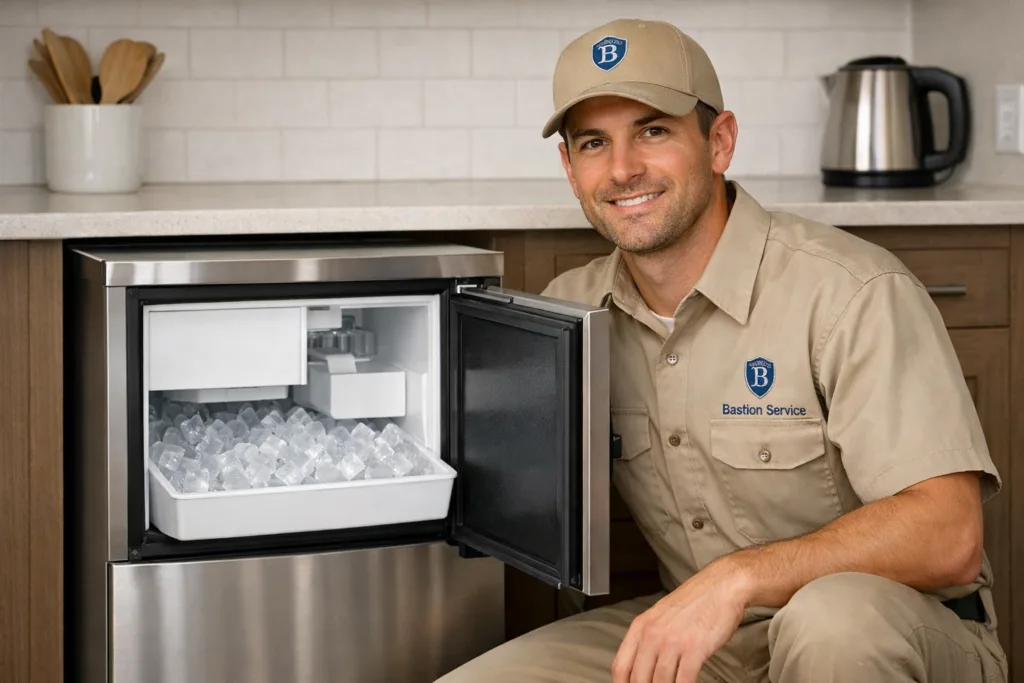
EdgeStar ice maker issues often begin with low production, no ice, leaking, cloudy cubes, or batches that stop midway through the cycle. Some of these symptoms come from water supply restrictions or valve problems, while others relate to scale buildup, drainage issues, sensor faults, or poor cooling performance within the unit itself.
When an ice maker turns on but does not complete the harvest cycle, resets and repeated cleaning may only delay real service. If water is escaping onto the floor or pooling inside the machine, it is safer to stop use until the source is identified.
Wine coolers
Wine coolers usually reveal problems more gradually. The display may show one temperature while the cabinet feels warmer, bottles may no longer stay at a stable serving range, or condensation may collect around the door. Fan noise, poor recovery after opening, and erratic cycling can point to control issues, airflow restrictions, seal problems, or cooling-system weakness.
Because wine storage depends on steady conditions, small temperature swings matter more than many homeowners expect. A cooler that is only a few degrees off at first can drift further over time if the underlying fault is not corrected.
What certain symptoms often mean
- Constant running: often associated with dirty coils, warm air entering through the gasket, restricted airflow, sensor trouble, or reduced cooling efficiency.
- Clicking or humming followed by silence: can indicate relay, overload, start-device, or compressor-related failure.
- Water under the appliance: commonly tied to a blocked drain, condensation overflow, or a water-supply issue on ice-making models.
- Frost buildup: may signal door seal leaks, frequent warm-air intrusion, or a defrost system problem.
- Interior lights on but little or no cooling: usually points to a cooling, fan, or control issue rather than a simple loss of power.
- New buzzing, rattling, or scraping sounds: often helpful in narrowing the problem to fan blades, mounting vibration, airflow obstruction, or compressor strain.
These symptom groups are useful for narrowing direction, but they are not the same as testing. Different failures can produce nearly identical results, especially in small refrigeration appliances.
When waiting usually makes the problem worse
Some appliance issues can be watched briefly, but others should be addressed quickly. If an EdgeStar refrigerator or freezer is no longer holding safe temperatures, food loss becomes the immediate concern. If an ice maker or compact refrigerator is leaking, there is also a risk of floor damage or moisture spreading into surrounding cabinetry. If the unit begins tripping a breaker or making harsh mechanical sounds, continued operation may add electrical or compressor strain.
Recurring trouble is another sign not to keep guessing. When the same symptom returns after cleaning, unplugging, resetting, or defrosting, the root cause has probably not been resolved. Temporary improvement does not necessarily mean the appliance is healthy.
Repair or replace?
Not every EdgeStar appliance problem leads to the same answer. Repair is often reasonable when the fault is isolated to a gasket, fan, thermostat, sensor, drain issue, valve, or control-related component and the rest of the unit is in good shape. These problems can often be addressed without assuming the entire appliance is near the end of its life.
Replacement becomes more likely when the cooling system is failing, reliability has been poor across multiple repairs, or the total cost and risk no longer make sense for the appliance’s condition. For many Mar Vista homeowners, the right question is not simply whether a repair is possible, but whether it is likely to restore stable everyday use.
What a useful service visit should tell you
A worthwhile visit should do more than name a part. It should explain which system is failing, how that failure matches the symptoms you noticed, and whether repair is sensible based on condition, expected performance, and likely follow-through. That is especially important with EdgeStar products because similar symptoms can come from very different causes.
If your appliance is warming up, icing over, leaking, or cycling in a way that no longer seems normal, the most helpful next step is an evaluation that turns those symptoms into a realistic repair plan instead of a guess.


