
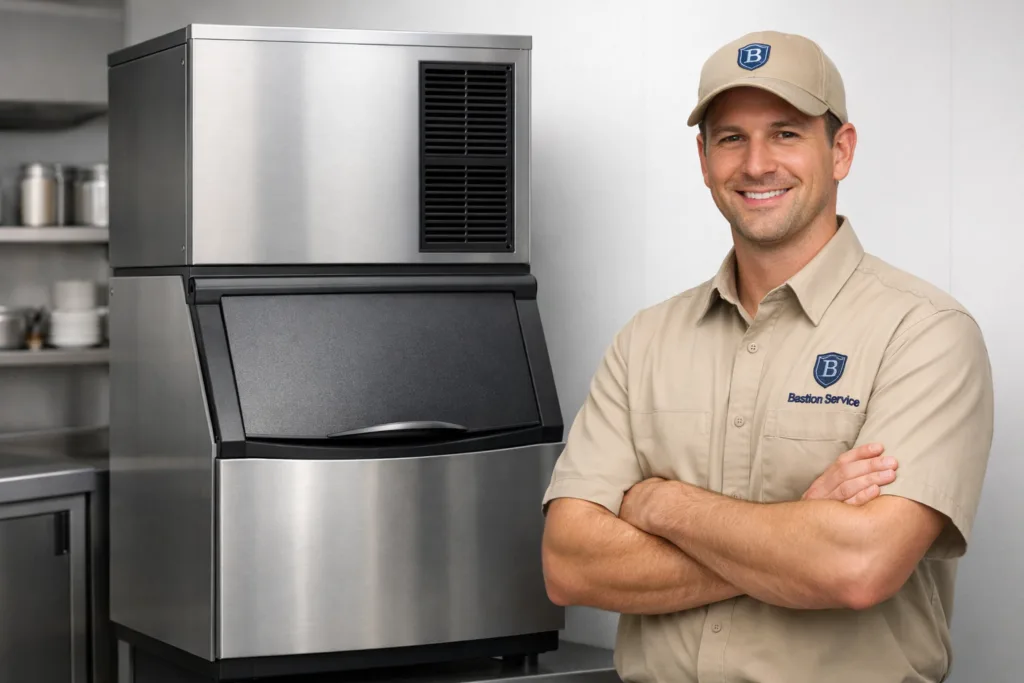




Commercial ice machines often fail gradually before they stop completely. A drop in daily output, longer freeze times, wetter cubes, or water around the unit can all point to a developing problem that affects service speed, sanitation, and labor efficiency. In restaurants, offices, healthcare spaces, and other business environments in Rancho Palos Verdes, early attention usually helps prevent a smaller issue from turning into a larger equipment interruption.
Related commercial equipment paths in Rancho Palos Verdes include Hoshizaki Ice Machine Repair in Rancho Palos Verdes.
Common commercial ice machine symptoms and what they can indicate
Low ice production or slow recovery
If the machine is producing less ice than usual or struggling to refill the bin during normal demand, the cause may involve restricted condenser airflow, scale buildup, a weak water fill, sensor trouble, or declining refrigeration performance. Slow recovery is especially important in commercial settings because the machine may still appear to be running while no longer keeping up with actual business use.
Cloudy, soft, small, or misshapen ice
Changes in cube quality usually indicate more than a cosmetic issue. Poorly formed ice can be tied to mineral accumulation, uneven water distribution, temperature inconsistency, or cycle-control problems that prevent proper freezing and harvest. When the ice itself changes shape or clarity, it often means efficiency has already started to decline somewhere in the system.
Leaks, overflow, or water around the machine
Water on the floor or inside the cabinet may come from blocked drains, loose fittings, damaged water lines, overflow during fill, or melting ice caused by incomplete cycles. A leak should not be treated as a minor nuisance in a commercial space, since it can lead to slip hazards, bin contamination concerns, and additional wear on nearby components.
Clumped ice or ice melting in the bin
Stored ice that fuses together or melts back down can point to harvest problems, poor bin temperature conditions, control faults, or inconsistent freezing. In some cases, the machine is making ice but not preserving it correctly, which creates waste and makes production seem lower than it actually is.
Unusual noise, shutdowns, or erratic cycling
Buzzing, grinding, repeated starts, or sudden shutdowns can be connected to fan motors, pumps, electrical faults, control boards, or compressor strain. When cycling becomes irregular, the machine may still operate intermittently, but continued use can increase stress on parts that are already failing.
Why the underlying cause matters
Commercial ice machines rely on several systems working together: water supply, drainage, airflow, controls, harvest timing, and refrigeration. Because different failures can create similar symptoms, the visible complaint is not always the true source of the problem. Low production, for example, might come from scale on internal components, a restricted inlet valve, a dirty condenser, or a sealed-system issue rather than a single obvious part failure.
A useful service approach starts by checking how the machine fills, freezes, harvests, drains, and stores ice. That process helps separate maintenance-related conditions from worn components or larger cooling-system problems. It also helps businesses avoid replacing parts based on guesswork when the actual issue is elsewhere.
When the problem may involve nearby refrigeration equipment
Some ice machine complaints overlap with broader cold-storage symptoms. If cooling problems are centered in the freezer compartment, Commercial Freezer Repair in Rancho Palos Verdes may be more relevant, especially when frost, poor temperature recovery, or airflow restriction appears on related equipment in the same workspace.
Likewise, when staff are noticing warmer holding temperatures, inconsistent cooling, or compressor-related performance changes beyond the ice machine itself, Commercial Refrigerator Repair in Rancho Palos Verdes may be the better path for the primary equipment issue. Looking at those patterns early can help determine whether the problem is isolated to the ice machine or part of a larger refrigeration strain.
When to schedule service
Service is usually worth scheduling once the machine shows a repeated pattern rather than a one-time slowdown. That includes reduced output, repeated leak events, poor ice quality, long freeze cycles, unexpected shutdowns, or bin ice that starts melting or clumping. In a commercial setting, waiting too long often means paying for water and electricity while getting less usable ice in return.
Immediate attention is more important when the machine is leaking, tripping power, making sharp mechanical noise, or failing during normal business demand. If employees are already changing routines, buying bagged ice, or limiting beverage service because of the machine, the issue has moved beyond inconvenience and into operational impact.
When continued use can make damage worse
Some machines can continue operating for a short period with only reduced production, but others should be taken out of use quickly. Running with a blocked drain, unstable cycling, heavy condenser restriction, or an active water leak can put more stress on pumps, motors, and cooling components. A machine that is freezing unevenly or failing to complete harvest can also create sanitation concerns if old ice remains in the bin while new ice production is inconsistent.
For businesses in Rancho Palos Verdes, the practical decision is often based on whether the machine is merely underperforming or clearly operating outside normal conditions. Once there is active leaking, repeated shutdown, or obvious ice-quality decline, continued use tends to carry more risk than benefit.
Repair versus replacement considerations
Repair is often the sensible choice when the issue is tied to cleaning-related blockage, water valves, sensors, pumps, fan motors, controls, or isolated electrical faults. Replacement becomes more worth discussing when the machine has recurring failures, severe corrosion, chronic scale damage, multiple worn components, or larger refrigeration wear that limits dependable output.
The best decision usually comes down to uptime, repair scope, and whether the machine can return to reliable production for the demands of the business. A careful diagnosis helps clarify whether the problem is localized and repairable or whether the unit is reaching the point where ongoing service is no longer the most efficient long-term option.


