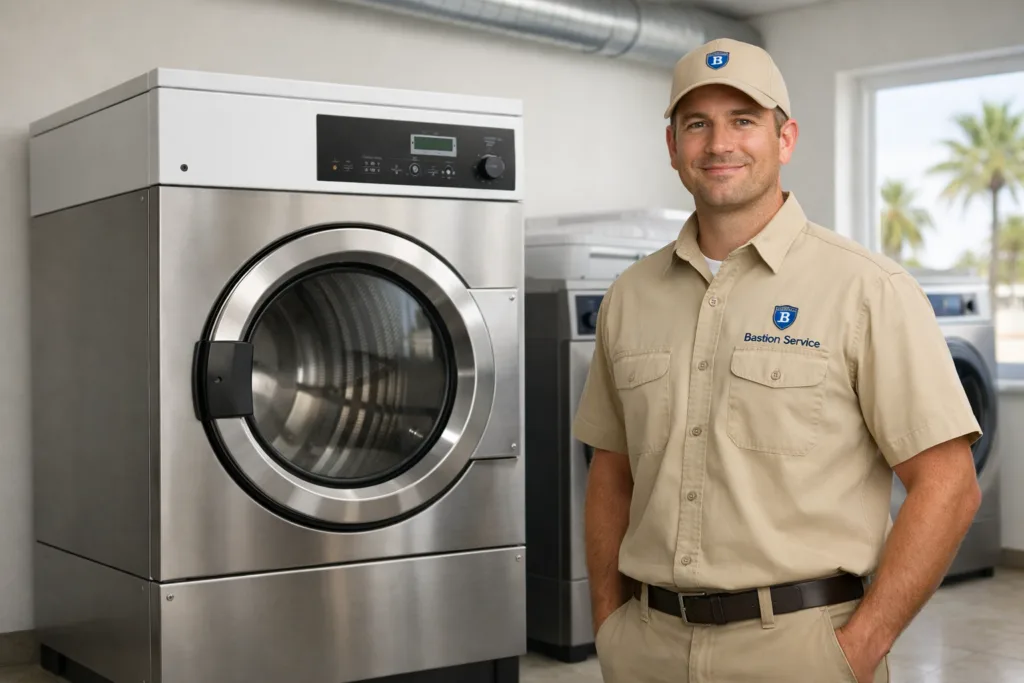




Commercial dryers often fail in ways that look similar at first but create very different risks for a business. A unit that tumbles without drying, overheats during a shift, or stops before the cycle finishes can slow linen turnover, delay uniforms, and force staff to rerun loads that should have been done the first time. The right next step is to identify whether the problem is tied to heat production, airflow, moisture sensing, drive components, or electrical controls.
Related commercial equipment paths in Hermosa Beach include Speed Queen Dryer Repair in Hermosa Beach and Wascomat Dryer Repair in Hermosa Beach.
Common commercial dryer issues that disrupt daily operations
One of the most frequent complaints is no heat or weak heat. In a commercial setting, that usually shows up as damp loads, repeated cycles, and equipment that appears to be running normally while output drops. The cause may involve heating elements, igniters, thermostats, thermal protection components, sensors, or restricted exhaust flow that prevents the dryer from moving moisture out efficiently.
Long dry times are another common problem, and they are not always caused by a failed heater. Poor airflow, lint buildup, vent restrictions, sensor faults, and control problems can all extend cycle times. Over time, that means reduced throughput, higher utility use, and avoidable wear from running more cycles than necessary just to reach the same result.
Mechanical symptoms matter just as much as heating complaints. Squealing, scraping, thumping, rumbling, or vibration can point to worn rollers, supports, glides, bearings, belts, or motor-related issues. When the drum is not turning smoothly, the machine can continue operating long enough to create secondary damage, especially under heavy commercial use.
Start failures, shutdowns, tripped breakers, and intermittent controls usually require direct electrical testing rather than guesswork. A machine that works for one load and fails on the next may have a failing switch, motor overload issue, control fault, or power-supply problem. In many businesses, these intermittent faults are especially disruptive because they make staffing and laundry timing harder to predict.
What specific symptoms can suggest
No heat but the drum still turns
If the drum rotates but items stay wet, the problem may involve the heating circuit, ignition system, thermostat, sensor, or safety cutoff. Restricted venting can create similar drying results even when some heat is present, so diagnosis should look at both internal components and the airflow path. In commercial environments, weak heat is often noticed first as a production issue rather than a complete equipment stop.
Dryer runs too long
Extended cycles often indicate reduced airflow, low heat output, moisture-sensing problems, or a control issue that is preventing the cycle from ending correctly. Businesses may see this as a steady loss of capacity over time, with more loads stacking up during peak demand. Because longer cycles also increase strain on moving parts, early service can help prevent a smaller problem from becoming a broader repair.
Noise, vibration, or a burning smell
Unusual noise is usually a sign that moving parts are wearing unevenly or no longer tracking correctly. A burning odor raises the urgency because it can indicate friction, overheating, belt distress, or lint-related heat buildup. If the sound or smell changes suddenly, continuing to run the dryer can increase the chance of drum, motor, or support-system damage.
Stops mid-cycle or will not start consistently
Intermittent operation may come from a door switch issue, motor overload behavior, control failure, wiring problem, or unstable power condition. These faults can be difficult to identify without testing because the dryer may appear normal when idle. Tracking when shutdowns occur, such as during heat-up, mid-cycle, or at high load volume, can make diagnosis more precise.
Laundry workflow problems are not always caused by the dryer alone
When a business is dealing with backed-up laundry, it helps to look at the full process rather than only the finishing equipment. If loads are arriving overly wet because of spin, drain, or extraction problems, Commercial Washer Repair in Hermosa Beach may be the better place to start before treating the dryer as the main failure point. That distinction matters because a dryer can seem underpowered when it is actually being asked to remove more moisture than usual from every load.
When to schedule service
Service should be scheduled promptly when drying times are increasing, loads come out damp, the unit overheats, the drum movement changes, or staff has to restart cycles to finish routine work. A commercial dryer does not have to be completely down to justify repair. Performance loss alone can be enough to affect operating schedules, labor use, and customer-facing reliability.
It is also wise to stop using the machine and arrange service if there is metal-on-metal noise, a strong burning smell, repeated breaker trips, or a drum that struggles to turn. Those symptoms often suggest that continued use could damage additional components and make downtime longer once repairs begin.
Repair versus replacement considerations
Repair is often the practical path when the problem is isolated and the rest of the dryer remains in good working condition. Replacement becomes more likely when the equipment has recurring failures, multiple worn systems, chronic performance decline, or a repair history that no longer supports stable daily use. The decision usually depends on age, overall condition, parts involved, and how much downtime the business can absorb.
For businesses in Hermosa Beach, the most useful service visit is one that identifies the failed system, explains whether continued operation risks added damage, and clarifies whether the machine is a good candidate for repair. That information helps owners and managers make decisions based on uptime, workflow, and actual equipment condition rather than trial and error.