
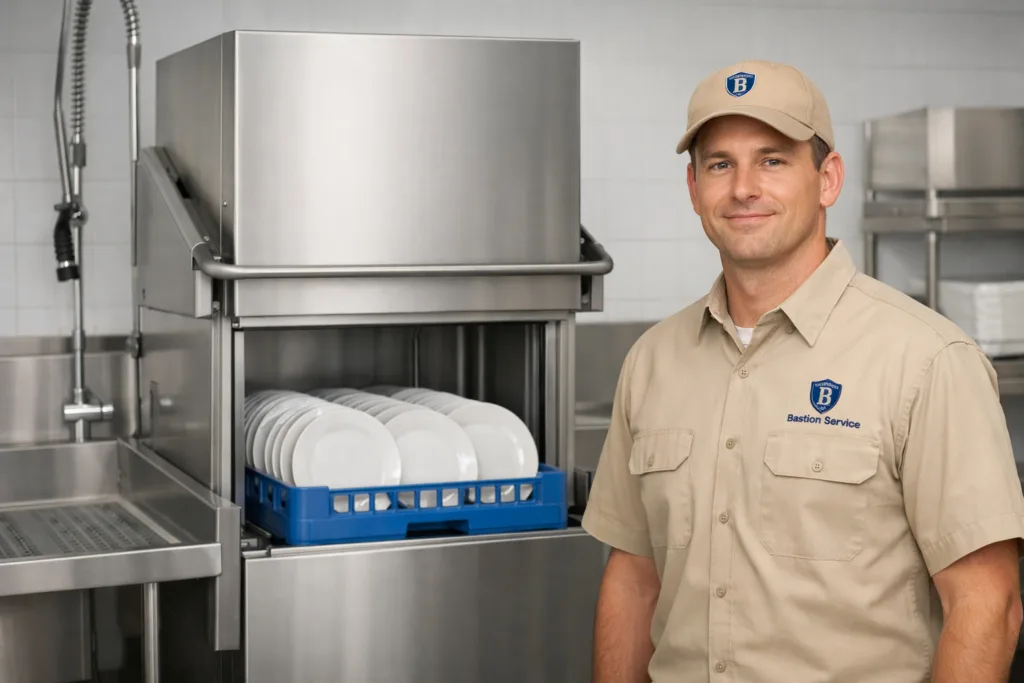





In a busy foodservice or hospitality setting, dishwasher trouble can create immediate pressure on sanitation routines, staff workflow, and service speed. Whether the issue shows up as poor wash results, standing water, low rinse temperature, or a machine that stops before the cycle finishes, the most useful next step is understanding what the symptom suggests and how urgent the repair may be.
Related commercial equipment paths in Rancho Park include Commercial Refrigerator Repair in Rancho Park, Commercial Freezer Repair in Rancho Park, and Hobart Dishwasher Repair in Rancho Park.
Commercial Dishwasher Problems That Commonly Disrupt Operations
Commercial dishwasher issues rarely stay isolated for long. A small fill problem can become a heating complaint, and a drain restriction can quickly lead to poor cleaning performance. Looking at the exact symptom pattern helps narrow down whether the problem is tied to water flow, circulation, heat, controls, or a mechanical failure inside the unit.
Poor wash results, film, or residue
If plates, utensils, pans, or glassware come out with soil, spotting, or a dull finish, the problem may involve weak spray pressure, clogged wash arms, low water temperature, detergent feed issues, or dirty water remaining in the system. In commercial use, this often leads to rewashing, slower turnaround, and inconsistent results during peak demand.
When poor cleaning starts gradually, it can be easy to overlook at first. But declining wash performance often points to a system that is no longer moving, heating, or draining water the way it should.
Drain problems and standing water
Water left in the tank or bottom of the machine after a cycle usually signals a blocked drain path, a pump problem, hose restriction, or a control issue that is not triggering proper draining. If wastewater is not clearing fully, the dishwasher may continue operating with reduced performance and increased strain on internal components.
Drain complaints are also important from a sanitation and workflow standpoint. A machine that does not empty correctly can slow the dish area and create uncertainty about whether items are being cleaned under normal conditions.
Leaks, overfilling, or water around the unit
Leaks can come from worn door gaskets, cracked hoses, loose clamps, drain components, inlet valves, or internal overflow conditions. In some cases, what looks like a door leak is actually the result of overfilling or spray pressure being redirected where it should not be.
Even a modest leak deserves attention in a commercial environment. Water on the floor can affect safety, damage nearby materials, and signal a larger issue developing inside the machine.
Low rinse temperature or no heat
When a commercial dishwasher is not reaching the expected rinse or wash temperature, cleaning consistency can suffer and cycle performance may become unreliable. Causes can include heating element failure, thermostat or sensor problems, relays, wiring issues, booster heater trouble, or control-board faults.
Temperature-related problems are especially disruptive because they affect both cleaning quality and confidence in the machine’s overall operation. If the unit appears to run but does not heat correctly, the fault may be deeper than a single failed heating component.
Fill issues or weak water entry
A dishwasher that fills too slowly, does not fill enough, or does not fill at all may have trouble with the water inlet valve, float system, sensors, supply restrictions, or electronic controls. Fill problems can show up as short cycles, weak washing action, or units that appear to start but never move into normal operation.
In some machines, inconsistent filling can also produce intermittent symptoms, which makes the issue harder to judge without testing the sequence and related parts together.
Pump issues, unusual noise, or interrupted cycles
Grinding, humming, buzzing, rattling, or repeated mid-cycle stopping can point to pump wear, obstructions, motor problems, failing bearings, control issues, or electrical faults. A machine that needs repeated resets or stalls at the same point in the cycle usually has a problem beyond routine wear-and-tear cleaning.
New sounds matter because they often indicate rising strain somewhere in the wash or drain system. Catching that early can help prevent a smaller fault from becoming a broader breakdown.
Why Symptom-Based Diagnosis Matters
The visible complaint is not always the failed part. A dishwasher that does not heat may have a bad heater, but it may also be responding to a sensor fault, wiring issue, safety limit, or control failure. A leak near the front of the unit may come from the door area, or it may be caused by overfilling deeper inside the machine.
That is why symptom-based diagnosis is so important for commercial equipment in Rancho Park. It helps separate a straightforward repair from a larger condition involving multiple worn systems, and it reduces the risk of replacing parts that do not solve the actual problem.
Signs the Problem Should Not Be Ignored
Some dishwasher problems allow the machine to keep running for a while, but that does not mean continued use is wise. Service should be scheduled promptly when you notice any of the following:
- Standing water after the cycle ends
- Repeated leaks or visible overfilling
- Low rinse temperature or no heat
- Cycles that stop, stall, or require resets
- Unusual grinding, buzzing, or vibration
- Cloudy or dirty ware despite normal loading and detergent use
- Slow filling or failure to start washing properly
These symptoms often worsen with continued operation. What begins as a restricted drain, weak pump, or faulty control signal can develop into larger component damage and more disruptive downtime.
How Continued Use Can Increase Repair Scope
Running a commercial dishwasher while it is leaking can affect floors, surrounding cabinetry, and nearby equipment. Operating with a drain problem can leave dirty water in circulation and put added load on the pump. If a motor or pump is already struggling, repeated use may push it past the point of a smaller repair.
Electrical symptoms deserve the same caution. If the unit trips protection, loses power during operation, or behaves unpredictably, it is better to have the cause evaluated than to rely on resets and temporary workarounds.
Repair Versus Replacement Considerations
Not every commercial dishwasher issue points toward replacement. Many problems are still worth repairing when the machine is otherwise in solid condition and the fault is limited to a known component or subsystem. On the other hand, replacement becomes a more serious discussion when the unit has recurring failures, corrosion, multiple weak systems, or parts challenges that make long-term reliability uncertain.
For businesses in Rancho Park, the decision usually comes down to a few practical questions:
- Is the current issue isolated or part of repeated breakdowns?
- Are major systems still in good overall condition?
- Will repair restore dependable day-to-day operation?
- Does the machine still match current throughput needs?
- Does the expected repair cost make sense for the unit’s remaining service life?
A useful service recommendation should address both the immediate fault and the broader condition of the dishwasher so the next step supports uptime rather than just postponing another interruption.
What Businesses Should Expect From a Service Visit
A productive commercial dishwasher repair visit should clarify more than whether the unit can be made to run again. It should identify the active fault, note whether there are related wear issues, explain whether continued use is advisable, and outline the likely repair scope in plain terms.
For managers and operators, that kind of information supports better decisions around staffing, sanitation routines, and scheduling. When the dishwasher is central to daily operations, understanding the cause of the failure is just as important as addressing the symptom that first got attention.
Commercial Dishwasher Repair Focused on Operational Uptime
Bastion Service helps businesses in Rancho Park with commercial dishwasher repair focused on clear diagnosis, practical service guidance, and dependable local support for dish-area uptime. Whether the issue involves wash quality, draining, filling, heating, leaks, pump performance, or cycle failure, the goal is to identify the condition accurately and help you make the right repair decision for your operation.


