
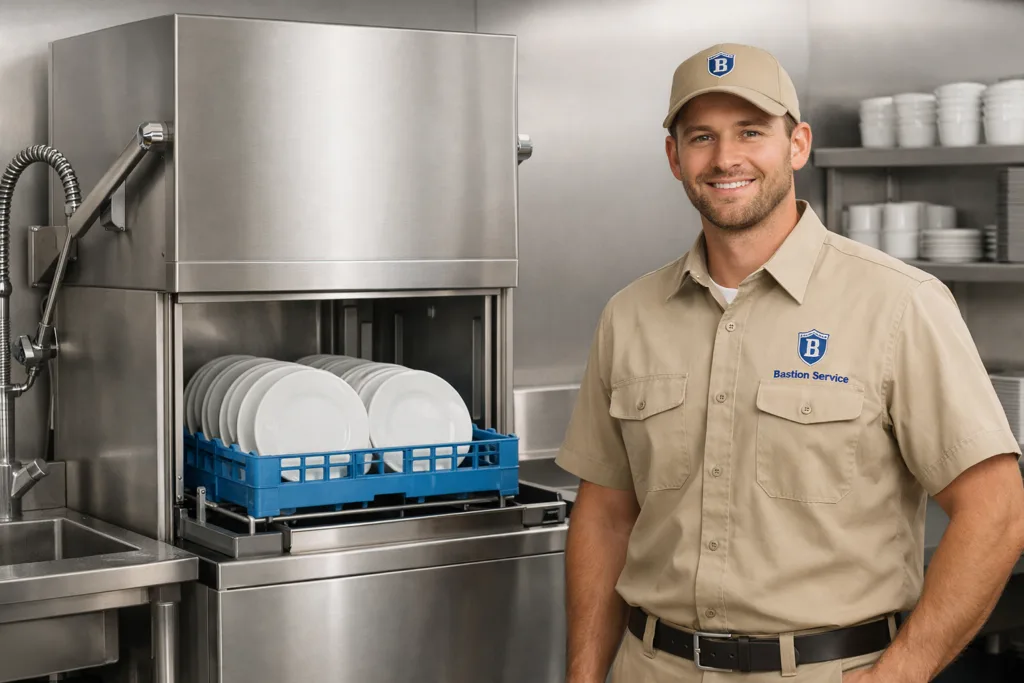




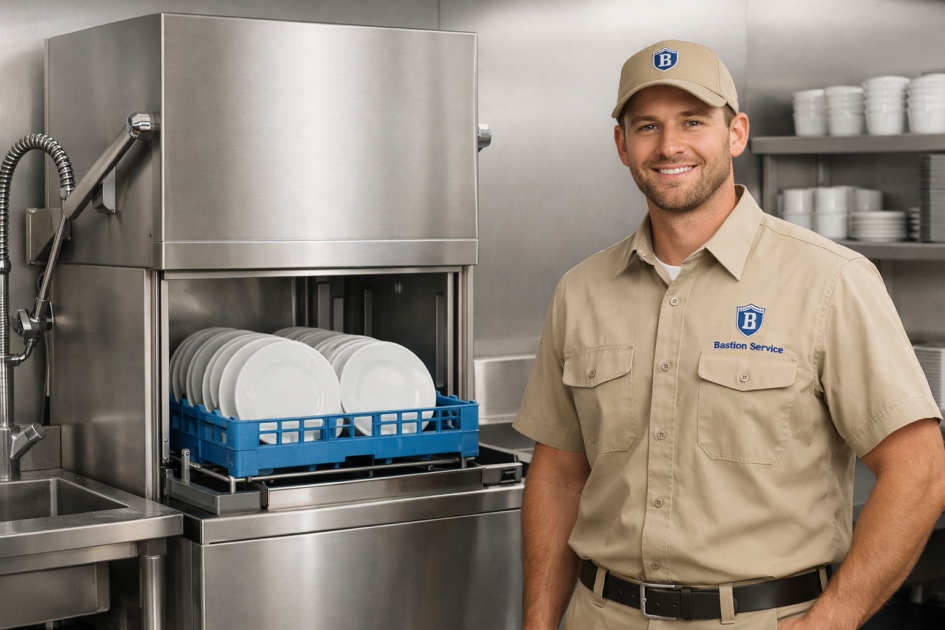
Dish-area slowdowns tend to show up first in workflow: racks backing up, staff rewashing items, or operators waiting on a machine that should have already finished its cycle. In a commercial setting, those interruptions affect labor use, sanitation consistency, and service pace. The most useful next step is to identify whether the fault involves water flow, heat, drainage, pump performance, controls, or a combination of smaller issues creating a bigger operational problem.
Related commercial equipment paths in Pico-Robertson include Commercial Fridge Repair in Pico-Robertson, Commercial Freezer Repair in Pico-Robertson, and Hobart Dishwasher Repair in Pico-Robertson.
Common commercial dishwasher problems that disrupt operations
Commercial dishwashers often show early warning signs before a full shutdown. Some problems develop gradually, such as declining wash quality or longer cycles, while others appear suddenly, like a leak or a machine that will not start. Looking at the symptom pattern usually helps narrow down what needs attention.
Poor wash results, residue, or cloudy ware
If dishes, glassware, or utensils come out with film, food soil, or inconsistent rinse results, the issue may not be as simple as detergent or operator technique. Low wash pressure, blocked spray arms, scale buildup, weakened pump performance, improper fill levels, or inadequate rinse temperature can all reduce cleaning effectiveness. In a busy operation, that leads to rewash time, higher water and chemical use, and slower turnaround on essential wares.
When cleaning performance changes from one load to the next, it can also suggest intermittent problems such as a failing component, inconsistent heating response, or controls that are not completing each phase correctly.
Drain failures and standing water
Water left behind after a cycle is a common sign that something in the drain system is not functioning as expected. Restrictions, pump trouble, valve issues, or control-related drain failures can all leave the machine unable to clear properly between cycles. That can affect both wash quality and odor control, and it often becomes more disruptive as staff start compensating manually.
If employees are emptying water by hand, restarting cycles to force draining, or noticing recurring backup in the machine, it is usually a sign that the problem should be addressed before it turns into a complete outage.
Low rinse temperature or heating problems
Heat-related issues can be easy to miss at first because the dishwasher may still appear to run normally. But if the machine is not reaching or maintaining the expected temperature, the result can be weak sanitation performance, longer cycle times, or inconsistent output. Depending on the machine, the cause may involve heating elements, thermostats, sensors, relays, wiring, incoming power issues, or control faults.
A unit that runs without proper heat is still creating operational risk, especially when staff assume the cycle completed correctly just because the rack moved through or the timer ended.
Leaks, overflow, and water on the floor
Leaks around the door, under the unit, or near supply and drain connections should be taken seriously in a commercial kitchen or dish area. A worn gasket, cracked hose, loose fitting, fill problem, damaged seal, or internal overflow condition can all allow water to escape. Even a minor leak can create slip hazards, damage surrounding surfaces, and point to a larger mechanical issue inside the machine.
If the leak only appears during specific parts of the cycle, that timing can be useful in narrowing down whether the problem is tied to filling, washing, draining, or rinse operation.
Cycle interruptions, shutdowns, and control problems
When a commercial dishwasher stops mid-cycle, fails to start, repeatedly needs to be reset, or behaves inconsistently from shift to shift, the cause may involve switches, sensors, relays, control boards, wiring, or safety-related shutdown conditions. These issues can be especially disruptive because they often seem intermittent at first. A machine may run for one load, then fail on the next, making it harder for staff to predict whether it can be relied on during busy periods.
Unusual noise, vibration, or pump-related symptoms
Grinding, humming, rattling, or cavitation-like sounds usually mean the machine is working harder than it should. Obstructions, worn motor components, failing bearings, circulation pump problems, or mounting issues can all create noise. If performance also drops at the same time, the machine may be losing wash pressure or straining during operation. Continued use in that condition can increase damage to connected parts.
Why symptom-based diagnosis matters
The visible complaint is not always the root failure. A machine that leaves dishes dirty may actually have a heat or circulation problem. A door-area leak may be caused by overfilling rather than a gasket alone. A drain complaint may involve controls, not just a blockage. That is why diagnosis should come before major repair decisions or repeated part replacement.
For businesses in Pico-Robertson, a good service evaluation helps answer practical questions: what failed, whether the problem is isolated or part of a broader wear pattern, and whether the unit is likely to return to stable operation after repair. That matters when the dishwasher supports daily throughput, staffing plans, and sanitation workflow.
Signs the machine should not be pushed through another shift
Some conditions justify prompt service rather than continued operation:
- Water leaking onto the floor or around electrical components
- Failure to drain completely between cycles
- Low or inconsistent rinse temperature
- Cycles stopping midway or failing to complete
- Repeated breaker trips or reset requirements
- Abnormal noise from the pump or motor area
- Consistently poor wash results despite normal loading and chemical use
Continuing to run the machine under those conditions can increase repair scope, create safety concerns, and turn a limited problem into a larger operational disruption.
Repair versus replacement for an aging commercial dishwasher
Not every commercial dishwasher with a problem needs to be replaced. In many cases, a targeted repair makes sense when the fault is limited and the rest of the machine remains in solid condition. Pumps, heating components, valves, sensors, and certain electrical parts can often be addressed without replacing the entire unit.
Replacement becomes a more serious consideration when the dishwasher has recurring breakdowns, visible corrosion, multiple worn systems, unreliable controls, or repair costs that no longer match the machine’s remaining useful life. For a business, the real question is not only whether the dishwasher can be fixed, but whether that repair is likely to support reliable operation going forward.
What a commercial service assessment should evaluate
A useful dishwasher service visit should look beyond the immediate complaint and check the machine as a working system. That typically includes fill performance, wash circulation, drain function, heating response, visible wear, electrical condition, and signs of recurring stress on seals, pumps, or controls. It also helps to note whether the problem appears under heavy load, after warm-up, or only at certain points in the cycle.
That broader view is often what separates a short-term workaround from a repair that actually helps restore stable dish-area performance.
Commercial dishwasher repair in Pico-Robertson for business operations
In Pico-Robertson, commercial dishwasher issues can affect restaurants, cafés, institutional kitchens, hospitality settings, and other businesses that rely on steady warewashing throughput. When the machine is not cleaning properly, not heating, not draining, or failing mid-cycle, the impact is rarely limited to the unit itself. It reaches prep timing, labor efficiency, and service readiness.
Bastion Service helps businesses in Pico-Robertson with commercial dishwasher repair focused on identifying the actual failure, explaining the condition of the equipment, and outlining the service path that best fits current operating needs.


