
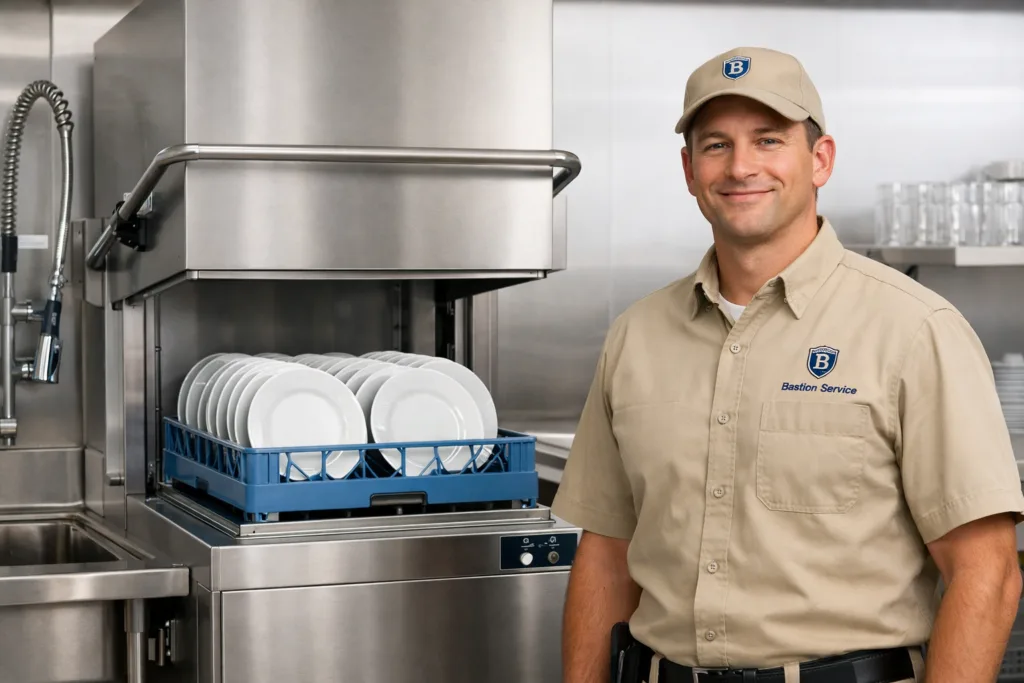




Dish-area delays can spread quickly through a business when a commercial dishwasher stops performing the way staff expect. Dirty wares linger, clean inventory runs short, and employees may need to spend extra time rewashing items by hand or waiting on a machine that is cycling inconsistently. In a busy Mar Vista operation, that kind of slowdown can affect sanitation routines, labor efficiency, and overall back-of-house timing.
Related commercial equipment paths in Mar Vista include Commercial Refrigerator Repair in Mar Vista, Commercial Freezer Repair in Mar Vista, and Hobart Dishwasher Repair in Mar Vista.
The most useful service approach starts with identifying which part of the wash process is failing. A dishwasher may appear to have one simple issue on the surface, but the root cause can involve water fill, circulation, drainage, heat, controls, or a combination of wear-related problems. Bastion Service helps businesses in Mar Vista with commercial dishwasher repair focused on clear diagnosis, practical service guidance, and dependable local support for dish-area uptime.
Commercial dishwasher issues that commonly disrupt operations
Commercial dishwashers usually give warning signs before a complete shutdown. Some units begin leaving residue on glasses and plates. Others take too long to drain, stop mid-cycle, fail to heat properly, or leak during operation. Even when the machine still runs, inconsistent results can create uncertainty for staff who rely on steady turnaround throughout the day.
Common service calls often involve problems such as:
- Standing water left in the bottom of the machine
- Poor wash results or repeat spotting and film
- Leaking around the door, underneath the unit, or near hoses
- Failure to fill with water or failure to advance through cycles
- Weak spray action or poor circulation
- Low rinse temperature or heating problems
- Grinding, humming, or unusual pump noise
- Intermittent shutdowns or controls that do not respond normally
These symptoms matter because they usually affect more than the machine itself. A dishwasher that cannot finish cycles reliably can slow tableware turnover, delay prep and closing tasks, and force staff to work around equipment that should be supporting the operation instead of interrupting it.
Symptom-based diagnosis helps narrow down the real cause
Not draining or draining slowly
If water remains in the machine after a cycle, the issue may be tied to a blocked drain path, clogged filter area, drain pump problem, or a control fault that prevents the drain sequence from finishing. Slow drainage can also lead to residue buildup inside the unit and place extra strain on pump components if the machine continues running without correction.
Poor cleaning performance
When dishes come out with food soil, cloudiness, or uneven cleaning, the problem is not always detergent alone. Wash quality may be affected by spray arm blockage, weak circulation, water temperature problems, scaling, pump wear, or inconsistent filling. Looking at the full wash process is important because the final result on the ware often reflects several systems working together incorrectly.
Leaks during or after a cycle
Water on the floor may come from worn door gaskets, loose hose connections, cracked lines, overfilling, pump seal failure, or drainage restrictions that force water where it should not go. In a commercial setting, leaks should be taken seriously because they can create slip hazards and may damage surrounding surfaces if the issue is allowed to continue.
Unit will not start or shuts off mid-cycle
A machine that does not respond when staff try to start it may have an electrical supply problem, interlock issue, failed switch, control fault, or motor-related failure. If the dishwasher starts and then stops before completing the cycle, that can point to overheating, sensor issues, fill problems, drain faults, or board-related interruptions. Repeated cycle failures usually need direct testing rather than trial-and-error part replacement.
Low rinse temperature or heat-related performance problems
Commercial dishwashing depends on proper temperature performance. If the machine is not reaching the expected wash or rinse conditions, the cause may involve heating elements, thermostats, controls, relays, or related electrical components. Heat problems can also show up as long cycle times, weak sanitizing confidence, or inconsistent results from one load to the next.
Grinding, humming, or abnormal sounds
Changes in sound are often early warning signs. Grinding may suggest debris in the pump system or mechanical wear. A persistent hum can indicate a motor trying to start under strain. Rattling or irregular noise may point to spray arm interference, loose components, or circulation issues. When noise changes at the same time cleaning quality declines, the problem may be developing beyond a single worn part.
Why recurring dishwasher problems should not be ignored
Some businesses keep using a commercial dishwasher as long as it still turns on, even if results are getting worse. That can be costly. A machine that leaks, drains poorly, or struggles to complete cycles may continue to operate for a while, but it often does so with added stress on pumps, heating components, controls, or seals. What begins as an intermittent issue can turn into a broader repair if the equipment is pushed too long.
It is usually time to schedule service when the same symptom appears more than once, when staff must compensate for the machine to get acceptable results, or when the unit is creating operational interruptions that affect kitchen flow. Repeat problems tend to be more useful diagnostic clues than one-time irregular cycles, and they should be addressed before they become a full outage.
What a service visit should help clarify
A worthwhile diagnosis should do more than confirm that the dishwasher is not working. It should help determine:
- Which stage of the cycle is failing
- Whether the issue is isolated or part of wider wear inside the machine
- What components are most likely involved
- Whether continued use risks additional damage
- Whether repair is likely to restore reliable operation
That information gives operators, managers, and facility teams a clearer basis for decision-making. Instead of guessing based on symptoms alone, they can understand whether the problem is a targeted repair, a progressive condition, or a sign that the machine is becoming less dependable overall.
Repair versus replacement for a commercial dishwasher
Many commercial dishwasher issues are repairable, especially when the problem is limited to a pump, valve, switch, gasket, hose, sensor, or control-related failure. In those cases, a focused repair may return the machine to stable service without the disruption of replacing the unit.
Replacement becomes a more practical discussion when the dishwasher has multiple failing systems at once, recurring downtime, extensive internal wear, or a pattern of breakdowns that keeps interrupting operations. The decision is usually less about whether the machine can be made to run one more time and more about whether it can return to dependable daily use.
For commercial kitchens and other business settings in Mar Vista, reliability is the key factor. If the machine can be repaired in a way that supports normal workflow, repair often makes sense. If service interruptions keep repeating and confidence in the equipment is low, planning for replacement may be the more stable long-term choice.
Business-focused service matters in a dish-area environment
Commercial dishwashing equipment works under heavier demands than residential machines, and the impact of failure is different as well. A problem with one unit can affect sanitizing routines, staffing efficiency, and the availability of clean wares needed for service. That is why symptom-based troubleshooting and realistic repair planning are especially important in commercial settings.
Whether the issue involves poor wash results, drainage trouble, leaking, weak heat, pump problems, or cycle failures, the goal is to restore dependable performance with the least disruption possible. When businesses in Mar Vista address dishwasher problems promptly, they are usually in a better position to protect uptime and avoid larger interruptions to daily operations.


