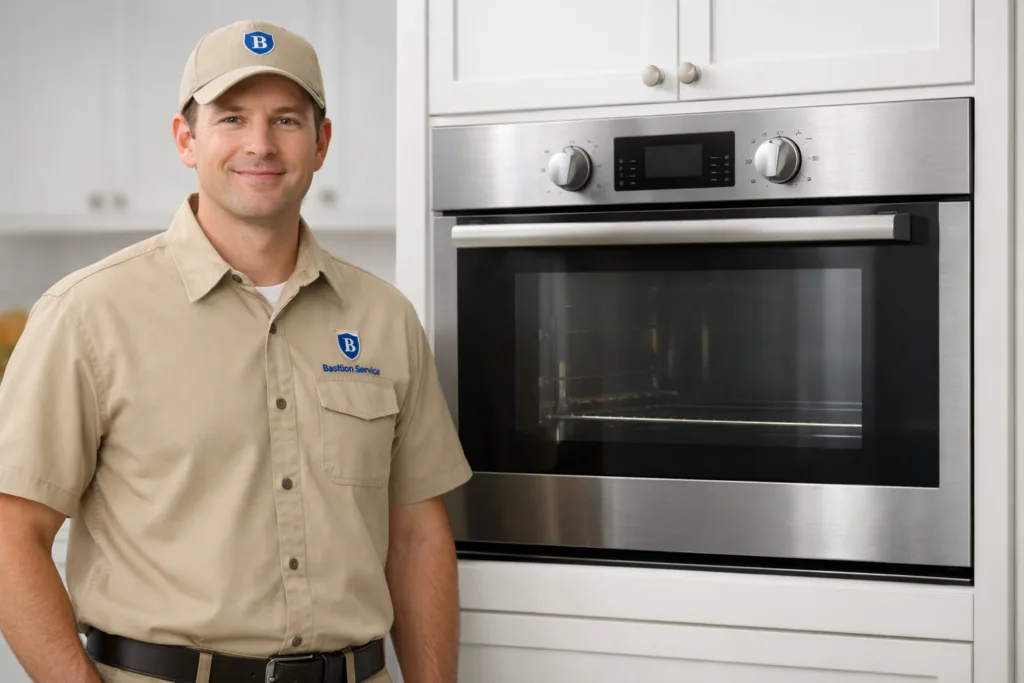
Common Bosch wall oven problems in Century City homes

Bosch wall ovens tend to fail in recognizable ways. Some stop heating altogether. Others still run, but preheat slowly, bake unevenly, or drift above and below the selected temperature. In many homes, the first clue is not a complete breakdown but cooking results that gradually become less reliable.
Related Bosch and wall oven service paths in Century City include Bosch Appliance Repair in Century City, Wall Oven Repair in Century City, and Bosch Refrigerator Repair in Century City.
A blank display, flashing error code, oven that shuts off mid-cycle, or door that does not close properly can all point to different underlying faults. What matters is separating a heating problem from a sensor issue, power problem, door-latch fault, or electronic control failure before deciding what repair makes sense.
What specific symptoms can mean
Oven turns on but does not heat
If the panel responds and cooking modes can be selected, but the oven cavity stays cold, likely causes include a failed heating circuit, temperature sensor problem, damaged wiring, or an issue on the control side. On some units, the symptom may appear only in bake or only in broil, which helps narrow down where the fault is occurring.
This kind of problem usually does not improve on its own. If the oven is needed daily, early service can help prevent repeated attempts to run a component that is already failing.
Slow preheat
Slow preheat often shows up before a full no-heat failure. The oven eventually reaches temperature, but only after a much longer wait than normal. That can happen when one part of the heating system is weak, when the sensor is feeding inaccurate readings, or when the control is not cycling heat correctly.
Homeowners often notice this first with weeknight meals, baked dishes, or recipes that used to be predictable. If preheat times keep increasing, the problem is usually becoming more pronounced rather than resolving itself.
Uneven baking or roasting
When food browns too quickly on one side, remains pale on another, or comes out inconsistent from rack to rack, the oven may not be maintaining heat evenly. This can be tied to temperature regulation, airflow behavior, weak element performance, or calibration drift.
Uneven baking is easy to dismiss as cookware or recipe error, but repeat patterns across different dishes usually point back to the appliance. If cookies, casseroles, and roasted foods all start finishing unpredictably, the oven should be evaluated.
Temperature swings
Some fluctuation is normal during cooking, but sharp swings are not. If the oven runs much hotter than the set point, falls well below target temperature, or alternates between overcooking and undercooking, the issue may involve sensing, control logic, or a heating component that is not responding consistently.
Temperature instability is especially frustrating because the oven may still appear to work. The bigger concern is that inconsistent heat can become overheating, shutdowns, or repeated fault codes if the underlying issue worsens.
Error codes or intermittent shutdowns
Bosch wall ovens can display faults related to temperature sensing, communication, latch behavior, internal electronics, or other safety-related conditions. Intermittent issues are common at first: the oven works one day, then fails the next, or shuts off during a cycle and restarts later.
That pattern usually means a part is not failing cleanly. Intermittent faults can be harder to identify without testing, but they are important to address because they often become complete failures at inconvenient times.
Door, latch, or self-clean problems
If the door does not seal properly, cooking performance drops because heat escapes and the oven has to work harder to maintain temperature. Latch problems can also affect normal use, especially if the oven struggles before, during, or after a self-clean cycle.
In some cases, the issue is mechanical. In others, heat exposure during self-clean can stress sensors, latch assemblies, or electronic parts. A door problem may look minor at first, but it can contribute to poor results and longer run times.
Signs the issue is likely getting worse
Wall oven problems often progress in stages. A short delay in preheat can turn into no heat. A rare error code can become a recurring interruption. A door that needs an extra push to close can eventually affect cooking temperature every time the oven is used.
- Preheat times that keep getting longer
- Cooking results changing from one use to the next
- Recurring error messages
- Display interruptions or controls that stop responding
- Cycles that cancel or shut off unexpectedly
- Noticeable overheating or burning at normal settings
When symptoms are becoming more frequent, repair decisions are usually easier and less frustrating after a proper diagnosis than after repeated trial-and-error use.
When to stop using the oven until it is checked
Some issues are inconvenient but manageable for a short time. Others are a reason to stop using the appliance until it has been inspected. That includes overheating, burning smells, repeated tripping of power, a door that will not close securely, or faults that interrupt operation in the middle of cooking.
If the oven is running far hotter than the selected setting, it can create safety concerns in addition to ruined meals. A unit that shuts off unpredictably or shows signs of electrical stress should not be pushed through repeated cycles just to see if it recovers.
Why accurate diagnosis matters on a Bosch wall oven
Many wall oven symptoms overlap. Slow preheat, uneven baking, and temperature swings can all stem from different failures that look similar from the outside. Replacing parts based on guesswork can add cost without solving the real problem.
A useful service visit should determine whether the fault is primarily in the heating system, sensor circuit, control assembly, latch mechanism, wiring, or another related component. That gives Century City homeowners a practical repair plan based on what the oven is actually doing, not just what the symptom seems to suggest.
Repair or replacement?
Repair is often worthwhile when the oven is otherwise in solid condition and the problem is limited to a serviceable component or isolated system. That is especially true when the cabinet fit, kitchen layout, and appearance of the existing wall oven still work well for the household.
Replacement may make more sense when there are multiple failing systems, recurring electronic issues, or age-related wear that suggests additional repairs are likely. The best choice usually depends on the model condition, the exact failure, and whether the repair path restores dependable day-to-day use.
What Century City homeowners can do before scheduling service
Before assuming the worst, it helps to note the exact pattern. Is the oven failing in bake, broil, or both? Does it stop mid-cycle only after preheating? Is the display active when the cavity stays cold? Did the issue begin after self-clean or after a recent power interruption?
Those details can make diagnosis faster and more accurate. It is also helpful to write down any error code exactly as shown and pay attention to whether the problem is constant or intermittent. Small observations often reveal whether the issue is temperature-related, electrical, or tied to controls.
Service focused on the symptom, not guesswork
For homeowners in Century City, the most useful repair approach is one that stays centered on the actual behavior of the oven. Whether the problem is no heat, poor temperature control, repeated fault codes, or a door issue affecting performance, the right next step comes from identifying the failed system and determining whether repair is practical for the appliance’s condition.