
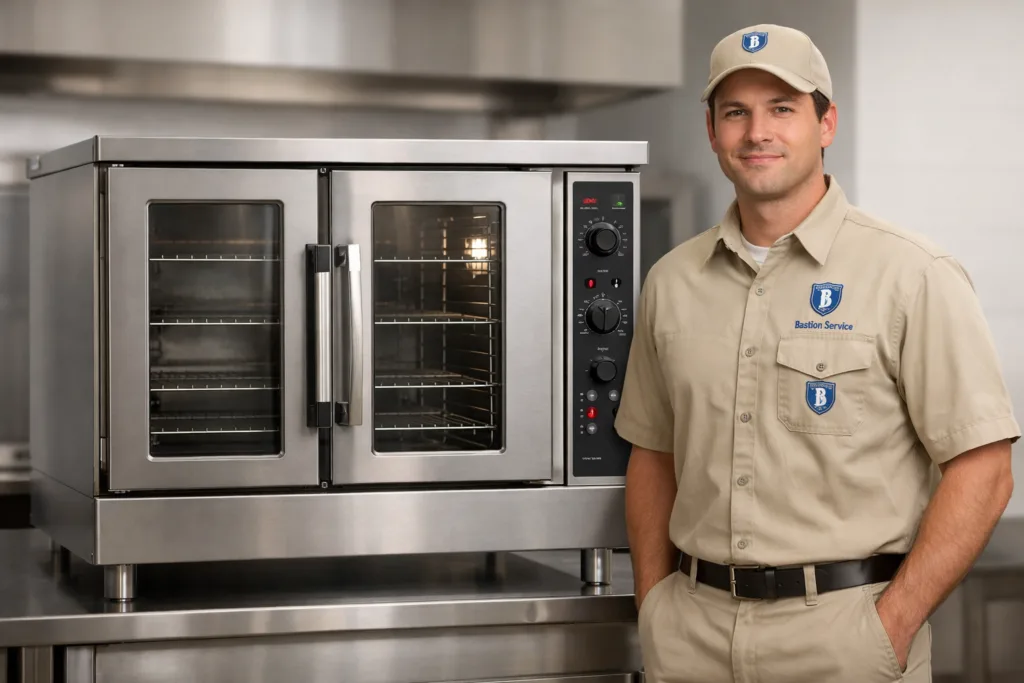




When Blodgett cooking equipment starts affecting output, timing, or consistency, the most useful next step is service that connects the symptom to a repair decision. For businesses in Westwood, that usually means identifying whether the trouble is tied to heat generation, ignition, controls, airflow, safety circuits, or power-related faults, then deciding whether the equipment can stay in operation, needs prompt repair scheduling, or should be taken offline to avoid a bigger interruption. Bastion Service works with Westwood businesses that need that process handled with minimal disruption to kitchen operations.
For specific equipment paths in Westwood, review Blodgett Oven Repair in Westwood and Commercial Appliance Repair in Westwood.
Although many calls begin with an oven complaint, the underlying issue is often broader than one obvious symptom. Slow recovery, unstable temperatures, failed startup, burner problems, mid-cycle shutdowns, and inconsistent cook results can each point to different causes. A service visit is most valuable when it helps management understand both what failed and how urgently the problem needs attention.
Blodgett cooking equipment problems that commonly require repair
Cooking equipment issues do not always begin with a full breakdown. More often, performance slips first. Staff may notice longer preheat times, uneven results between racks, controls that do not respond normally, or units that run for a period and then stop unexpectedly. Those symptoms can reduce throughput well before the equipment becomes unusable.
Temperature drift and poor heat consistency
If the unit is running hotter or cooler than the set point, missing targets during production, or struggling to recover between loads, the cause may involve sensors, thermostatic components, control boards, relays, heating systems, or restricted airflow. From an operator standpoint, these faults usually show up as inconsistent product quality, longer ticket times, and repeated adjustments by staff just to maintain output.
Temperature problems are worth addressing early because they tend to create waste and can place extra stress on related parts. If one batch is finishing correctly and the next is not, or if staff are compensating by changing cook times throughout the day, the equipment is no longer supporting predictable service.
Ignition and startup failures
Startup trouble may appear as delayed ignition, repeated clicking, burners that do not light reliably, intermittent heating, or equipment that powers up but will not begin a normal cycle. In busy kitchens, that kind of problem creates uncertainty because the unit may seem usable one moment and fail the next.
These issues can involve ignition components, gas-related systems, flame sensing, safety devices, wiring, or control faults. Because startup problems can escalate into repeated shutdowns during service, they are usually better handled before the equipment becomes completely unavailable.
Unexpected shutdowns during operation
When cooking equipment stops mid-cycle, loses heat without warning, or resets during use, the root cause may not be obvious from the front panel. Safety cutoffs, overheating conditions, unstable electrical supply, failing controls, and intermittent component failure can all produce similar behavior. Repeated shutdowns are especially disruptive because they affect both food quality and line timing.
If the unit is dropping out under load, the question is not just whether it can restart. The more important issue is whether it can be trusted during active production without creating avoidable downtime.
Control panel and display issues
Unresponsive buttons, settings that will not hold, inconsistent readouts, blank displays, and erratic programming behavior often point to a control-side problem rather than a simple operating error. In some cases the issue is the control itself; in others, the visible symptom comes from sensor feedback, wiring faults, or incoming power problems.
Because control complaints can imitate other failures, diagnosis matters before parts are approved. Replacing visible components without testing can extend downtime and still leave the original fault unresolved.
Uneven cooking, airflow, and recovery problems
Hot spots, poor browning, weak circulation, and slow recovery after the door opens are all signs that heat is not moving through the equipment correctly. Depending on the model and configuration, that may involve fans, airflow paths, burners, calibration, heating elements, or control timing.
In practical terms, uneven performance usually shows up as inconsistent batches, menu delays, and staff workarounds that slow the kitchen down. Once operators start rotating pans, changing placement patterns, or extending cook cycles to compensate, service is often justified.
How symptom patterns help guide repair decisions
The same category of complaint can mean very different things depending on when it occurs. A unit that misses temperature only during heavy use suggests a different repair path than one that never reaches set point at startup. A shutdown that happens after preheat may indicate something different from a unit that will not start at all. That is why symptom timing matters.
- Problems only during peak production: often point to recovery, airflow, load-related heating, or intermittent control issues.
- Problems at startup: more often involve ignition, power, safety circuits, or control initialization.
- Problems that come and go: may indicate loose electrical connections, failing components, or heat-related intermittent faults.
- Constant poor performance: can suggest calibration drift, sensor failure, damaged heating components, or a larger control problem.
For businesses in Westwood, this kind of symptom-based information helps determine how quickly service should be scheduled and whether temporary continued use is realistic.
Signs the equipment should not stay in normal use
Some faults allow limited operation while repair is being arranged. Others carry too much risk for normal production. If the equipment is overheating, failing to ignite reliably, shutting down repeatedly, tripping breakers, showing large temperature swings, or producing clearly inconsistent results, continued use can increase the chance of a broader failure.
That matters not only for repair cost, but for scheduling. A unit that is barely operating may fail completely during a high-demand period, forcing an unplanned stoppage when the kitchen can least absorb it. Service is often easier to manage when the issue is addressed before it becomes a full outage.
What businesses should note before scheduling service
Good symptom details make repair planning easier. Before the visit, it helps to identify what the equipment is doing, when the problem appears, and whether the issue is constant or intermittent. Even a short record from staff can improve the first inspection.
- Whether the unit fails at startup or after heating
- If temperature is too high, too low, or unstable
- Whether the problem affects every cycle or only busy periods
- Any unusual noises, smells, error behavior, or visible shutdown patterns
- Whether staff have noticed slower recovery or uneven batch results
This information can help narrow the likely fault range and improve scheduling decisions, especially when the equipment is still operating inconsistently rather than fully down.
Repair planning for kitchens that depend on daily output
Repair decisions are rarely about one failed part alone. Businesses also need to weigh recurrence, equipment age, production impact, and whether related components may be contributing to the problem. A useful service call should help clarify the scope of the issue, the urgency of repair, and whether the equipment can reasonably stay in rotation while the next step is arranged.
For kitchen operators, that context is often as important as the repair itself. Knowing whether the fault is isolated or part of a larger reliability problem helps with staffing, prep planning, and service expectations.
Blodgett repair support in Westwood
If Blodgett cooking equipment is causing temperature issues, ignition trouble, production delays, or repeated shutdowns in Westwood, scheduling service is the practical next move. A repair visit can confirm the source of the problem, explain the operational risk of continued use, and help you decide on the right repair timing before downtime spreads to the rest of the kitchen.


