





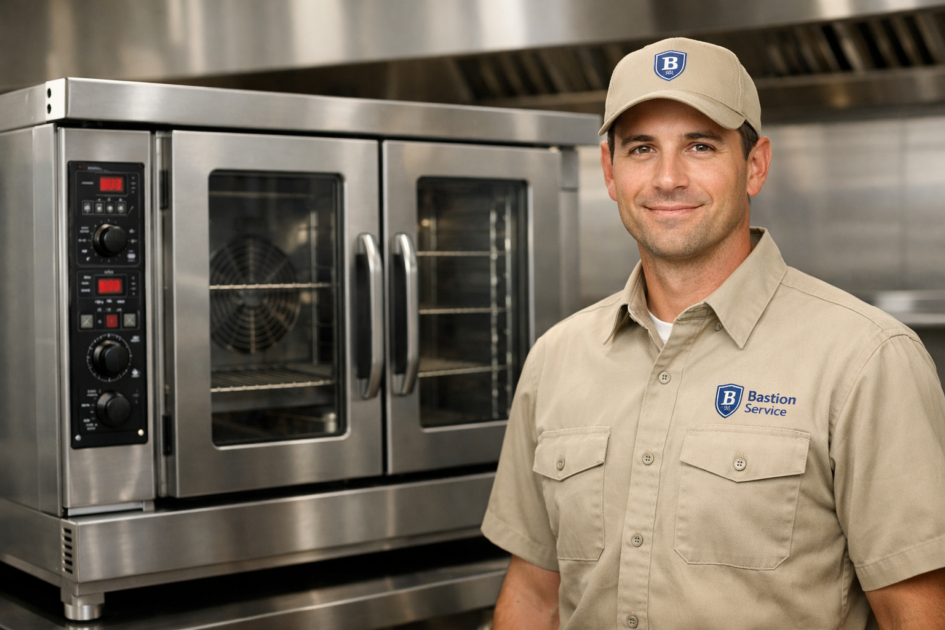
When Blodgett cooking equipment starts missing temperature targets, delaying recovery, or shutting down during production, the most useful next step is service that identifies the actual fault before more output is lost. In Hawthorne, that usually means evaluating whether the issue is tied to ignition, controls, heating performance, airflow, sensors, wiring, or power supply problems, then deciding how quickly repair should be scheduled and whether the equipment should stay in use.
For specific equipment paths in Hawthorne, review Blodgett Oven Repair in Hawthorne and Commercial Appliance Repair in Hawthorne.
Bastion Service works with restaurants and other food-service operations that rely on Blodgett equipment for daily production. The goal is to help managers and kitchen teams move from symptom confusion to a repair plan that fits the urgency of the problem, the condition of the equipment, and the risk of further downtime.
Blodgett cooking equipment problems that commonly lead to service
Blodgett equipment issues often start with one symptom but affect the whole kitchen quickly. A unit that heats slowly, runs unevenly, or trips out occasionally can disrupt ticket times, product consistency, labor planning, and service flow long before it fails completely. Early repair attention is often the difference between a scheduled fix and an unexpected outage.
Temperature inconsistency and poor heat control
If cooking results are inconsistent from batch to batch, the problem may be more than calibration. Equipment that runs cold, overshoots set temperatures, cycles erratically, or drifts during use may have issues involving sensors, thermostatic controls, relays, boards, burners, elements, or airflow-related components. These faults matter because they affect cook times, holding quality, and repeatability during busy periods.
In ovens especially, unstable heat can show up as uneven browning, extended bake times, undercooked centers, or hot spots that force staff to rotate pans and compensate manually. If operators are adjusting settings constantly just to get acceptable results, repair is usually more cost-effective than continuing to work around the problem.
Ignition and burner problems
Hard starts, delayed ignition, burners that do not light consistently, or units that attempt to fire and then shut back down should be checked promptly. Depending on the equipment configuration, the issue may involve igniters, flame sensing, gas valve response, control communication, wiring, or power supply instability. Repeated resets may temporarily restore operation, but they do not resolve the cause.
These symptoms are especially disruptive because they can turn an otherwise usable piece of cooking equipment into an unreliable one during service. If the unit cannot be trusted to start cleanly and stay running, production planning becomes difficult and kitchen staff lose time monitoring equipment instead of working the line.
Slow heat-up and delayed recovery between loads
One of the most common complaints with business-use cooking equipment is that it eventually reaches temperature but takes too long to get there, or it falls behind as volume increases. Slow recovery can point to weak heating output, airflow imbalance, worn components, door sealing problems, control faults, or a system that can no longer maintain expected performance under demand.
For kitchens, this usually shows up as longer wait times, reduced throughput, and more pressure on other equipment. When recovery becomes noticeably slower than normal, repair should be considered before delays begin affecting service windows and customer experience.
Intermittent shutdowns and control-related faults
Equipment that runs normally one shift and fails the next can be more disruptive than a total failure because staff cannot predict when it will act up. Random shutdowns, flashing displays, fault codes, unexpected resets, and controls that stop responding often require hands-on testing rather than guessing at parts. The cause may involve boards, safety circuits, switches, loose connections, heat-stressed wiring, or component failure that only appears once the unit is hot.
These are the kinds of issues that can lead to repeat downtime if the first repair is based only on the most obvious symptom. A structured service call helps narrow the failure to the components that are actually causing the interruption.
Equipment coverage for Blodgett cooking systems
Although many calls center on ovens, cooking equipment service is rarely limited to a single symptom or one style of unit. Kitchens may be dealing with deck ovens, convection ovens, rotating rack ovens, or other Blodgett cooking systems that share similar complaints involving heat delivery, recovery time, controls, ignition, or shutdown behavior.
Customer-facing concerns usually sound simple:
- The oven does not hold temperature consistently.
- The unit takes too long to preheat.
- Recovery between batches is slowing production.
- The burner does not light reliably.
- The controls are erratic or the display is showing errors.
- The equipment shuts off during operation.
- Food quality is becoming inconsistent across the day.
Those symptoms can come from different underlying causes, which is why service should focus on the full operating pattern rather than one isolated complaint.
Signs the problem is starting to affect kitchen operations
Some operators wait to schedule repair until the equipment is completely down, but performance decline often creates losses before a full shutdown happens. It is usually time to book service when staff are compensating for the equipment every day or when the problem is affecting output in measurable ways.
- Cook times are getting longer than the menu or process allows.
- Staff have to monitor the equipment continuously to avoid mistakes.
- Products are coming out unevenly cooked or inconsistent in appearance.
- Production has to be shifted to other stations to keep up.
- Supervisors are unsure whether the unit should remain in rotation.
- The same reset or workaround keeps being repeated.
Once those patterns are established, the issue is no longer just technical. It becomes an operations problem that affects labor, timing, and service quality.
When continued use may increase downtime risk
Some symptoms suggest the equipment should not be relied on until it has been checked. Examples include repeated ignition failure, major temperature swings, visible control malfunction, burning smells, unexplained shutdowns, or performance that is getting worse from day to day. In those situations, pushing through service can make the repair larger and create a more expensive interruption later.
Intermittent faults deserve the same attention. A problem that happens only during peak use or only after the unit has been on for a while is often harder on operations because it creates uncertainty. If the equipment cannot be trusted during the busiest part of the day, scheduling repair sooner is usually the better decision.
Repair versus replacement considerations
Many Blodgett equipment issues are repairable, especially when the main structure of the unit remains sound and the fault is isolated to controls, ignition parts, sensors, heating components, wiring, or related electrical parts. Replacement becomes more likely when failures are stacked together, downtime has become frequent, or the cost of restoring reliability no longer makes sense for the condition of the unit.
A service visit helps managers make that decision based on findings instead of assumptions. That matters when the equipment is central to daily production and the business needs to weigh immediate repair against longer-term planning.
What a service visit should help clarify
A productive repair appointment should answer more than whether a part has failed. It should help identify the active symptom pattern, confirm likely failure points, define the repair scope, and explain the urgency in business terms. For some kitchens, that means confirming the equipment can stay in limited use until repair is completed. For others, it means taking the unit out of rotation before the next production cycle.
If your Blodgett cooking equipment in Hawthorne is causing temperature problems, ignition issues, slow recovery, control errors, shutdowns, or production delays, the practical next step is to schedule service so the fault can be diagnosed, the repair path explained, and downtime contained before it spreads further.


