





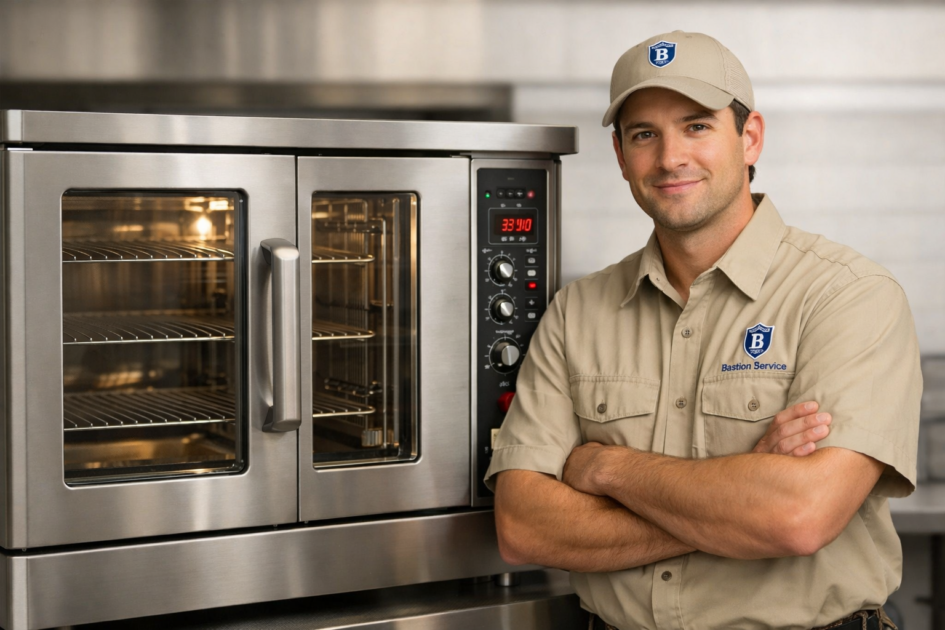
When Blodgett cooking equipment begins affecting prep flow, ticket times, or food consistency, the priority is getting the problem identified quickly and scheduling repair around the realities of daily kitchen use. A symptom such as slow heat-up, burner trouble, or an unexpected shutdown can come from several different faults, so the service decision should be based on how the equipment is actually behaving under load, not on assumptions. For operators in Culver City, that means focusing on uptime, safe operation, and the fastest practical path back to stable performance.
For specific equipment paths in Culver City, review Blodgett Oven Repair in Culver City and Commercial Appliance Repair in Culver City.
Bastion Service helps businesses evaluate Blodgett cooking equipment problems in a way that supports day-to-day operations. That includes checking whether the issue is isolated to ignition, temperature control, sensors, airflow, burners, or electrical components, and whether the unit should remain in use until repair is completed. For kitchens that depend on consistent oven performance, timing matters just as much as the repair itself.
Blodgett cooking equipment problems that commonly disrupt service
Many issues start as performance changes rather than a full breakdown. Staff may notice longer cook times, uneven browning, missed temperatures, or a unit that needs repeated restarting. Those early signs are often the best time to schedule service, because they can point to wear in critical heating or control systems before a complete outage interrupts production.
Temperature drift and uneven cooking results
If the equipment runs too hot, too cool, or does not hold a stable temperature, the cause may involve thermostats, probes, relays, control boards, or burner regulation. In a busy kitchen, even a small temperature error can affect product quality and force staff to change cook times manually. Once those adjustments become routine, the equipment is no longer performing predictably enough for reliable service.
Uneven cooking can also point to airflow problems, worn door gaskets, heat distribution issues, or internal component wear. These are the kinds of faults that may not stop production immediately, but they often lead to waste, slower output, and inconsistency from batch to batch.
Ignition trouble and burner performance issues
Delayed ignition, repeated clicking, failure to light, weak flame, or burners that cycle improperly usually indicate that the heating system needs attention. Common causes include worn igniters, flame-sensing issues, gas valve problems, burner contamination, or electrical faults affecting the ignition sequence. If the unit lights intermittently or drops heat during use, the risk is not just inconvenience. It can create production delays that spread across the line.
These symptoms should be taken seriously when they become repeatable. A unit that starts eventually today may fail entirely during peak demand tomorrow, especially when components are already showing signs of wear.
Slow heat-up and poor recovery between loads
Blodgett cooking equipment that takes too long to preheat or struggles to recover after doors are opened can reduce throughput even if it never fully shuts down. This type of complaint often points to weakened burner performance, control inaccuracy, heat loss, sensor issues, or declining efficiency in key heating components.
For operators, slow recovery is more than a technical annoyance. It affects timing, staff coordination, and the ability to keep output steady during heavy service periods. If the equipment cannot keep pace with normal kitchen demand, repair becomes an operations decision as much as a maintenance one.
Control faults, error displays, and unexpected shutdowns
Unresponsive controls, intermittent resets, display faults, or a unit that shuts off without warning can be linked to failing boards, loose electrical connections, communication faults, or heat-related damage inside the control system. Problems in this category often appear inconsistent at first, which makes them easy to underestimate.
When shutdowns start happening during use, or when staff have to restart the equipment to keep working, service should be scheduled promptly. Repeated resets can mask a deeper fault and may increase the chance of a more disruptive failure later.
Supported Blodgett equipment coverage for kitchen operations
Blodgett is widely used in cooking environments where dependable heat and consistent output are essential. For businesses in Culver City, repair needs often center on oven performance, but the larger issue is how the cooking equipment is affecting workflow, product quality, and service timing.
Common service concerns include:
- Ovens not heating properly or not holding temperature
- Ignition systems failing intermittently or not starting at all
- Burners producing weak, unstable, or uneven heat
- Controls not responding correctly to settings or programming
- Recovery times becoming too slow for normal production volume
- Unexpected shutdowns that interrupt kitchen output
- Error conditions that return after restarting the unit
Even when the complaint seems simple, such as “it runs cold” or “it keeps turning off,” the repair path depends on what is failing behind the symptom. That is why symptom-based testing is more useful than replacing parts based only on guesswork.
Signs it is time to schedule repair instead of waiting
There is a point where continued use creates more risk than value. If staff are compensating for unreliable temperatures, restarting the unit during service, rotating product to work around uneven cooking, or avoiding certain settings because they trigger a problem, the equipment is already affecting operations in a measurable way.
It makes sense to arrange service when you notice:
- Temperature complaints that keep returning
- Ignition failures more than once
- Longer-than-normal preheat or recovery times
- Burners that sound, smell, or perform differently than usual
- Controls that freeze, reset, or display inconsistent readings
- Shutdowns during active use
- Production delays tied to one piece of cooking equipment
Waiting for a complete failure often leads to more disruption, especially when the unit is part of a tightly scheduled kitchen routine. Earlier repair can help reduce food loss, labor inefficiency, and emergency scheduling pressure.
How repair decisions are usually made
Not every problem means the equipment is at the end of its useful life. Some issues are limited to a specific ignition component, sensor, control part, or burner-related fault. Others reveal a pattern of broader wear that makes repair planning more complicated. The right decision depends on the condition of the unit, the severity of the symptom, expected part needs, and how essential that piece of equipment is to the kitchen’s daily output.
For managers and owners, the practical questions are straightforward: Is the problem isolated or spreading? Can the equipment be used safely until repair is completed? Will the fix restore dependable operation, or is the unit already showing repeated failures across multiple systems? A proper evaluation helps answer those questions before downtime gets worse.
What a service visit should help you understand
A productive repair visit should clarify what failed, how it is affecting heating performance, whether continued use is reasonable, and what the next scheduling step should be. That matters for restaurants and other food-service businesses in Culver City that cannot afford uncertainty around core cooking equipment.
If your Blodgett unit is heating inconsistently, struggling with ignition, recovering too slowly, or shutting down during use, the next step is to schedule repair and have the symptom pattern checked before it turns into a larger interruption for the kitchen.


