
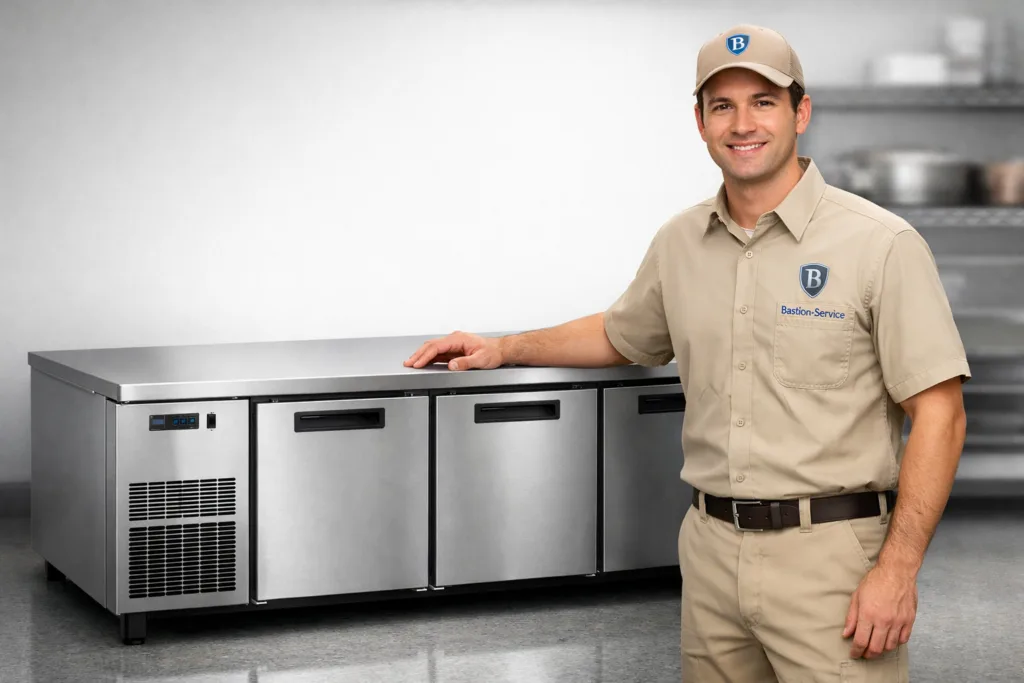




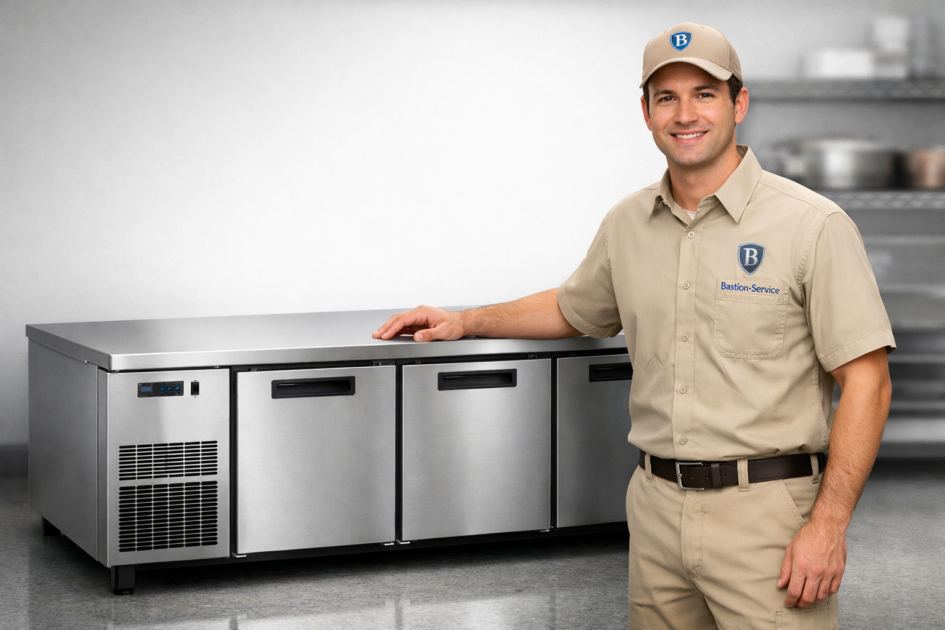
Refrigeration problems rarely stay isolated for long. When a Beverage-Air refrigerator or freezer starts running warm, frosting over, leaking, or struggling to recover temperature, the issue can quickly affect inventory, prep flow, and day-to-day operations. For businesses in Inglewood, repair service is most valuable when it focuses on the actual symptom pattern, the likely failed components, and how soon the equipment needs to be addressed to reduce downtime and avoid a larger breakdown.
For specific equipment paths in Inglewood, review Beverage-Air Refrigerator Repair in Inglewood, Beverage-Air Freezer Repair in Inglewood, and Commercial Appliance Repair in Inglewood.
Bastion Service works with businesses in Inglewood that rely on Beverage-Air refrigeration equipment for daily holding and storage. The repair process should answer practical questions: what is failing, whether the unit can stay in use temporarily, what parts or labor are likely involved, and whether repair still makes sense based on equipment condition and operational impact.
What Beverage-Air refrigeration equipment problems do you troubleshoot?
Beverage-Air refrigerator and freezer issues often begin with a few visible symptoms, but those symptoms can come from more than one fault. A warm cabinet may be caused by airflow restrictions, fan motor failure, control problems, gasket leakage, dirty condenser coils, defrost failure, or a refrigeration-system issue. A freezer that holds temperature overnight but rises during heavy use may point to different causes than a unit that never reaches setpoint at all.
Typical service calls involve problems such as:
- Refrigerators not staying cold enough
- Freezers softening product or failing to pull down temperature
- Frost or ice buildup inside the cabinet
- Water leaks or drainage problems
- Weak airflow or uneven cooling from top to bottom
- Units running constantly or short cycling
- Fans making abnormal noise or not moving air properly
- Cabinets that struggle to recover after door openings
Because the same complaint can come from several different component failures, repair decisions are stronger when they are based on testing rather than assumptions.
Warm cabinet and temperature control issues
A refrigerator that drifts above holding temperature or a freezer that cannot maintain a stable range should be evaluated before the problem spreads to product loss or compressor strain. In many cases, temperature complaints trace back to poor heat transfer, blocked airflow, weak evaporator circulation, failing sensors, control board issues, or door sealing problems that let in excess ambient air.
Temperature inconsistency can also appear as a cabinet that seems cold in one section and warm in another. That symptom often matters just as much as a total cooling failure because it suggests the unit is no longer distributing air correctly. In busy kitchens and storage areas, uneven performance can lead to repeated door checks, stock rearranging, and uncertainty about what product is still safe to keep in the unit.
If the equipment is running longer than normal, cycling oddly, or showing a steady decline in holding performance, it is usually better to schedule repair before the problem becomes a full no-cool condition.
Freezer recovery problems
Freezers that lose ground during loading, restocking, or frequent door openings may not be failing completely, but they are often showing early signs of trouble. Slow recovery can indicate restricted coils, evaporator fan issues, frost accumulation, sensor problems, or a refrigeration system that is no longer operating at full capacity. In business use, delayed recovery matters because the freezer may appear functional while still exposing product to unacceptable swings.
Frost buildup, ice accumulation, and blocked airflow
Frost is one of the clearest signs that service may be needed. Light frost can become heavy ice quickly when defrost components stop working correctly, doors do not seal well, or airflow through the evaporator is reduced. As frost builds, air movement drops, cooling becomes less even, and the system may run longer in an attempt to compensate.
In Beverage-Air refrigeration equipment, frost-related complaints often include:
- Ice forming on interior panels or around the evaporator area
- Product near the air path freezing while other sections run warm
- Reduced airflow from vents
- Doors that seem to sweat or fail to close tightly
- Recurring ice after the cabinet has already been cleared once
Repeated frost return is a strong sign that the underlying cause has not been corrected. Simply defrosting the cabinet may restore short-term operation, but it does not resolve failed heaters, sensors, fan problems, drainage restrictions, or gasket issues that allowed the condition to develop in the first place.
Leaks, condensation, and drainage problems
Water around a refrigerator or freezer can create both equipment and workplace problems. In some cases, the cause is relatively contained, such as a blocked drain or condensation issue. In others, leaking is tied to freeze-ups, door seal failure, improper defrost operation, or temperature instability that creates excess moisture inside the cabinet.
Leaks deserve prompt attention because they can signal that the unit is no longer managing moisture correctly. They can also affect surrounding floors, storage areas, and workflow. If water is appearing repeatedly inside the cabinet or around the base, it is important to determine whether the issue is limited to drainage or whether it is part of a broader cooling problem.
Airflow problems and fan-related symptoms
Good airflow is essential to both refrigerators and freezers. When circulation drops, the cabinet may still seem partly cold, but product temperatures can become inconsistent and the system may run much harder than normal. Weak airflow often shows up as warm spots, longer run times, frost concentration in one area, or a cabinet that seems fine immediately after service but deteriorates again under regular use.
Fan issues may be suspected when:
- The unit sounds different than usual
- Air movement from interior vents feels weak
- Cooling is uneven from shelf to shelf
- Ice develops near the evaporator section
- The compressor appears to run but cabinet performance still drops
These symptoms may involve evaporator fans, condenser airflow problems, or secondary issues that cause the system to lose efficiency. Confirming which part of the airflow path is failing helps determine whether the repair is straightforward or part of a larger condition.
Signs the equipment should be serviced soon
Some symptom patterns justify faster scheduling because waiting increases the chance of a shutdown or inventory loss. Service should be prioritized when a Beverage-Air unit is showing any of the following:
- Cabinet temperature rising despite normal settings
- Freezer contents softening or not staying fully frozen
- Persistent frost or ice buildup
- Water leaks that return after cleanup
- Continuous running without reaching target temperature
- Clicking, buzzing, or abnormal fan noise
- Poor temperature recovery after doors are closed
- Repeated tripping, restart issues, or alarm conditions
Even if the unit is still running, these symptoms often mean the problem is no longer just a maintenance concern. Early service can prevent an isolated component issue from leading to more expensive repairs or a complete loss of refrigeration.
How repair decisions are usually made
For businesses in Inglewood, the right repair decision depends on more than whether the cabinet is cold today. Age, recent repair history, severity of the current failure, parts condition, and the cost of downtime all matter. A unit with a contained airflow or control issue may be a solid repair candidate. A unit with repeated cooling failures, multiple worn components, or signs of deeper refrigeration-system trouble may need a more careful cost-benefit discussion.
Diagnosis helps answer the questions that matter operationally:
- Is the failure isolated or part of a pattern?
- Can the equipment remain in service temporarily?
- Is the repair likely to restore stable operation?
- Are additional failures likely in the near term?
- Would replacement planning be more practical than repeated repair?
That kind of evaluation is especially important for equipment used heavily throughout the day, where unreliable cooling can disrupt more than one station or storage point at once.
Whether the unit can keep running before repair
Not every problem requires immediate shutdown, but not every unit should stay in use either. A refrigerator with a minor performance drop may remain usable for a short period with close monitoring, while a freezer with rising temperature, severe frost, constant running, or heavy leakage may need to be taken offline. The safest choice depends on current cabinet conditions, product sensitivity, and whether continued operation risks additional equipment damage.
Repair support for Beverage-Air equipment in Inglewood
Businesses dealing with refrigerator or freezer trouble need more than a list of possible causes. They need service that connects the symptom to the likely repair path, the urgency of scheduling, and the real effect on operations. If Beverage-Air refrigeration equipment in Inglewood is running warm, building frost, leaking, losing airflow, or struggling to recover, the next step is to arrange service, identify the fault, and decide whether the unit should stay in operation, be repaired promptly, or be evaluated for replacement based on condition and downtime risk.


