
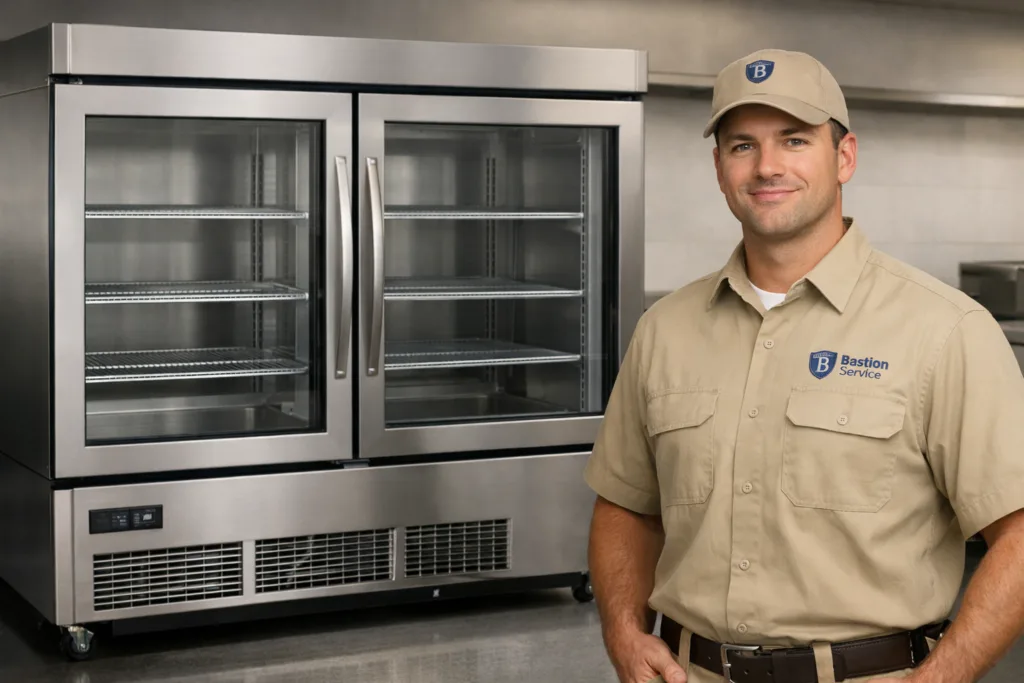




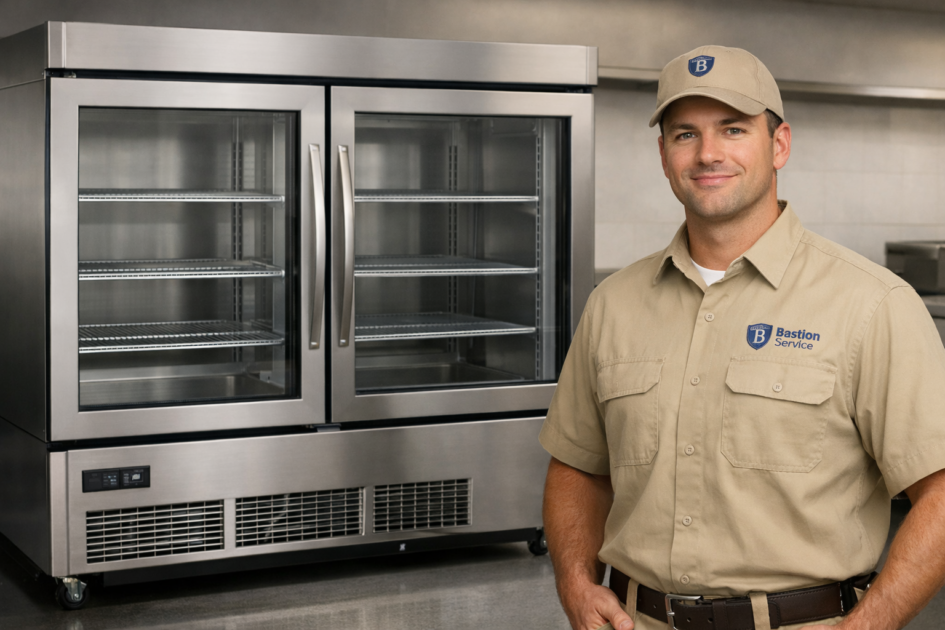
Downtime from a failing Beverage-Air refrigerator or freezer can quickly affect product protection, prep flow, staffing, and service speed. For Hawthorne businesses, the most useful next step is a service visit that identifies the actual fault, gauges repair urgency, and helps determine whether the unit can stay in operation while work is scheduled. Bastion Service handles Beverage-Air refrigeration equipment issues with that business-first approach, focusing on symptom patterns that impact daily operations rather than guessing from one visible problem.
For specific equipment paths in Hawthorne, review Beverage-Air Refrigerator Repair in Hawthorne, Beverage-Air Freezer Repair in Hawthorne, and Commercial Appliance Repair in Hawthorne.
What Beverage-Air refrigeration equipment problems do you troubleshoot?
Beverage-Air refrigeration equipment problems often show up as temperature instability, frost buildup, water leaks, reduced airflow, noisy operation, long run times, or cabinets that no longer recover after doors are opened during normal use. In a business setting, those symptoms may affect reach-in refrigerators, undercounter units, prep refrigeration, merchandisers, and freezers used to hold product safely during busy hours.
Troubleshooting usually starts by separating cabinet symptoms from root-cause failures. A warm interior does not always mean the same repair as a unit with heavy frost, and a leaking freezer may not have the same cause as a refrigerator that runs constantly. The goal is to determine whether the issue points to airflow restriction, control failure, fan problems, door sealing issues, drainage trouble, electrical faults, or a more serious cooling-system problem.
Refrigerator and freezer symptoms that usually need service
Warm cabinets and temperature drift
When a refrigerator struggles to stay in a safe holding range or a freezer starts softening product, service should not be delayed. Temperature drift can be tied to dirty condenser sections, weak airflow, faulty evaporator fans, sensor errors, thermostat or control problems, door gasket wear, or stress on the refrigeration system itself.
In real-world operation, this problem often appears first as slow recovery after loading, warmer spots in one section of the cabinet, or product temperature that does not match the display. That gap matters because it can signal that the unit is still running but no longer cooling effectively enough for business use.
Frost buildup and icing inside the unit
Freezers with excessive frost and refrigerators with repeated ice formation usually need more than simple cleanup. Frost can restrict airflow, reduce storage usability, and push components to run longer than normal. Common causes include defrost issues, doors not closing fully, torn gaskets, fan failures, moisture intrusion, or controls that are no longer managing the system correctly.
In a freezer, frost around evaporator areas can block circulation and create uneven product conditions. In a refrigerator, partial icing may show up as cold spots, damp surfaces, or inconsistent cooling from shelf to shelf. The longer this continues, the more likely the problem spreads into broader performance loss.
Water leaks and interior moisture
Water around a Beverage-Air unit is more than a nuisance. It can create slip risk, damage flooring, and indicate that drainage, defrost, or sealing problems are affecting the cabinet. Leaks may come from clogged drains, frozen drain lines, excessive condensation, thawing ice buildup, or repeated warm-air infiltration.
If staff are wiping up water regularly or seeing moisture return after cleaning, the problem should be evaluated before it starts affecting nearby equipment or storage areas. Moisture issues often overlap with cooling issues, so a leak is not always an isolated repair.
Poor airflow and uneven cooling
Airflow problems can make a unit look partly functional even when it is not protecting product well. One section may feel cold while another stays warm, or the cabinet may cool normally overnight but struggle during business hours. Restricted circulation may be caused by fan motor failure, ice obstruction, overloaded product placement, blocked evaporator paths, or component issues that prevent normal air movement.
For businesses, uneven cooling is especially risky because it can hide spoilage conditions until product is checked more closely. A diagnosis helps determine whether the problem is airflow alone or part of a wider refrigeration failure.
Constant running, short cycling, or unusual noise
A Beverage-Air refrigerator or freezer that runs almost nonstop is usually compensating for an underlying issue. That may include heat exchange problems, door leaks, sensor faults, fan issues, low cooling performance, or controls that are not cycling correctly. Short cycling can point to electrical or control trouble, while buzzing, rattling, clicking, or scraping sounds may signal worn motors, loose components, fan interference, or compressor-related stress.
These symptoms are important even if the cabinet is still cold. Equipment can remain partly operational while reliability drops and energy use rises, which often leads to a more disruptive failure later.
Why symptom-based diagnosis matters for business equipment
Two units with the same complaint can need very different repairs. A freezer that runs warm because of a fan problem is not the same service call as a freezer that runs warm because of a sealed-system issue. A refrigerator with water in the bottom of the cabinet may need drain service, while another with similar moisture may have a defrost or door-seal problem driving the condition.
That is why symptom-based diagnosis is valuable for business operators. It helps answer practical questions such as:
- Is the unit still safe to use before repair?
- Is the problem likely isolated or system-wide?
- Could continued operation cause more damage?
- Will the repair likely restore stable day-to-day performance?
- Should product be moved or workflows adjusted while service is arranged?
Good diagnosis supports scheduling decisions, staffing adjustments, and inventory protection instead of leaving managers to make those calls with incomplete information.
When refrigerator and freezer problems become urgent
Some symptoms point to a need for prompt repair scheduling. If a refrigerator is not holding temperature, a freezer is no longer maintaining a hard freeze, frost is blocking airflow, leaks are recurring, or the unit is repeatedly alarming, the risk is no longer just inconvenience. At that stage, product loss, service interruptions, and additional equipment strain become more likely.
Urgency also increases when the cabinet has trouble restarting, cycles erratically, produces sharp new noises, or shows signs of major recovery delay after doors are opened. Even when the unit still seems to cool somewhat, those symptoms often mean the equipment is operating outside normal conditions and may not support consistent business use.
Repair planning for Beverage-Air equipment in Hawthorne
Repair decisions are not only about whether a part failed. They are also about how important the unit is to the operation, whether downtime can be managed, and whether the expected repair result justifies keeping the equipment in service. For a heavily used refrigerator or freezer, a smaller repair may be straightforward. For an older unit with repeated cooling problems, the better question may be whether another repair will produce reliable performance or only temporary relief.
Useful repair planning considers the symptom history, severity of the failure, overall condition of the equipment, and whether the problem affects daily storage capacity or line support. That gives business operators a clearer way to weigh repair scope against disruption, rather than looking at one symptom in isolation.
What local businesses should do when performance starts changing
Once a Beverage-Air unit begins running warm, icing heavily, leaking, or struggling to recover temperature, it helps to treat the change as an operational warning rather than waiting for complete shutdown. Staff can note when the issue appears, whether it worsens during peak hours, and whether the problem affects the whole cabinet or only one section. That information often speeds up troubleshooting and helps define the repair path more accurately.
For Hawthorne businesses relying on Beverage-Air refrigeration equipment, the best next step is to schedule service before reduced cooling turns into inventory loss or a full interruption. A focused repair visit can clarify what failed, whether the unit should remain in use, and what action makes the most sense to restore dependable refrigerator or freezer performance.


