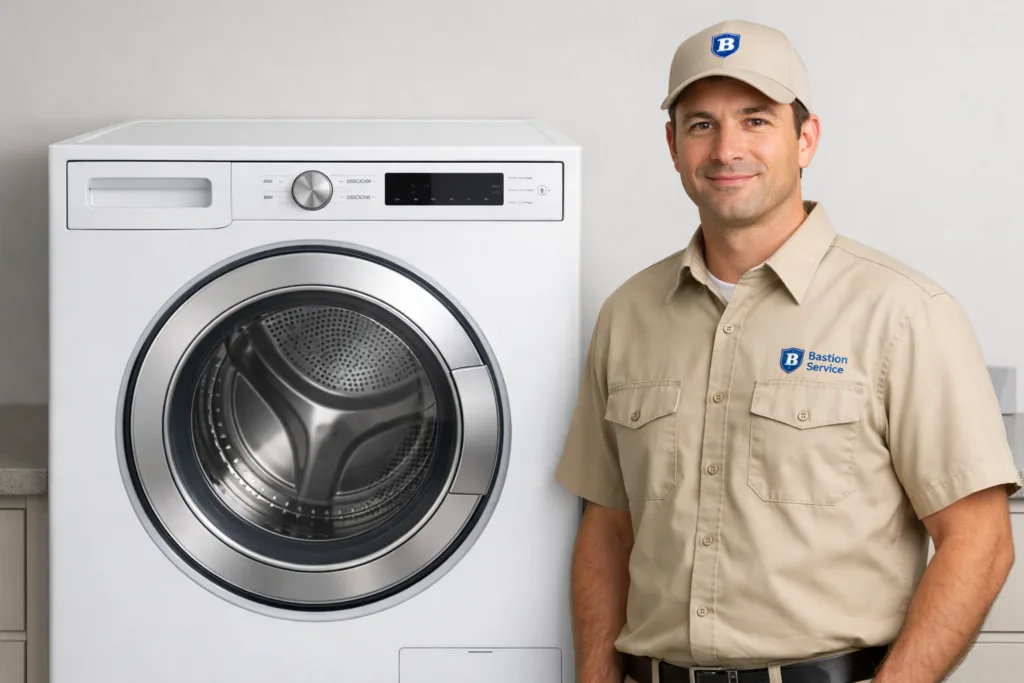
Dryer trouble tends to show up in a few familiar ways: clothes stay damp, cycles take far longer than normal, the machine will not start, or the drum begins making noise that was not there before. With an Asko dryer, those symptoms can overlap, so the best next step is to match the repair approach to what the machine is actually doing rather than assuming every drying problem is a heating failure.
Symptoms that often point to Asko dryer service
Some dryer problems are immediate and obvious. Others develop gradually over several weeks, with performance slipping load by load. Paying attention to the exact pattern helps narrow down whether the issue involves heat, airflow, drum movement, sensors, or electrical controls.
Dryer runs but clothes are still damp
If the drum turns normally but laundry remains wet, the cause may be restricted airflow, a weak heating component, a thermostat problem, or moisture sensing that is no longer reading fabric conditions correctly. Long dry times can also happen when heat is present but not circulating the way it should, causing the machine to work harder without fully drying the load.
This symptom is often more noticeable with towels, bedding, and heavier fabrics. If one load dries eventually but only after repeated cycles, the appliance is usually signaling that something is no longer operating efficiently.
Dryer will not start
A dryer that does nothing when Start is pressed may have a door switch issue, thermal protection failure, control fault, or power-related problem. If the display responds but the cycle does not begin, that points in a different direction than a unit that appears completely dead.
It also helps to notice whether the dryer failed all at once or became unreliable first. A machine that occasionally starts after several tries may be dealing with a developing switch, latch, or control problem rather than a total electrical loss.
Cycle stops early or shuts off mid-load
When a dryer begins a cycle and then stops before clothes are dry, the issue may involve temperature sensing, airflow restriction, overheating protection, or electronic control behavior. Early shutoff can look minor at first, but repeated interruptions usually mean the appliance is reacting to a condition that needs correction.
New squealing, thumping, grinding, or rattling
Mechanical noise often points to wear in rollers, belt components, drum supports, or the motor system. Some dryers continue running with these symptoms for a while, but the sound is usually a warning that internal parts are no longer moving smoothly. Addressing noise early can help prevent damage from spreading to additional components.
How specific symptom patterns change the diagnosis
One reason dryer repair can be confusing is that the same basic complaint can come from different failures. “Not drying” does not always mean the heater is bad. “Shutting off” does not always mean the control board has failed. A machine has to be evaluated by the way the symptom behaves during a cycle.
No heat at all
If the dryer tumbles but never warms up, likely causes can include heating circuit failure, thermal safety parts, wiring issues, or certain control-related faults. In some cases, airflow problems contribute to repeated overheating events that then trigger protective components to stop heat production altogether.
Weak heat with long dry times
When the dryer produces some warmth but loads still take too long, the problem often involves poor air movement, inconsistent heating performance, or sensors that are ending or extending cycles incorrectly. This is one of the most common situations where replacing the wrong part based on guesswork leads to wasted time and money.
Overheating or a very hot cabinet
A dryer that feels unusually hot on the outside, gives off sharp heat, or seems to run hotter than normal should not be ignored. Airflow restrictions, thermostat problems, and internal component failures can all create unsafe temperature conditions. Continued use under those conditions can put added strain on the appliance and increase the chance of broader internal damage.
Intermittent operation
If the dryer works normally one day and fails the next, intermittent faults may be developing in electrical connections, control systems, motor circuits, or heat-related safety components. These problems can be frustrating because the appliance may appear fine during one load and then stop cooperating without warning during the next.
Why airflow matters more than many homeowners expect
Airflow problems can mimic several other dryer failures. A venting restriction or poor internal air movement may cause slow drying, excess heat, repeated shutoffs, or moisture left in clothes even when the heating system is still functioning. That is why airflow should be considered any time an Asko dryer seems to run normally but drying performance has clearly dropped.
Typical signs include loads that feel hot but remain damp, cycles that seem longer than before, or a dryer that shuts down after getting too warm. Even when the root cause turns out to be a failed part inside the machine, airflow conditions often shape how the symptom appears.
Signs the problem is becoming more urgent
Some dryer issues are inconvenient but manageable for a short time. Others should move to the top of the list because they suggest excess heat, mechanical wear, or unstable operation.
- Burning smells during or after a cycle
- Repeated mid-cycle shutdowns
- Loud scraping, grinding, or heavy thumping
- A drum that turns unevenly or struggles to start
- Clothes staying damp despite multiple cycles
- A cabinet or laundry area becoming unusually hot
If any of these are happening, it is best to stop using the dryer until the source of the problem is identified. Waiting can turn a limited repair into a more expensive one.
Repair or replace? What usually matters most
Not every dryer problem leads to the same decision. If the unit is otherwise in good condition and the issue is isolated to a repairable component, service is often the sensible path. If the dryer has multiple failing parts, a history of recurring problems, or signs of heavier wear in both mechanical and control systems, replacement may deserve consideration.
Homeowners in Sawtelle usually benefit most from looking at the full picture: the current symptom, the overall condition of the appliance, whether the failure appears isolated or stacked, and how likely the machine is to return to stable performance after repair.
What to notice before scheduling service
A few observations can make a dryer appointment more productive. Try to note whether the drum turns, whether heat is present, whether the problem affects every cycle or only certain settings, and whether any sound or smell appears at a specific point during operation.
- Does the dryer power on but refuse to start?
- Does it heat at first and then stop?
- Are heavy loads much worse than light ones?
- Did noise begin suddenly or build up over time?
- Does the dryer stop only after running for several minutes?
These details can help separate a heating issue from an airflow issue, or a sensor problem from a mechanical one.
Asko dryer repair for Sawtelle households
Most people are not looking for a complicated explanation. They want to know why the dryer is not working the way it should and whether fixing it makes sense. For Sawtelle households, that usually means focusing on the real-world symptom first: no heat, long dry times, no start, unusual noise, or cycles that no longer finish reliably.
When the problem is identified accurately, the next step becomes much clearer. That could mean a straightforward repair, a warning to stop using the machine until a safety-related issue is corrected, or a realistic discussion about whether the appliance is still worth repairing. The goal is to get the laundry routine back to normal without unnecessary part swapping or avoidable delay.